
Owlet, Inc. Faces Operating Struggles Amid Tariff Pressures and Leadership Turnover
Owlet’s recent CEO change underscores urgent strategic challenges amid ongoing losses and tariff-related cost pressures.
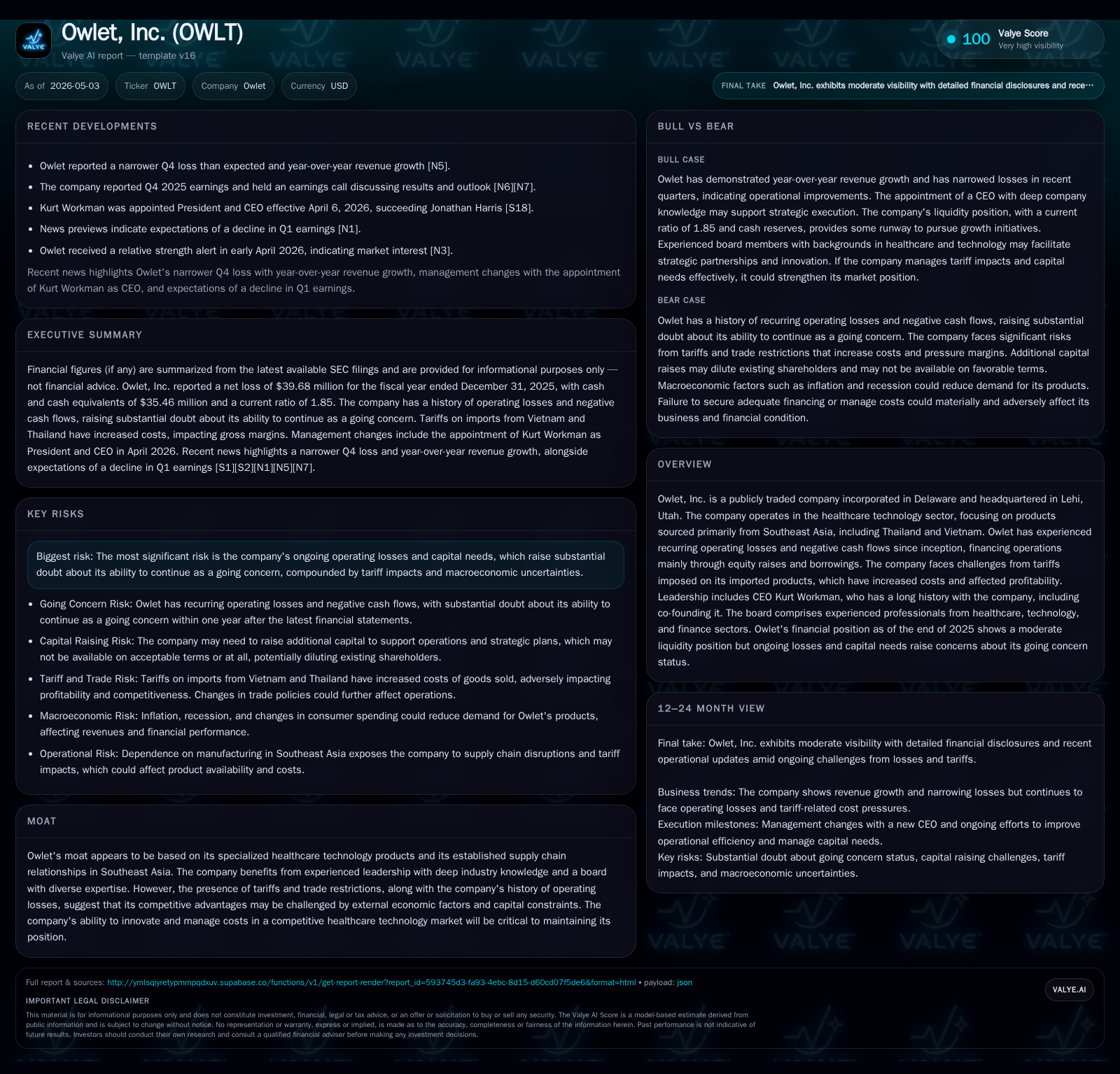
In April 2026, Owlet appointed founder Kurt Workman as CEO amid continued operating losses detailed in its late 2025 quarterly filing. The company’s healthcare technology business faces sustained margin compression primarily due to tariffs on products sourced from Southeast Asia. Owlet’s recurring negative cash flow and capital dependence create substantial going concern risks, even as Workman aims to steer a turnaround through cost management and growth initiatives. Industry competition and supply chain tariffs remain critical constraints, with prospects hinging on execution under new leadership.
Latest Operational Developments Highlight Leadership Transition
Owlet announced a pivotal leadership change on April 3, 2026, appointing Kurt Workman as President and Chief Executive Officer effective April 6, 2026 [S3]. This transition replaces Jonathan Harris amidst a continued operational backdrop marked by the recurring losses reported in the company’s Q3 2025 filing from November [S2]. Workman is no stranger to Owlet; as a co-founder, his return reflects board-level confidence in leveraging his deep institutional knowledge to arrest margin pressures primarily caused by tariffs on the company's supply chain. This move underscores an urgent strategic recalibration required to navigate persistent financial headwinds.
Owlet’s Healthcare Technology Model and Product Offering
Owlet develops specialized healthcare monitoring devices primarily sourced from Southeast Asia — specifically Thailand and Vietnam [S1]. Its core offerings include baby monitors integrating smart sensor technology designed to track vital signs remotely. Production is concentrated in Vietnam for camera-enabled products, with socks and multi-function devices like Dream Sock and Dream Duo assembled mostly in Thailand [S1]. While this geographic sourcing affords cost advantages, it exposes Owlet to significant import tariffs imposed by the U.S., disrupting unit economics and inflating cost of goods sold (COGS).
The business derives revenue predominantly from device sales rather than recurring subscription models, anchoring its revenue mechanics heavily on product volume combined with price resiliency in a competitive marketplace. Customer retention is tied closely to product quality and brand trust, which has been challenged by pricing pressures stemming from external tariff impacts.
Industry Context: Competitive Dynamics and Supply Chain Risks
Owlet operates within the dynamic healthcare technology sector focused on infant monitoring solutions — a space blending medical device regulation with consumer electronics competitive forces. Its moat hinges largely on its specialized product designs and established supply chain relationships across Southeast Asia [S1]. However, rising U.S. tariffs—20% on Vietnamese imports increasing to 40% in cases of transshipment—and retaliatory trade responses serve as structural challenges [S25]. These tariff impositions directly elevate COGS and compress already tight gross margins into the low-50% range or below [S6].
Competitors able to source components domestically or adjust production locales may maintain more stable gross margins. Meanwhile, Owlet must negotiate increasingly costly supply chain logistics amidst geopolitical uncertainty, which also brings regulatory complexity impacting timing and cost structures.
Drivers Supporting Growth and Margin Improvement
Owlet’s path forward rests on multiple interconnected drivers. First, product innovation aimed at expanding its device portfolio or enhancing existing offerings can stimulate demand growth [S1]. Second, scaling distribution channels—including partnerships with healthcare providers or retailers—could expand market penetration.
Crucially, margin recovery may depend on mitigating tariff impacts through supply chain reconfiguration or cost savings initiatives under new CEO Workman’s leadership [S3]. Strategic initiatives might target diversifying sourcing locations or lobbying for favorable trade treatments. Operational efficiencies could be driven by tighter inventory management or automation enhancements.
Leadership’s track record in navigating Owlet’s historical challenges provides some confidence that near-term milestones will emerge around sales traction improvement or margin stabilization benchmarks.
Critical Risks Including Liquidity and Tariff Impact
Operating losses have been persistent since inception with negative operating cash flows consistently reported [S2]. This creates an overarching risk encapsulated in the company’s going concern disclosures citing substantial doubt about continuing viability without fresh capital infusions [S2],[S13]. Despite a reasonable current ratio of 1.85 and $35.46 million cash reserves as of December 31, 2025 [F1], Owlet faces an uphill battle balancing working capital needs against shrinking margins.
Tariff-induced cost escalations heighten this stress further by exerting continuous pressure on profitability [S25]. The unpredictability of trade policy escalation adds uncertainty that may disrupt already tight unit economics.
Refinancing or equity raises appear inevitable for sustaining operations; however, adverse market conditions or investor apprehension linked to the going concern caveats could limit access to capital or impose dilutive terms [S2],[F1]. Execution missteps under new management or delayed product adoption could exacerbate these risks.
Key Upcoming Catalysts to Monitor
Investors should focus closely on forthcoming quarterly earnings reports expected mid-2026 as primary markers for progress assessing margin improvement efforts and topline growth dynamics [N1],[S3]. These disclosures will indicate initial effectiveness of workstream changes following the CEO transition.
Additional signals include tangible progress in tariff mitigation measures such as supplier diversification announcements or regulatory developments favoring reduced import taxes. Monitoring updates from management relating to longer-term strategic pivots or cost restructurings will be critical as well.
Customer feedback trends reflected via sales velocity metrics also will help gauge market receptivity post-leadership change.
Financial Overview: Liquidity, Losses, and Capital Structure
Latest financial snapshot
| Metric | Value | Period |
|---|---|---|
| Cash & equivalents | $35mm | |
| 2025-12-31 | ||
| Current assets | $82mm | |
| 2025-12-31 | ||
| Current liabilities | $44mm | |
| 2025-12-31 | ||
| Current ratio | 1.85x | |
| 2025-12-31 |
Source: SEC companyfacts cache [F1].
A brief financial snapshot rooted in SEC filings highlights key metrics illustrating Owlet’s fragile but manageable financial condition heading into 2026:
| Metric | Value | Period End |
|---|---|---|
| Cash & Equivalents | $35.46 million | |
| 2025-12-31 | ||
| Total Debt | $2.11 million | |
| 2024-06-30 | ||
| Current Ratio | 1.85 | |
| 2025-12-31 | ||
| Operating Income | -$8.26 million | |
| 2025-12-31 | ||
| Net Income | -$39.68 million | |
| 2025-12-31 |
Careful capital management paired with aggressive margin control constitutes workmanlike demands placed on new leadership moving forward.
Disclaimer: This analysis is based solely on publicly available SEC filings up to May 2026 and news sources cited herein. It does not constitute investment advice or recommendations.
Disclaimer: This is research-only, informational analysis and not investment advice. It may include AI-generated interpretation and general industry context. Always verify important details using primary sources.

Comments