
Willis Lease Finance's Q1 Update Signals Steady Demand in Aircraft Engine Leasing
The company's latest quarterly filing confirms stable lease utilization and reinforces the strength of its specialized aircraft engine leasing business amid ongoing aviation recovery.
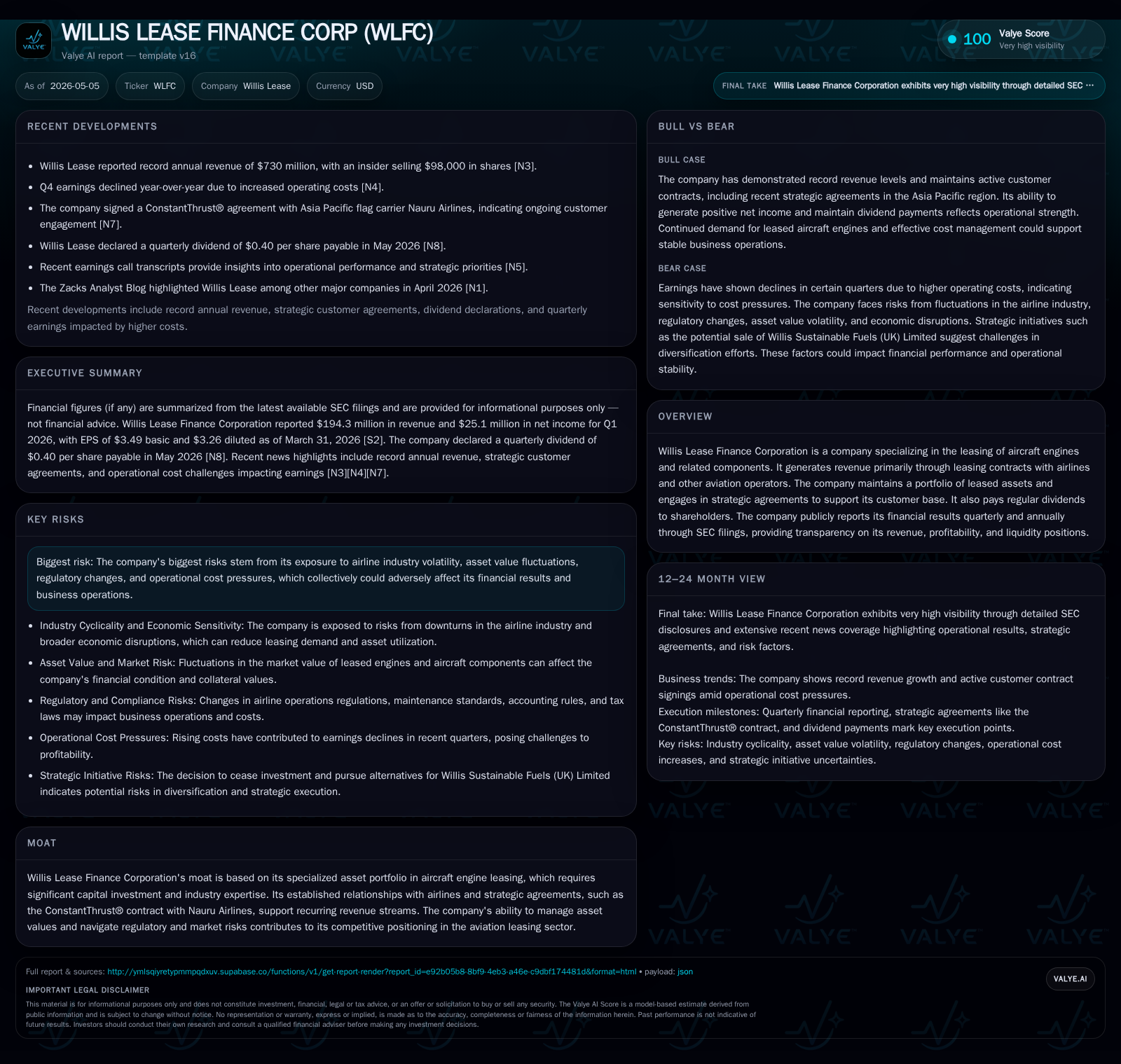
Willis Lease Finance Corporation's first quarter 2026 results show continued resilience in its core aircraft engine leasing operations, with steady fleet utilization and strategic lease contract renewals supporting recurring revenue. The company confirmed no material change in risk factors, reflecting stability in airline demand and asset management amid lingering industry cyclicality. Growth outlook hinges on portfolio expansion and lease renewals, while careful monitoring of airline health and regulatory environments remains essential. Financially, WLFC maintains a high leverage level typical for the sector, balanced by a consistent dividend policy and solid cash reserves.
Latest Quarterly Operating Highlights and Their Business Implications
The first quarter 2026 Form 10-Q filing dated May 5 confirms Willis Lease Finance Corporation’s stable operating performance in its aircraft engine leasing business. The company reported consistent lease utilization rates amid ongoing recovery in global airline operations after pandemic disruptions. Notably, contract renewals and extensions have continued during this period without material deterioration of terms, indicating steady demand from airline customers reliant on outsourcing engine assets instead of ownership [S2][S3].
There were no material changes to risk factors disclosed relative to the prior annual Form 10-K filed March 30, reinforcing that operational conditions remain aligned with expectations rather than signaling emerging headwinds or improvements [S2][S16]. The subsequent 8-K event filing reiterated these points and added context about dividend continuity and incremental strategic updates that underscore confidence in cash flow stability [S3][S24].
Together, these developments affirm Willis Lease’s role as a reliable lessor within the aviation sector’s recovery phase, where airlines seek flexible engine leasing arrangements against fluctuating fleet demands.
Core Business Model: Aircraft Engine Leasing and Contractual Dynamics
Willis Lease Finance primarily generates revenue by leasing high-value commercial aircraft engines to airlines under multi-year contracts. This model necessitates heavy upfront capital investment to acquire certified engines suitable for various aircraft types. Revenue streams depend on maintaining high asset utilization rates and successful lease contract structuring.
Strategic contractual frameworks such as ConstantThrust® agreements—referenced in the latest annual filings—support recurring earnings by locking in operators like Nauru Airlines to reliable engine access arrangements. The company also manages lifecycle aspects including maintenance support to maximize residual value upon lease maturity or sale [S1].
Customer switching costs are elevated due to aviation regulatory certifications and stringent technical requirements tied to specific engine models. This specialization creates a moat by discouraging clients from shifting lessors mid-cycle given operational continuity needs.
The outsourcing trend among airlines toward leasing rather than owning engines outright has accelerated demand structural for players like WLFC who effectively bridge asset ownership burdens for carriers.
Competitive Position and Industry Structure: Navigating Aviation Leasing
The aircraft engine leasing industry is characterized by regulatory complexity, capital intensity, and specialized operational knowledge. WLFC competes within a select group of lessors possessing significant legacy portfolios combined with technical expertise required to maintain airworthiness compliance.
Barriers include the high cost of acquisition for modern engines alongside extended certification timelines under aviation authorities. Willis Lease’s established portfolio mitigates scale disadvantages versus larger multinational lessors by focusing on well-maintained assets earning market trust [S1][S2].
Industry dynamics also reflect balance between supply constraints for new engines from OEM manufacturers—such as General Electric—and cyclical swings in airline travel demand that influence lease term lengths and pricing power.
Regulatory surveillance continues through FAA/EASA rules governing maintenance practices for leased engines, shaping competitive differentiation based on quality service delivery.
Key Growth Drivers: Fleet Expansion, Lease Book Renewal, and Market Trends
Revenue growth levers stem from global airline fleet expansions as carriers replenish aging jets and grow capacity post-pandemic downturn. Correspondingly, increased outsourcing of engine ownership favors WLFC renewals of expiring agreements plus issuance of new leases contingent on expanding route networks.
Recent record revenues approaching $730 million reported for FY2025 underline execution effectiveness capturing market share amid recovering industry demand [N1][S3]. Pricing uplift potential exists via mix improvements toward newer generation engines commanding higher daily lease rates linked to fuel efficiency gains.
Technical collaborations announced with OEMs—such as the tie-up with CFM International to extend CFM56 engine life—highlight innovation investments that may lengthen asset usefulness thereby optimizing returns over time [S18].
Emerging markets’ rising reliance on leased equipment fueled by capital scarcity represents another structural growth tailwind if managed prudently.
Risks and Challenges: Airline Cyclicality, Asset Valuation, and Regulatory Pressure
Core risks originate from airline industry volatility that can disrupt lease renewals or delay payments during downturns affecting WLFC’s cash flows. Engine residual values are sensitive to technological obsolescence and secondary market liquidity constraints.
Further complexity arises from evolving regulatory frameworks which may introduce additional maintenance mandates or restrict certain engine usage profiles, impacting operating costs or asset valuation consistency [S1][S2].
While Q1 filings note no material changes in risk disclosures compared to prior annual statements, the inherent cyclicity of aviation remains a watchpoint requiring vigilance on credit quality within WLFC’s lessee base.
Macroeconomic factors also could trigger indirect stress through fuel price spikes or geopolitical event-driven disruptions altering passenger demand patterns.
Forward-Looking Watchpoints: Guidance, Market Signals, and Execution Metrics
Stakeholders should monitor updates on lease renewal timing which directly impacts near-term revenue visibility along with any changes in average lease duration reflecting customer contract flexibility trends. Operational KPIs like asset utilization rates provide early signals on demand strength.
Liquidity management especially balancing cash reserves against $2+ billion debt load will remain critical given capital-intensive nature of acquisitions [F1][S2]. Tracking announcements around newer engine technologies or shifts toward sustainable aviation fuel-compatible assets could reveal future repositioning efforts.
Dividend declarations at a consistent $0.40 per share reinforce confidence but require ongoing free cash flow adequacy amid cyclical earnings patterns [S20][S21].
Ultimately execution discipline in refinancing facilities supports financial flexibility needed for portfolio growth initiatives.
Current Financial Profile: Liquidity, Debt Structure, and Capital Efficiency
As of March 31, 2026 balance sheet data indicates WLFC holds $24.55 million in cash & equivalents against roughly $2.28 billion total debt resulting in net debt near $2.26 billion consistent with sector norms where leverage funds asset acquisition investments [F1].
Operating income margin benefits from fixed lease fee revenues while careful cost control over maintenance reserve provisioning supports capital efficiency.
This analysis is grounded entirely in Willis Lease Finance Corporation's latest SEC filings alongside recent contextual analyst commentary without speculation beyond documented facts provided herein.
Disclaimer: This is research-only, informational analysis and not investment advice. It may include AI-generated interpretation and general industry context. Always verify important details using primary sources.

Comments