
Sotera Health Strengthens Market Leadership with Robust Q1 Execution Amid High Leverage and Regulatory Complexities
Sotera Health’s latest quarterly performance underscores its resilient sterilization and testing platform, supported by entrenched contracts and advanced technology, but faces challenges from regulatory risks and capital structure.
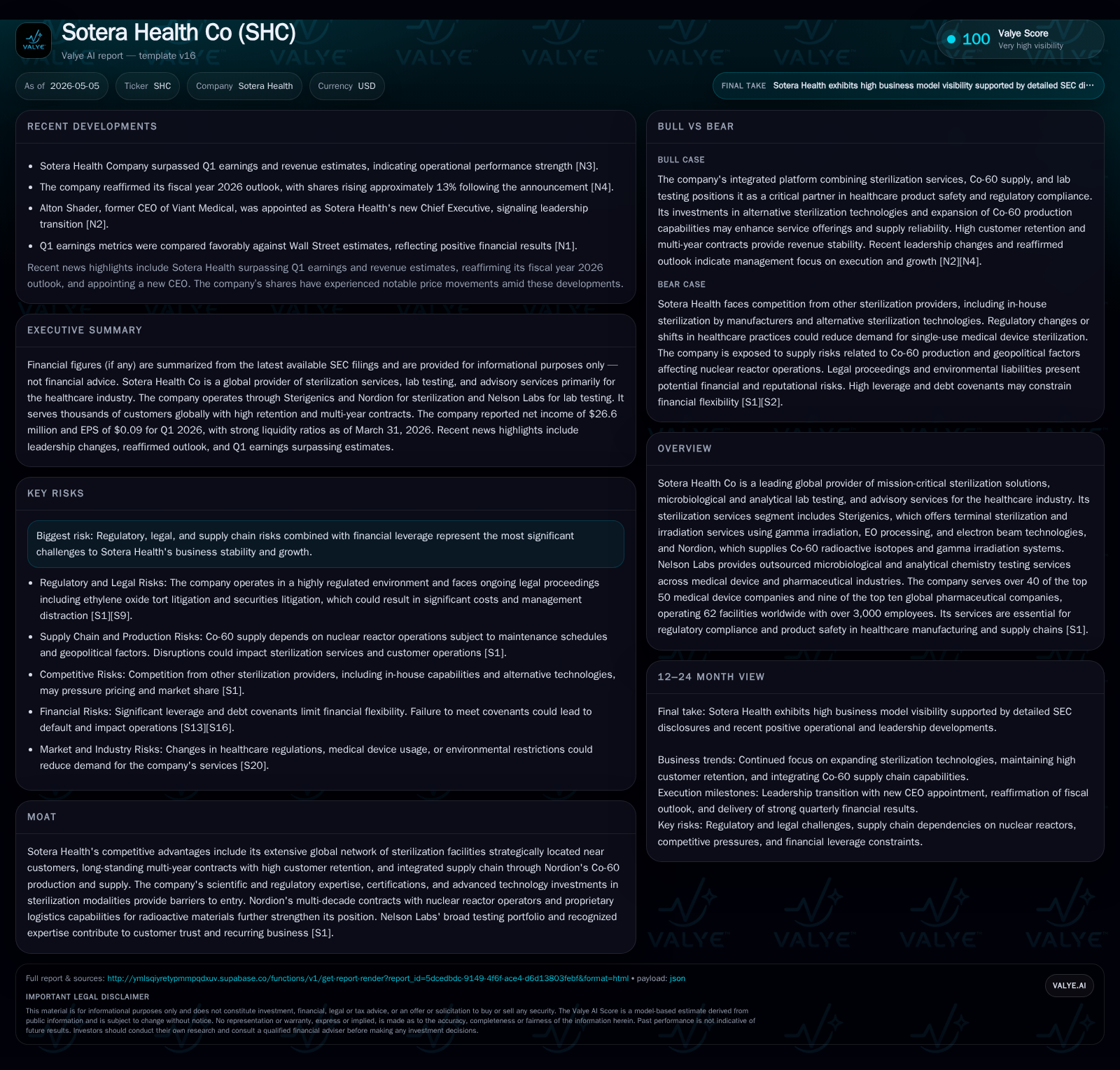
In Q1 2026, Sotera Health delivered solid operating results that surpassed market expectations, driven by strong demand for its sterilization and microbiological testing services essential to healthcare product safety. The company’s business model leverages a diversified global footprint and integrated supply chain assets, notably Nordion’s cobalt-60 isotope production, which create significant entry barriers. However, regulatory compliance pressures and elevated financial leverage present material risks that require ongoing management focus. Growth will hinge on capacity expansions, modality innovation especially in irradiation technologies, and progress in resolving legal contingencies.
Recent Operating Update: Q1 2026 Performance Highlights
Sotera Health disclosed its first-quarter 2026 results on May 5th [S2][S3], showcasing revenue and profitability beats relative to Wall Street expectations [N1][N2]. The company continues its trajectory as a dominant provider of sterilization services integral to medical device and pharmaceutical manufacturing. Its ability to surpass estimates evidences resilient customer demand across its service segments despite persistent sector-specific regulation challenges.
The firm holds a strong liquidity position highlighted by a current ratio near 2.82 as of March 31st, reflecting sound short-term asset coverage against liabilities [F1]. However, total debt reaches $2.17 billion with net debt approximating $1.85 billion after cash offsets—underscoring the company’s leveraged capital structure which could weigh on financial agility amidst potential regulatory or market shifts.
Importantly, risk factors identified remain consistent with prior disclosures emphasizing regulatory scrutiny related to EO sterilization emissions litigation and geopolitical influences on critical raw material availability (notably cobalt-60) [S2][S1]. No material changes were noted this quarter but these remain key watch points.
Business Model Overview
At its core, Sotera generates revenue by delivering mission-critical sterilization solutions primarily through two main subdivisions: Sterigenics (sterilization services) and Nordion (irradiation technology supply), complemented by scientific testing through Nelson Labs.
Sterigenics applies terminal sterilization techniques—gamma irradiation, ethylene oxide (EO) gas processing, and electron beam (E-beam) radiation—to final-packaged medical devices ensuring compliance with mandated safety standards before product shipment [S1]. This captive role within end-product manufacturing establishes durable demand dependencies. The firm operates 62 global facilities (23 for gamma irradiation, 17 EO processing, 8 E-beam) positioned near key manufacturing hubs to reduce logistics friction.
Nordion specializes in cobalt-60 radioactive isotopes critical for gamma sterilization technologies. It maintains exclusive multi-decade contracts with nuclear reactors producing Co-60 inventory alongside proprietary transport logistics handling hazardous materials—a rare integrated capability supporting overall supply chain security for Sterigenics’ sterilization business [S1].
Nelson Labs contributes outsourced microbiology and analytical laboratory testing essential for pre-market regulatory clearances across medical device and pharmaceutical clients—relying on deep scientific validation expertise that fosters high customer retention through recurring contracts.
Revenue is driven by contracted volume throughput tied to customers’ production schedules combined with pricing mechanisms aligned to cost inputs like EO gas costs or raw material inflation within service agreements. Pricing power is rooted in the indispensable nature of these compliance-driven services paired with high switching costs due to certification complexity.
Industry Structure & Competitive Position
The healthcare sterilization industry is characterized by high technical barriers to entry: stringent regulatory oversight mandates certifications including FDA clearances; specialized handling of hazardous substances; complex logistic networks; and significant upfront capital investments required to build irradiation systems or establish EO sterilization plants.
Globally approximately 200 large-scale gamma irradiation systems operate with Nordion having constructed over 120—emphasizing its leading footprint in certified infrastructure [S1]. Competitors exist predominantly in China, Sweden, North America but lack Nordion’s nuclear source production breadth or integrated contamination control capabilities. Alternative modalities such as X-ray irradiation are emerging but not yet widely deployed commercially at scale; Sotera is investing proactively here to maintain modality diversification.
Customer concentration is notable yet stable: serving more than 40 of the top 50 medical device companies along with nine of the top ten pharma firms ensures embeddedness within complex supply chains relying on Sotera's quality assurance ecosystem [S1]. This client roster reinforces long duration contract profiles reducing churn risk.
Growth Drivers
Several levers underpin Sotera’s growth outlook:
- Capacity Expansion: Strategic investments into facility upgrades or new builds aim to meet rising global demand for terminal sterilization services fueled by growing medical device innovations and pharma pipeline expansions globally.
- Modality Innovation: Qualification of X-ray irradiation as a commercial supplement presents upside by offering an alternative to EO or gamma-based methods—potentially circumventing some environmental restrictions tied to chemical sterilants [S1].
- Service Mix Enhancement: Shifting towards higher value analytical testing via Nelson Labs supports margin enhancement while enabling broader customer service portfolios beyond pure sterilization throughput.
- Geographic Expansion: Extending reach into emerging markets though cautious given geopolitical risks affecting export flows especially in China/Europe balance [S1].
- Contract Renewals & Long-Term Partnerships: Maintaining multi-year agreements drives steady revenue visibility; securing incremental volumes or new partnerships within pharma segments offers runway expansion possibilities.
Risks & Watchpoints
Risks remain materially centered on:
- Regulatory & Legal Exposure: Ethylene oxide emission liability claims across multiple US states pose reputational and financial contingencies requiring resolution; pending lawsuits inject uncertainty into future cash flow sustainability [S1].
- Raw Material Supply Chain Vulnerabilities: Dependence on cobalt-60 sourced under geopolitical tensions creates exposure to disruptions or cost escalations impacting Nordion operations.
- Environmental Compliance Costs: Increasingly stringent environmental health standards mandate technology upgrades potentially pressuring operating margins.
- Leverage Constraints: Elevated net debt (~$1.85B) limits financial flexibility against investment needs or unexpected expense shocks despite satisfactory liquidity metrics [F1].
- Competitive Advancements: Emerging irradiation technologies or aggressive capacity additions by competitors particularly in Asia could pressure market share if not met by innovation cadence.
What To Watch Next
Investors should monitor:
- Progress updates on the rollout and commercial qualification of X-ray irradiation systems as an alternative sterilization modality.
- Legal developments pertaining to EO emission claims resolution timelines and potential settlement impacts.
- Capacity utilization trends at key global facilities signaling ability to convert installed assets into incremental profit growth.
- Renewal rates of major multi-year contracts in pharmaceutical testing services revealing customer confidence levels.
- Quarterly earnings results relative to FY26 guidance reaffirmed recently alongside any revisions prompted by changing macroeconomic inputs or operational headwinds [N6][S3].
- Integration efficacy under new CEO leadership appointed May 2026 highlighting strategic refocus areas towards operational excellence [N5].
Financial Snapshot (Q1 Ending March 31, 2026) [F1]
Latest financial snapshot
| Metric | Value | Period |
|---|---|---|
| Cash & equivalents | $314mm | |
| 2026-03-31 | ||
| Total debt | $2.2bn | |
| 2026-03-31 | ||
| Net debt | $1852mm | |
| 2026-03-31 | ||
| Current assets | $586mm | |
| 2026-03-31 | ||
| Current liabilities | $208mm | |
| 2026-03-31 | ||
| Current ratio | 2.82x | |
| 2026-03-31 |
Source: SEC companyfacts cache [F1].
| Metric | Value (USD million) |
|---|---|
| Cash & Equivalents | 314 |
| Total Debt | 2,166 |
| Net Debt | ~1,852 |
| Current Assets | 586 |
| Current Liabilities | 208 |
| Current Ratio | 2.82 |
Liquidity remains adequate based on current assets coverage though gross debt levels mandate prudent monitoring amid ongoing capital expenditures related to capacity expansions and technological upgrades.
This analysis synthesizes recent filings up to May 5th, 2026 without speculation beyond provided disclosures. It aims to clarify Sotera Health's positioning within a highly regulated niche critical to healthcare manufacturing safety frameworks while highlighting both growth enablers and structural risks inherent in its operating environment.
Disclaimer: This is research-only, informational analysis and not investment advice. It may include AI-generated interpretation and general industry context. Always verify important details using primary sources.

Comments