
Alight’s Post-Divestiture Adaptation: Platform Focus and Execution Risks Shape Growth Outlook
Alight’s latest quarter underscores progress on its strategic pivot to cloud-based employee benefits technology amid a challenging economic backdrop and competitive pressure.
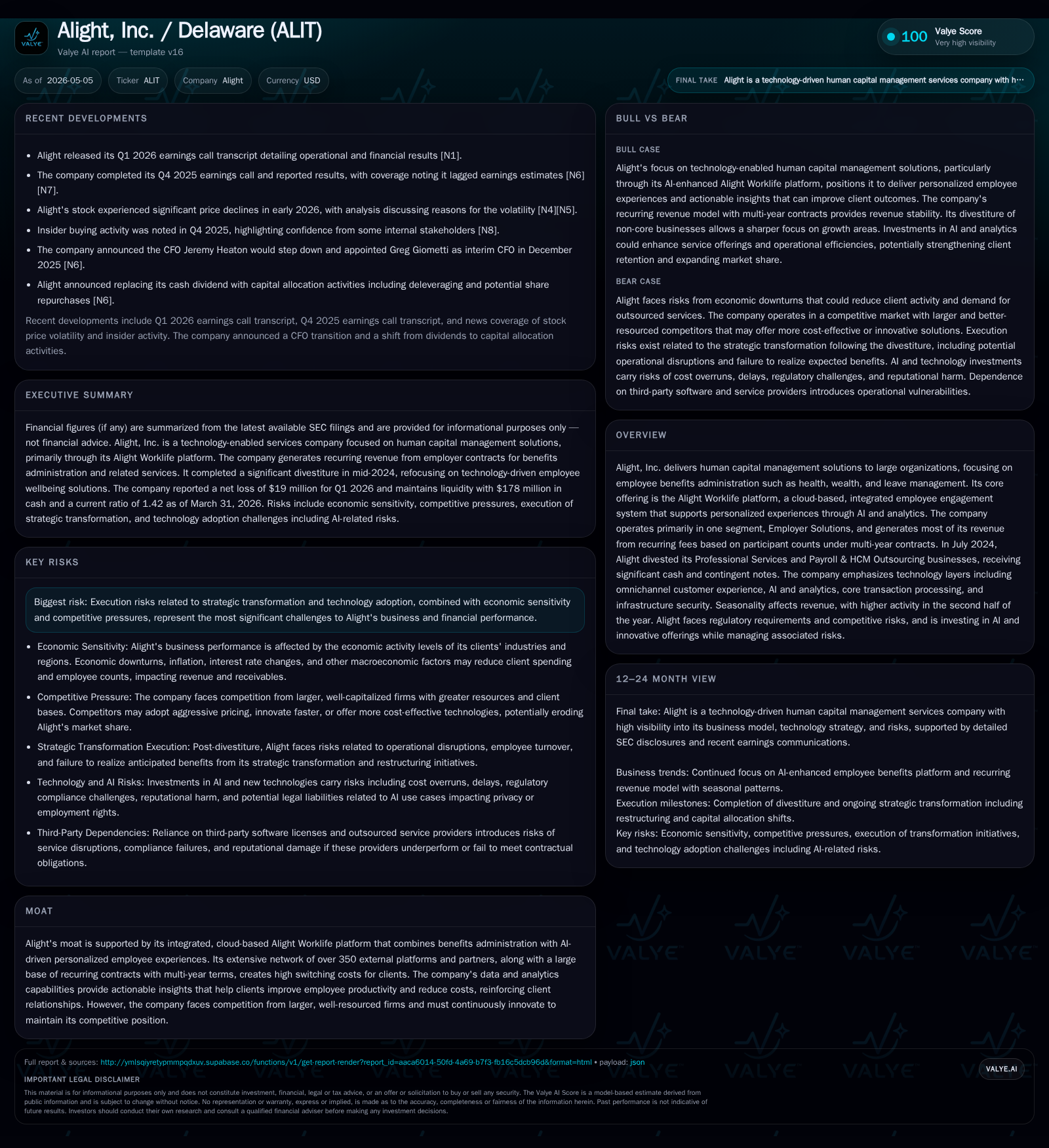
In Q1 2026, Alight, Inc. maintained operational stability following its 2024 divestiture of Professional Services and Payroll businesses, continuing to emphasize its integrated Alight Worklife platform. Revenue remains largely driven by recurring per-participant fees under multi-year contracts, with AI-driven analytics and extensive partner integrations reinforcing client retention. However, execution risk in strategic transformation, cyclical demand sensitivity, and competitive intensity from larger firms pose tangible challenges. The shift away from dividends toward deleveraging and share repurchases highlights an evolving capital allocation approach amid balance sheet leverage considerations.
Recent Operating Update
Alight’s first quarter report for the period ending March 31, 2026 ([S2], [S3]) reveals a continuation of its focused strategy following the significant divestiture completed in July 2024. The sale peeled off the Professional Services segment and Payroll & HCM Outsourcing businesses, crystallizing Alight's position as a cloud-first employee benefits administration company centered on its proprietary Alight Worklife platform.
This quarter saw no material changes to risk factors or new threats surfaced beyond those documented in the February 2026 annual report ([S1], [S2]). Operationally, revenue generation remains predominantly fee-based on participant counts within multi-year contracts typical of the Employer Solutions segment. Meanwhile, capital management shifted markedly: dividend payments were eliminated in early 2026 in favor of deleveraging efforts and opportunistic share repurchases as discussed in filings earlier this year ([S4], [S5]).
Business Model Analysis
Alight operates primarily through a single segment—Employer Solutions—which leverages the Alight Worklife platform to provide integrated human capital management services such as benefits administration covering health, wealth, leave management, and retiree healthcare ([S1]). This offering is delivered via a cloud-native platform augmented by AI-driven analytics intended to enhance employee engagement through personalized experiences. The value proposition targets both employees seeking tailored benefits navigation and employers aiming to optimize workforce productivity and reduce healthcare costs.
Revenue mechanics center around contracted fees usually assessed per participant per period (monthly or annually), leading to highly recurring income streams ([S1]). Contracts are typically three to five years with renewal options, creating a predictable base but also entrenching clients due to switching costs linked to integration depths and data dependencies across over 350 third-party platforms connected through the Alight Partner Network.
Technology serves as both backbone and differentiator. The work is organized around four layers: omnichannel customer experience interfaces that allow personalized interactions; AI/analytics layers that amalgamate transactional and third-party data for actionable insights; core transactional systems handling benefit elections; and infrastructure ensuring security at scale ([S1]). This architecture supports customized engagement and administrative automation aiming to reduce client operational burdens.
Industry Structure & Competitive Position
The human capital management (HCM) market is intensely competitive. Alight faces rivals with broader HCM suites or deeper payroll outsourcing capabilities—sectors it exited with its divestiture—leaving it concentrated on benefits administration technology services ([S1]). Larger competitors have significant resources enabling faster innovation cycles particularly around AI adoption. Pricing pressure arises from these competitors’ scale advantages alongside broader industry trends that can increase commoditization risks.
However, Alight’s moat stems from its integrated platform combining benefits administration with AI-powered personalization unmatched by most smaller providers (). Additionally, its entrenched client relationships secured via long-term contracts create high switching barriers. Yet sustaining this advantage requires continuous technology investment, especially as clients demand more seamless digital experiences.
Growth Drivers
Several distinct vectors underpin growth potential:
- Platform Adoption & Expansion: Scaling participation on the Alight Worklife platform drives volume growth supported by upselling additional modules like leave management or healthcare navigation.
- AI & Analytics Innovation: Advancing predictive analytics delivers measurable cost savings for clients (e.g., reduction in claims), underpinning renewal propensity.
- Partner Ecosystem Extensions: Leveraging over 350 external integrations expands offerings without proportionate internal investment.
- Client Retention & Contract Renewals: Given the recurring revenue model, maintaining high renewal rates is critical; improvements here drive organic growth even absent new client additions.
- Post-Divestiture Operational Optimization: Ongoing restructuring aims at cost efficiency gains allowing margin expansion as fixed costs dilute over growing revenue bases ([S1], [S8]).
These drivers link directly to KPIs like participant counts under management, engagement scores on Worklife platform interfaces, contract renewal percentages, average fee per participant realized, and AI-enabled client outcome improvements reported internally.
Risks and Growth Constraints
Key risk considerations include:
- Execution Risk: The company’s strategic pivot following the divestiture requires smooth operational adjustments; failure could disrupt service quality impacting retention.
- Economic Sensitivity: Macroeconomic downturns may depress client hiring or benefit outsourcing demands affecting participant counts ([S6]).
- Competitive Pressures: Larger firms investing heavily into HCM clouds may erode pricing power or lure away clients.
- Regulatory Complexity: Operating globally entails compliance burdens that could constrain product deployment speeds or cost structures ([S25], [S26]).
- Balance Sheet Leverage: With net debt approximating $1.8 billion versus cash near $178 million as of Q1-end ([F1]), financial flexibility might be limited especially if refinancing conditions deteriorate or interest rates remain volatile.
- Technology Security: Data privacy breaches or cyber incidents could impair reputation or lead to litigation costs given sensitive personal data handled ([S9], [S10]).
What to Watch Next
Critical near-term indicators comprise:
- Progress updates on embedding AI tools into product workflows highlighting usability gains or cost savings for clients.
- Metrics regarding contract renewals scheduled through upcoming quarters give signals on retention strength amid competition.
- Participant count trajectories signaling underlying demand robustness or headwinds linked to economic cycles.
- Capital allocation moves including pace of share repurchases relative to improvements in leverage ratios.
- Regulatory developments potentially affecting benefits plan rules which could alter client requirements or margins.
- Any company disclosures addressing responses to NYSE listing compliance issues noted recently ([S29]) offer insight into corporate governance health.
Financial Snapshot (As of March 31, 2026) [F1]
Latest financial snapshot
| Metric | Value | Period |
|---|---|---|
| Cash & equivalents | $178mm | |
| 2026-03-31 | ||
| Total debt | $2.0bn | |
| 2026-03-31 | ||
| Net debt | $1826mm | |
| 2026-03-31 | ||
| Current assets | $981mm | |
| 2026-03-31 | ||
| Current liabilities | $693mm | |
| 2026-03-31 | ||
| Current ratio | 1.42x | |
| 2026-03-31 |
Source: SEC companyfacts cache [F1].
The balance sheet reflects considerable leverage consistent with prior filings post-divestiture but maintains adequate liquidity for near-term obligations. Operating income at latest annual filings recorded a loss impacted by restructuring costs and transformation expenses ([F1]).
This analysis provides an informed overview grounded strictly in publicly filed quarterly and annual reports along with recent event disclosures without extrapolation beyond stated facts. It reflects operating realities rather than speculative forward forecasts.
Disclaimer: This is research-only, informational analysis and not investment advice. It may include AI-generated interpretation and general industry context. Always verify important details using primary sources.

Comments