
Soleno Therapeutics’ Acquisition Agreement and Shifting Market Prospects
Recent regulatory and corporate developments have reshaped Soleno Therapeutics’ strategic trajectory amid its pending acquisition by Neurocrine Biosciences.
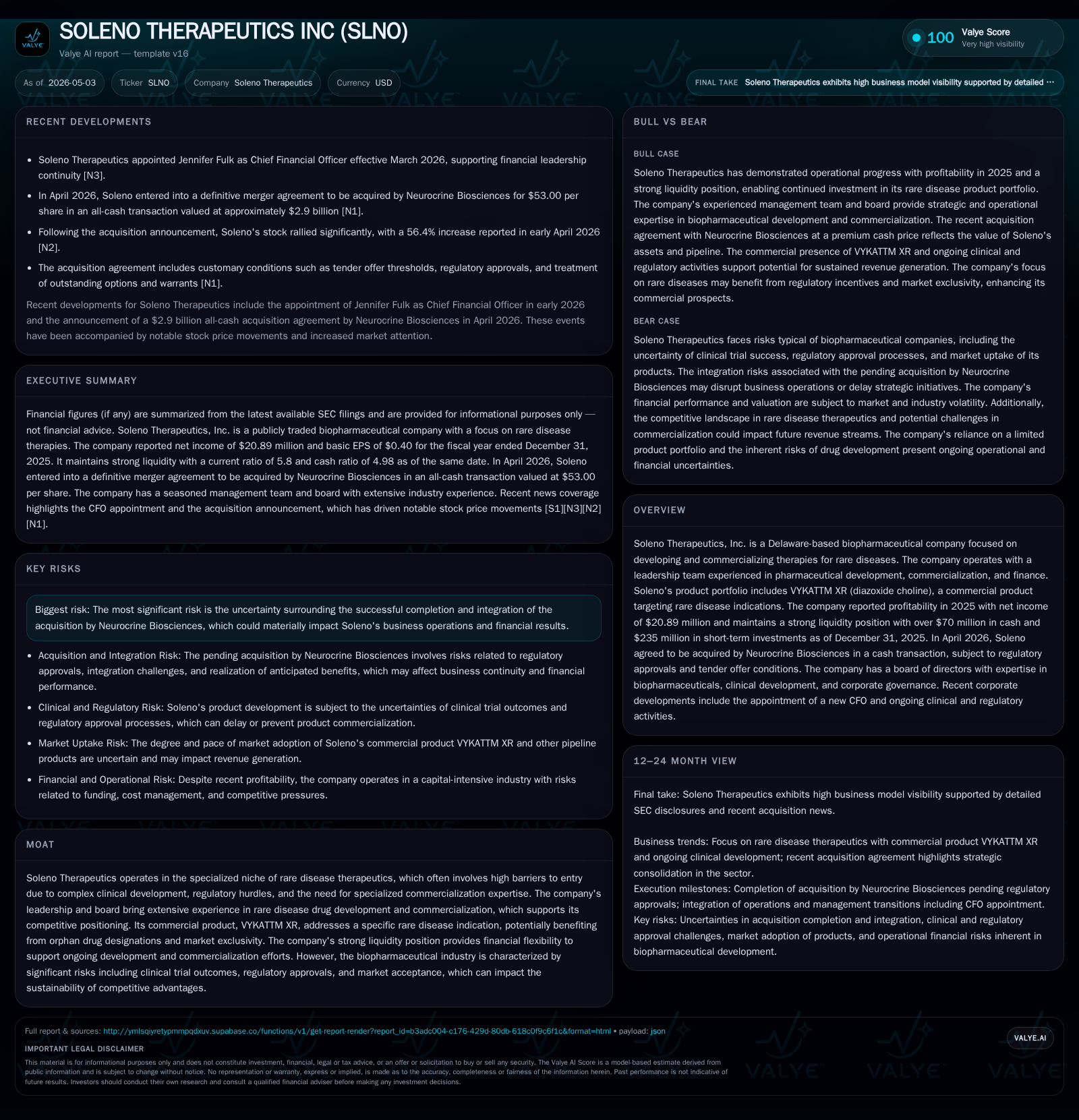
Soleno Therapeutics recently withdrew its European marketing application for VIOKAT XR while simultaneously agreeing to a cash acquisition by Neurocrine Biosciences, marking a pivotal shift in its operational outlook. The company’s business model centers on its approved rare disease therapy VYKAT XR targeting hyperphagia in Prader-Willi syndrome, supported by orphan drug status. Market exclusivity and leadership expertise underpin competitive advantages in a niche biopharma segment, though the near-term outlook faces execution risk tied to deal closure and regulatory repositioning. Investor focus now turns to the completion of the acquisition, integration prospects, and any residual regulatory milestones.
Recent Operating Developments
The most material immediate development for Soleno Therapeutics is twofold, anchored by its latest quarterly Form 10-Q filing dated November 4, 2025 [S2] and a subsequent April 7, 2026 current report (Form 8-K) [S3]. On April 7, the company disclosed that it had voluntarily withdrawn its marketing authorization application (MAA) for VIOKAT prolonged-release tablets from the European Medicines Agency (EMA). This product is known as VYKAT XR in the United States where it is an approved therapy for hyperphagia associated with Prader-Willi Syndrome (PWS) in patients aged four years or older.
Concurrently, Soleno announced it entered into a definitive agreement to be acquired by Neurocrine Biosciences in a cash transaction valued at approximately $2.9 billion [N1][N3]. This transaction is subject to customary regulatory approvals and tender offer conditions. The combination of withdrawing the EMA application while unveiling this large-scale acquisition marks a pronounced pivot away from direct European commercialization ambitions toward integration under Neurocrine’s ownership.
This shift recalibrates the company's near-term operational focus away from diversifying revenue streams via international approval toward capitalizing on its current U.S.-based assets during acquisition proceedings. Market reaction was immediate with shares surging over 30% pre-market upon announcement reflecting investor enthusiasm for the buyout premium juxtaposed against somewhat diminished standalone growth prospects following the EMA withdrawal.
Commercial Model and Product Portfolio
Soleno operates predominantly as a specialty biopharmaceutical entity focused on rare diseases. Its core product is VYKAT XR (diazoxide choline extended release), approved in the United States for treating hyperphagia symptoms in Prader-Willi syndrome patients—a genetic disorder characterized by insatiable appetite often leading to life-threatening obesity.
The rare disease focus inherently involves targeting small patient populations underpinned by orphan drug designations providing benefits such as market exclusivity extensions, reduced regulatory fees, and potential tax credits [S1]. Such factors underpin pricing power in these niche indications where therapeutic alternatives are absent or insufficient, enabling premium reimbursement profiles despite limited patient volume.
Revenue generation derives mainly from sales of VYKAT XR through focused specialized sales forces adept at navigating payor ecosystems sensitive to cost-effectiveness evidence and highly selective formularies. Given PWS's rarity—estimated prevalence measuring in thousands within relevant markets—the growth potential largely depends on expanding patient identification rates and improving adherence via education programs.
The company faces typical challenges common among rare disease biopharma: high per-unit selling costs offset by small volumes; reliance on payer acceptance cycles; and the need for continuous engagement with patient advocacy groups to maximize treatment penetration and maintain reimbursement status.
Strategic Landscape and Competitive Positioning
Soleno’s niche sits within a high-barrier segment of biopharmaceuticals—rare disease therapeutics—that commands substantial clinical development rigor coupled with complex regulatory pathways. Orphan drug designation affords critical protection against generic competition via exclusivity periods typically ranging from seven to ten years post-approval.
The industry’s structural characteristics include limited but highly specialized competition where incumbents benefit from strong patient switching costs largely driven by physician familiarity with unique therapeutic profiles and specific formulation attributes tailored to debilitating conditions such as PWS.
Leadership expertise at Soleno further cements competitive advantages. The executive team boasts proven track records spanning pharmaceutical innovation, launch execution in niche markets, and financial stewardship critical for navigating volatile biotech environments [S1].
Pricing power reflects the interplay between orphan exclusivity protections and payer negotiations; while durable due to limited alternatives, it remains moderated by healthcare budget constraints particularly outside the U.S., reinforcing the significance of market diversification strategies—which recent developments have complicated.
Neurocrine Biosciences’ acquisition signal represents recognition of strategic fit: expanding Neurocrine’s portfolio into rare genetic conditions complements its existing neurological disorder franchises potentially unlocking cross-selling opportunities and operational scale.
Growth Catalysts and Expansion Prospects
Prior to the voluntary EMA withdrawal, Soleno anticipated expanding VIOKAT XR internationally, which would have diversified revenue beyond its U.S. commercial base [N5]. With that channel now closed temporarily or indefinitely following strategic review linked to acquisition talks, organic growth hinges on deeper penetration within existing U.S. markets.
Key drivers include increasing diagnosis rates of PWS patients presenting clinically with hyperphagia amenable to treatment; advancing provider education programs; securing broader insurance coverage; and improving patient compliance through enhanced formulations or support services.
Beyond current product scope, incremental opportunities could arise through indication expansion granted additional clinical evidence or advancing pipeline candidates addressing other rare diseases—a path that may accelerate under Neurocrine’s larger-scale research infrastructure.
Potential synergies loom around integrating Soleno’s commercial operations into Neurocrine’s existing platform offering cost rationalization benefits alongside more robust access capabilities across payors nationwide—factors that could improve margins over time post-close.
Risks, Constraints, and Deal Uncertainties
The dominant near-term risk resides in successfully closing the proposed acquisition transaction with Neurocrine Biosciences given regulatory scrutiny inherent in sizable pharma deals alongside customary tender offer contingencies outlined in merger agreements [S2][S3][S28]. Failure or delay could unsettle market confidence substantially.
Moreover, stepping back from European expansion relinquishes potential upside from an untapped market that could have represented meaningful mid-cycle revenue diversification had the EMA's assessment trajectory remained positive. This heightens dependence on sustaining momentum within the U.S., exposing growth more acutely to single-market dynamics including reimbursement shifts or competitive entrants.
Further latent risks embedded within rare disease drug development remain: unforeseen clinical trial delays; regulatory changes impacting pricing policies; dependency on successful patient identification initiatives; plus financial pressures linked to capital deployment prior to deal consummation when resource allocation may constrict.
Finally, while Soleno holds a strong liquidity position bolstering operational runway ahead of closing [F1], ongoing integration complexities under new ownership pose execution risk related to retention of critical personnel and administrative harmonization during transition phases.
Near-Term Corporate Milestones to Monitor
Monitoring activities revolve around tracking key legal and procedural steps tied to acquisition execution: initiation of Neurocrine’s tender offer filings and stockholder response rates; satisfaction of antitrust approvals potentially extending past initial deadlines; shareholder vote scheduling; plus any emerging regulatory observations impacting timing or deal terms [S7][S28].
Operationally, attention focuses on quarterly releases scheduled post-announcement reflecting product demand stability amid transactional uncertainty—particularly any traction loss attributable to EMA withdrawal fallout or competitive activity disruptive trends.
Pipeline updates after closing might signal strategic prioritization changes under Neurocrine ownership including accelerated development investments or termination decisions affecting long-term company value trajectories.
Summary Financial Profile
Latest financial snapshot
| Metric | Value | Period |
|---|---|---|
| Cash & equivalents | $70mm | |
| 2025-12-31 | ||
| Total debt | $50mm | |
| 2025-12-31 | ||
| Net debt | $-20mm | |
| 2025-12-31 | ||
| Current assets | $356mm | |
| 2025-12-31 | ||
| Current liabilities | $61mm | |
| 2025-12-31 | ||
| Current ratio | 5.8x | |
| 2025-12-31 |
Source: SEC companyfacts cache [F1].
Financial discipline is evident with Soleno reporting profitability for fiscal year 2025 highlighted by net income totaling approximately $20.89 million supported by operating income of roughly $9.41 million per latest annual Form 10-K filed April 2026 [F1].
Balance sheet strength persists with cash & equivalents near $70 million complemented by short-term investments boosting liquidity reserves significantly beyond gross debt obligations around $50 million yielding a negative net debt position close to $-20.11 million as of December 31, 2025—a buffer conducive for sustaining commercial operations during transition phases [F1].
Current assets vastly exceed liabilities producing a current ratio above 5x reflecting solid working capital management crucial for funding commercialization efforts without dilution pressure ahead of acquisition closure [F1].
This financial robustness underlines baseline enterprise value underpinning transaction valuation while equipping management with optionality should transitional complexities require tactical maneuvering before deal consummation completes fully.
This analysis synthesizes most recent SEC filings alongside public information to articulate Soleno Therapeutics’ evolving business situation driven primarily by regulatory setbacks compounded with transformative acquisition announcements that together reshape operational prerogatives within rare disease biotechnology landscapes. It does not constitute investment advice but rather aims to provide informed perspectives on strategic shifts impacting stakeholders' understanding of business fundamentals going forward.
Disclaimer: This is research-only, informational analysis and not investment advice. It may include AI-generated interpretation and general industry context. Always verify important details using primary sources.

Comments