
Knife River Accelerates Growth but Faces Margin Pressures After Q1 2026
Latest quarterly results reflect volume gains driven by acquisitions and favorable weather amid ongoing cost and margin challenges.
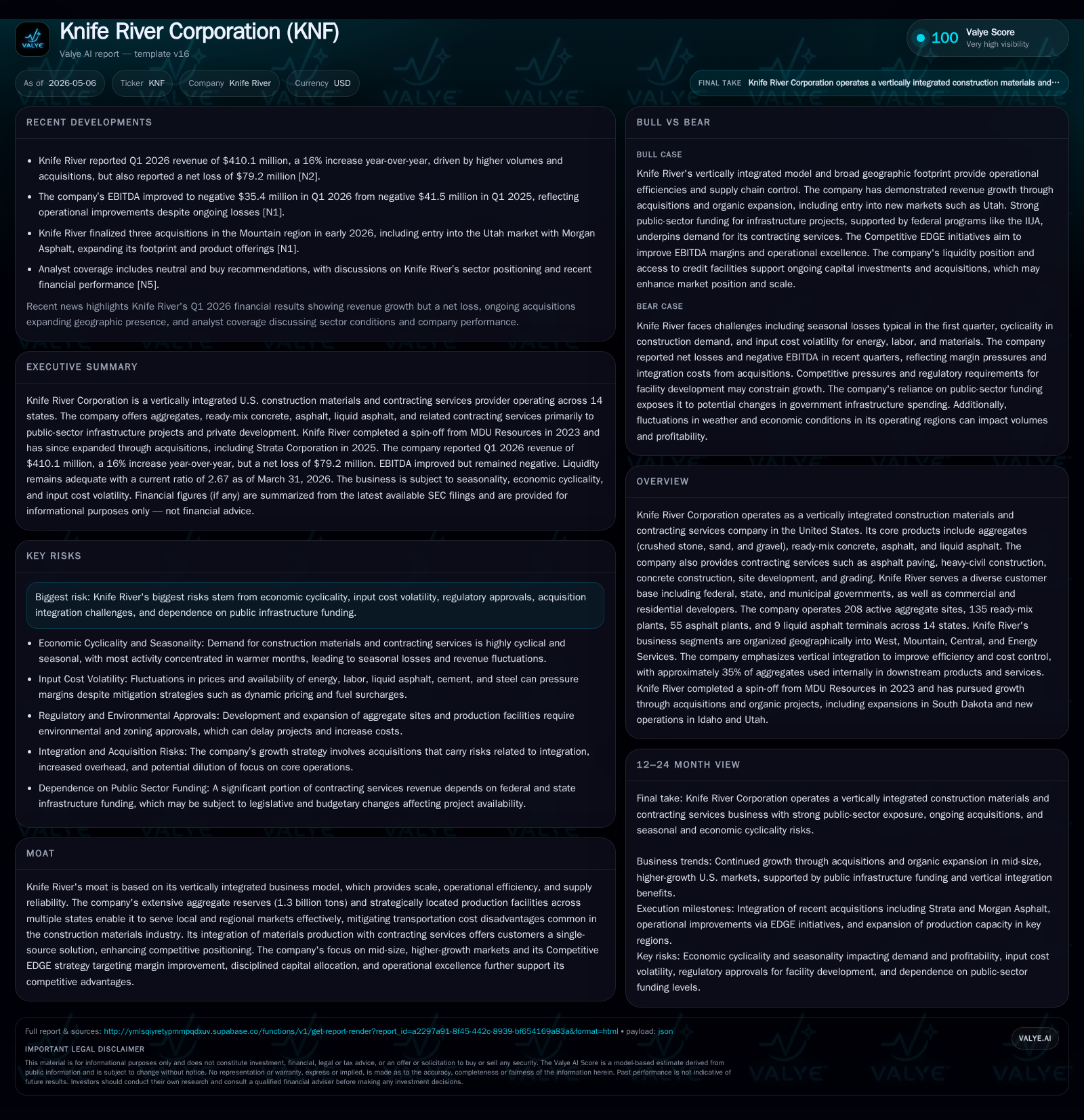
Knife River Corporation's Q1 2026 showed revenue growth powered by higher volumes in ready-mix concrete and aggregates, bolstered by recent acquisitions and early favorable weather conditions. Despite this top-line improvement, EBITDA declined due to seasonal operational losses at Strata and rising labor and overhead expenses. The company continues to rely on vertical integration across materials production and contracting services, targeting mid-size regional markets with further organic and acquisition-driven expansion. Risks remain tied to input cost volatility, public infrastructure funding uncertainty, and integrating recent acquisitions. Knife River’s disciplined capital allocation supports ongoing investment in capacity expansions and operational efficiency initiatives under its Competitive EDGE strategy.
Recent Operating Update
In its latest quarterly report ending March 31, 2026, Knife River Corporation delivered top-line growth with nuanced earnings pressure reflecting the seasonality of its core businesses alongside integration costs from recent acquisitions [S2]. Total reportable segment revenue rose markedly due to a $35.8 million increase in ready-mix concrete volumes and a $21.5 million uplift from aggregates sales. This was driven partly by favorable weather enabling earlier season contracting activities as well as contributions from acquisitions completed in late 2024 and 2025 [S2][S12]. The Energy Services segment notably recorded a 47% revenue increase to $20.4 million on higher sales volumes and reduced operating costs previously incurred for boiler repairs and railcar maintenance [S2].
However, Knife River's adjusted EBITDA declined marginally compared to Q1 2025 due to extended seasonal losses at the recently acquired Strata Corporation operation in North Dakota, which management notes will temper near-term earnings [S2]. Selling, general & administrative expenses increased primarily from payroll growth tied to acquired staff additions and amortization of intangible assets related to purchase accounting adjustments [S2]. Corporate services contributed negative EBITDA consistent with prior year levels but reflected increased salaries.
Liquidity remains sufficient with $13.3 million cash-on-hand at quarter-end against total debt of approximately $1.43 billion; working capital is strong at $590 million supported by a current ratio of 2.67x [F1][S2]. Capital expenditures amounted to $77.3 million for Q1 with an additional $174 million invested in acquisitions net of cash acquired—far lower than the prior year's figure reflecting large deals such as the Strata purchase completed in March 2025 [S2]. The company's ability to manage seasonal cash flow swings hinges on access to capital markets for liquidity needs not met through operations.
Business Model
Knife River operates as a vertically integrated construction materials supplier coupled with contracting services across fifteen U.S. states organized into four segments: West, Mountain, Central, and Energy Services [S1][S2]. The core of its business model is anchored on its vast aggregate reserve base totaling approximately 1.3 billion tons that underpins internal supply for downstream products like ready-mix concrete and asphalt while supporting external sales across multiple product lines [S1]. Approximately 35% of aggregates produced are utilized internally to fortify value-added products or contracting work such as heavy-civil construction including paving, site development, grading, bridges, and concrete structures.
Vertical integration drives enhanced cost control by leveraging scale across mining operations (208 active sites), processing plants (135 ready-mix; 55 asphalt), liquid asphalt terminals (9), and an extensive logistics fleet delivering materials via truck, rail or barge depending on local market needs [S1]. This full-stack capability enables Knife River to offer bundled solutions that appeal to public agencies and private developers seeking a reliable single-source provider able to maintain supply reliability amidst fluctuating local demand.
The company generates revenue primarily through direct product sales (recognized at delivery) across aggregates, asphalt, ready-mix concrete plus ancillary items such as cement or burner fuels. Contracting services revenue is recognized over time based on project progress using cost-to-cost input methods typical for heavy civil construction contracts [S24]. The margin profile benefits from integrated material inputs lowering procurement expense volatility while the contracting arm captures premium pricing opportunities tied to public infrastructure spending.
Knife River’s ‘Competitive EDGE’ initiative is central to margin enhancement efforts focusing on process improvements via PIT Crews dedicated to boosting operational efficiency across product lines. These teams deploy real-time visibility tools enabled by new technologies along with targeted training programs aimed at reducing production costs without sacrificing quality or safety standards [S2][S1]. Complementing these efforts is disciplined bidding on higher-margin projects facilitated by region-specific market knowledge combined with strategic capital deployment on organic expansions—like the planned aggregate capacity increase in Sioux Falls expected online by 2027—as well as bolt-on acquisitions to consolidate fragmented regional markets.
Industry Structure and Competitive Position
Knife River operates within the highly fragmented U.S. aggregates and construction materials industry characterized by significant barriers related to resource access (aggregate reserves) and geographic logistics cost sensitivity. Transportation distances materially affect competitive dynamics since hauling heavy materials like crushed stone or asphalt significantly inflates costs beyond local supply radius limits.
The company’s moat stems from its expansive reserve base strategically spread across multiple states alongside an integrated network of production facilities carrying scale advantages typically inaccessible to smaller competitors limited either to mining or contracting alone [S1]. This network provides flexibility in reallocating resources during economic cycles or localized demand shifts while maintaining continuous supply reliability—a crucial differentiator when bidding for sizable public infrastructure projects requiring phased deliveries.
Moreover, Knife River’s vertical integration reduces dependence on third-party suppliers for critical raw materials thereby partially insulating margins from commodity price fluctuations such as diesel fuel or liquid asphalt pricing seen industry-wide. While tariff impacts on inputs have been modest so far owing to contractual passthrough arrangements with customers for most input cost escalations, rising inflationary pressures for materials input remain a watchpoint impacting industry-wide profitability [S1][S2].
The firm targets mid-sized growing regional markets rather than competing head-on in densely saturated metropolitan areas where larger national players dominate. In existing core geographies like Montana or North Dakota following the Strata acquisition, Knife River enhances local market penetration providing differentiated bundled services combining material supply with execution capabilities valuable for complex civil infrastructure projects funded largely through federal/state programs such as IIJA [Infrastructure Investment & Jobs Act] allocations totaling over $1 trillion over five years nationally but subject to distribution timetables varying across states [S1][N2].
Growth Drivers
Growth prospects revolve around three principal vectors:
Acquisition-led expansion: Knife River has demonstrated an aggressive buy-and-build approach acquiring vertically integrated peers like Strata (North Dakota/ Minnesota) along with smaller operators in Montana during Q1 2026 adding incremental reserves, plant footprint and skilled workforce enhancing scale benefits across segments [S2][S12]. The acquisition pipeline remains active targeting materials-led businesses aligned geographically with existing markets facilitating rapid synergies realization.
Organic capacity investments: Capital spending includes replacement of depleting reserves—the lifeblood of aggregate producers—and greenfield projects designed to expand throughput such as an ongoing South Dakota aggregates project slated for completion next fiscal year providing new volume sources for growing local demand pockets [S1][S2]. Ongoing upgrades integrate advanced processing technologies enabling incremental productivity gains supportive of margin expansion.
Public infrastructure funding tailwinds: Federal programs like IIJA underpin robust government budgets in most states where Knife River operates; eleven out of fifteen have record DOT budgets for fiscal year 2026 typically resulting in heightened bid lettings for highway/building projects driving contract backlog growth especially visible in Central segment geographies like North Dakota where bid lettings have more than doubled year-over-year fueling backlog increases [S1][N5]. However ~43% of authorized IIJA formula funds remain pending disbursement creating cautious visibility horizons.
These drivers connect directly with measurable KPIs including backlog growth trends evidenced particularly in government contracting opportunities; plant utilization metrics benefiting from early season favorable weather; acquisition-related volume liftings reflected in aggregate sales gains; and ongoing stabilizations or improvements in adjusted EBITDA margins driven by operational enhancements under Competitive EDGE processes.
Risks / Watchpoints / Growth Constraints
Key risks include:
- Economic cyclicality: Construction activity inherently fluctuates seasonally with material demand peaking during warmer months leading to negative EBITDA intervals during winter quarters exacerbated recently by Strata's extended losses post-acquisition highlighting integration seasonality impacts [S2].[N7]
- Input cost inflation: Material price volatility notably diesel fuel, liquid asphalt, cement and steel could pressure margins despite contractual mitigants; ongoing energy escalations require constant management vigilance especially given current geopolitical uncertainties affecting global commodity markets [S2][S1]
- Public funding uncertainty: Timing lags around IIJA allocation release remain considerable risking project delays or reduced contract awards despite nominal state level budget strength requiring prudence around forecasts reliant on government spending flows [N5][S1]
- Acquisition integration: Absorbing multiple acquired businesses demands close alignment on culture/operations/systems; execution missteps could dilute expected synergies or elevate overhead costs constraining profit improvements amid competitive bidding landscapes.
- Regulatory compliance/environmental matters: Aggregate mining licensing involves ongoing environmental approvals subject to evolving regulatory frameworks potentially delaying expansions or incurring compliance costs restricting flexibility.
What To Watch Next
Investors should monitor:
- Quarterly volume trends across aggregates vs ready-mix segments as lead indicators of contracting activity progression particularly outside peak seasons.
- Backlog changes specific to states receiving increased federal-distributed funding reflecting conversion of infrastructure appropriations into awarded projects driving future revenues.
- Margin trajectory influenced by Competitive EDGE initiative implementation effectiveness visible via cost reduction metrics reported periodically comparing material input trends against realized selling prices.
- Progress reports on key organic expansions including the South Dakota aggregates project timeline adherence benchmarking capacity ramp potential beyond current plant footprint constraints.
- Further acquisition announcements especially targeting contiguous regional footprints implying scalable cross-segment synergies enhancing long-term embedded growth runways.
- Developments related to raw material input price pressures alongside adaptive pricing clauses effectiveness mitigating margin erosion risks.
Financial Profile Summary
Latest financial snapshot
| Metric | Value | Period |
|---|---|---|
| Cash & equivalents | $13mm | |
| 2026-03-31 | ||
| Total debt | $1433mm | |
| 2026-03-31 | ||
| Net debt | $1420mm | |
| 2026-03-31 | ||
| Current assets | $942mm | |
| 2026-03-31 | ||
| Current liabilities | $352mm | |
| 2026-03-31 | ||
| Current ratio | 2.67x | |
| 2026-03-31 |
Source: SEC companyfacts cache [F1].
Knife River reported unrestricted cash balances of approximately $13.3 million versus total debt nearing $1.43 billion as of March 31st, depicting a leveraged but manageable capital structure typical for capital-intensive businesses relying heavily on credit facilities timed around seasonal working capital demands ([F1],[S2]). Capital expenditures reached $77 million this quarter reflecting ongoing commitment towards maintenance capex alongside strategic investments supporting growth ambitions despite cash usage intensifying relative to prior year periods where extraordinary divestment proceeds were realized ([S2]). Net investing cash flows contracted markedly due primarily to fewer acquisition outflows versus exceptionally heavy spending related to prior year expansive consolidation moves including Strata purchase considerations ([S2]). Adjusted EBITDA margins weakened slightly reflecting mix effects caused by seasonal startup headwinds at acquired entities supplemented by elevated SG&A expense levels driven principally by labor commitments required post-acquisition along with intangible amortization—consistent dynamics noted throughout industrial peer groups undergoing consolidation phases ([S24],[N6]).
This analysis synthesizes publicly filed SEC disclosures without recommending any investment action. Readers should consider broader market conditions alongside sector-specific developments impacting cyclical construction materials businesses before drawing conclusions about company prospects.
Disclaimer: This is research-only, informational analysis and not investment advice. It may include AI-generated interpretation and general industry context. Always verify important details using primary sources.

Comments