
AdaptHealth’s Growth Faces Regulatory Headwinds and Inflation Pressures in Home Medical Equipment Market
AdaptHealth reports solid operational scale with ongoing technology integration but grapples with CMS enrollment moratoria and inflation-driven cost challenges.
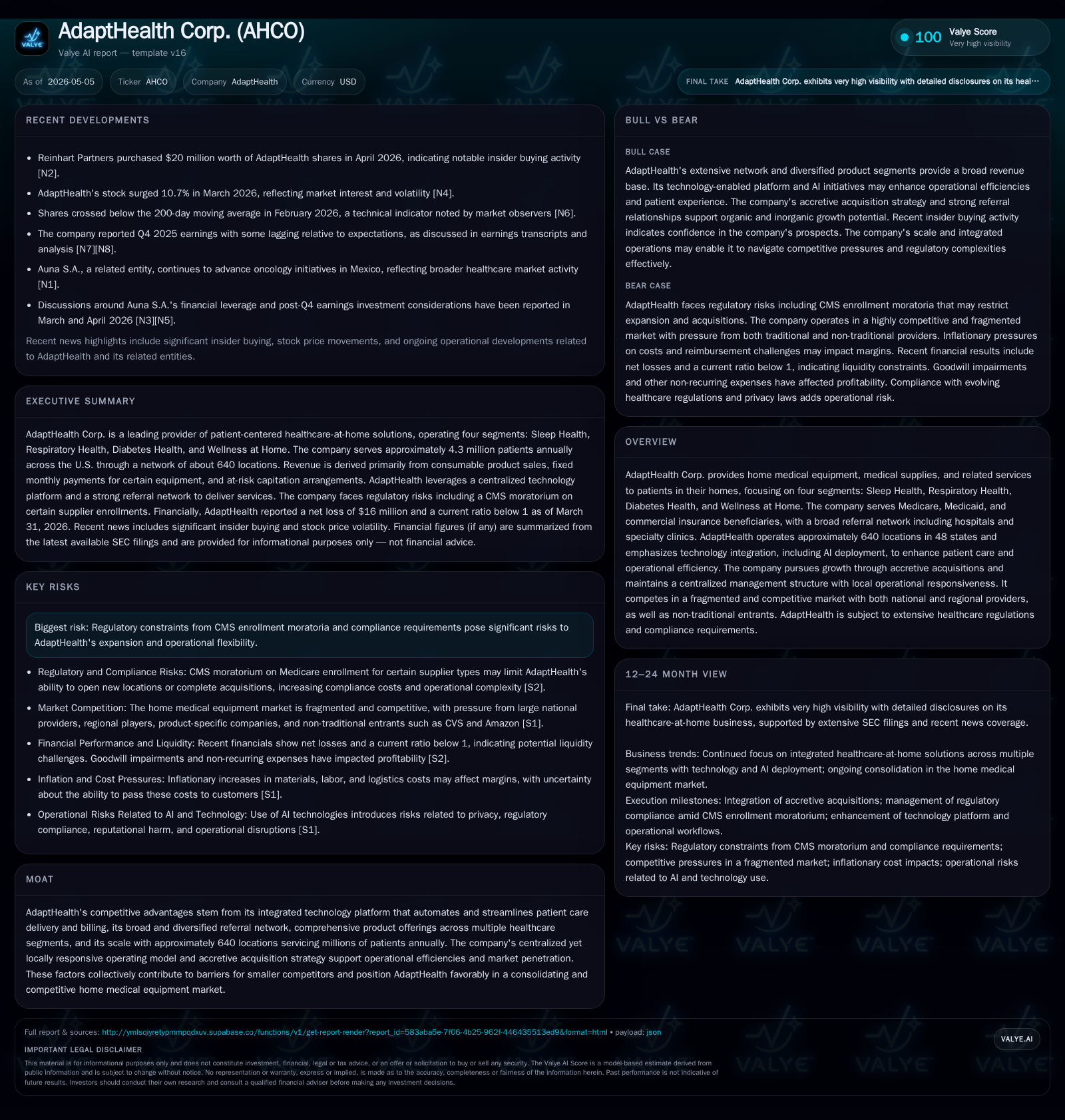
In its latest quarter, AdaptHealth Corp. reaffirmed its position as a leading provider of home medical equipment and services across four healthcare segments while highlighting emerging regulatory and inflation risks. The company’s integrated tech platform and expansive location network underpin its competitive moat, yet CMS-imposed supplier enrollment moratoria threaten expansion and acquisition activities. AdaptHealth’s growth outlook hinges on navigating complex healthcare regulations, managing inflationary cost pressures, and sustaining referrals in a fragmented yet consolidating industry.
Recent Operating Update
AdaptHealth Corp.'s Q1 2026 filings ([S2], [S3]) reaffirm its status as a national leader in home medical equipment (HME), servicing about 4.3 million patients annually through roughly 640 locations in 48 states. The latest disclosures emphasize both business scale and looming challenges from regulatory developments. Most notably, in February 2026, the Centers for Medicare & Medicaid Services (CMS) implemented a six-month nationwide moratorium on Medicare enrollments for certain Durable Medical Equipment Prosthetics Orthotics and Supplies (DMEPOS) "medical supply company" suppliers—the category relevant to AdaptHealth ([S2]). This moratorium restricts new supplier enrollments—including practice locations—and can be extended or expanded.
The direct consequence is that AdaptHealth's expansion plans via new location openings or acquisitions requiring supplier re-enrollment are now curtailed or delayed. Given the company's historical growth through accretive acquisitions involving multiple facility consolidations necessitating re-enrollment processes, this moratorium increases administrative burden and heightens compliance scrutiny. Additionally, this policy signal indicates a more stringent CMS enforcement environment targeting fraud waste and abuse risks in the DMEPOS sector. Such actions could therefore increase monitoring costs for AdaptHealth and potentially impact revenue growth trajectories if site expansions or M&A activity slow.
Business Model
AdaptHealth operates through four reportable segments aligned to key patient needs: Sleep Health (e.g., CPAP machines for sleep apnea), Respiratory Health (oxygen therapy & ventilation), Diabetes Health (glucose monitors & insulin pumps), and Wellness at Home (post-acute care supplies). The company serves insured beneficiaries predominantly under Medicare, Medicaid, and commercial insurance plans ([S1]).
Revenue is generated primarily by:
- Resupply Sales and One-Time Product Sales: Consumable supplies such as positive airway pressure masks and diabetes management items constitute approximately 63% of net revenue ([S1], [S23]). Payment occurs at sale point.
- Equipment Rentals: Certain durable medical equipment earns monthly reimbursement rates set by CMS or insurers (e.g., oxygen concentrators) booked over the service period.
- At-Risk Capitation Arrangements: A smaller portion (~4% of revenue) derives from fixed payments tied to patient eligibility periods under specific managed care contracts.
Revenue mechanics rely heavily on volume drivers including new patient starts fueled by referrals from hospitals, physicians (specialists like pulmonologists/endocrinologists), skilled nursing facilities, hospice operators, sleep labs, etc. Pricing power or margin improvements hinge on reimbursement rates from government programs which are subject to regulatory updates.
Margins can be influenced adversely by rising costs of goods sold inclusive of vendor pricing changes driven by tariffs or supply shortages alongside labor expenses tied to distribution—AdaptHealth coordinates logistics via owned/contracted delivery fleets ([S1]). Adaptive use of purchasing scale mitigates some pricing risk.
Industry Structure and Competitive Position
The home medical equipment industry is highly fragmented featuring national providers like AdaptHealth competing alongside numerous regional players plus non-traditional entrants leveraging telehealth or online distribution channels. The sector requires compliance with extensive regulation including billing documentation standards enforced under Medicare/Medicaid programs.
AdaptHealth's moat resides in an integrated technology platform that automates workflow from prescription intake through logistics to claims management. This system improves operational efficiency reducing billing errors/fraud risk while enhancing patient experience via digital interfaces—an increasingly vital factor as payors demand transparency and quality assurance ().
Scale provides economies across procurement negotiations with suppliers and expanded referral network coverage across U.S. states. Centralized management aligned to segment-specific operations enables responsiveness to local market nuances while maintaining consistent quality controls ([S23]).
The company continues consolidation efforts through acquisitions which strengthen its geographic presence especially where fragmentation persists with smaller operators lacking technological sophistication.
Growth Drivers
Growth at AdaptHealth is propelled by several structural factors:
- Demographic Tailwinds: Aging population trends increase demand for chronic disease management products like respiratory devices and diabetes technology.
- Shift to Home Care: Payer focus on cost containment drives preference toward outpatient/homecare settings over hospital stays enhancing HME utilization rates.
- Referral Network Expansion: Strengthening ties with hospitals discharging patients with complex needs fuels new patient inflows.
- Technology Differentiation: Continued investment in AI-driven platforms augments operational efficiencies enabling handling higher volumes without commensurate cost escalation ().
- Accretive Acquisitions: M&A activity expands product breadth/service offerings plus regional footprints although currently moderated by CMS enrollment restrictions.
Risks / Watchpoints / Growth Constraints
Despite scale advantages AdaptHealth faces several fundamental risks:
- CMS Enrollment Moratoria: The current suspension on supplier enrollments considerably restrains opening new locations or acquiring entities requiring re-enrollment—a key growth vector today ([S2]). Extensions or additional screening policies could prolong constraints.
- Regulatory Compliance / Fraud Investigations: Ongoing False Claims Act investigations into historic billing practices raise execution risk along with potential financial penalties or reputational harm ([S10], [S11], [S18]).
- Inflationary Pressure: Rising costs of materials, labor shortages amid tight healthcare labor markets, shipping delays materially press margins ([S1] Risk Factors). Pass-through pricing capability remains uncertain due to governmental payor controls.
- Supply Chain Dependencies: Reliance on limited suppliers heightens vulnerability to product shortages or price increases that may disrupt fulfillment schedules affecting patient satisfaction [S1].
- Legal Proceedings & Settlements: Pending multi-million-dollar settlements related to various class actions add contingent liabilities despite currently low materiality expectation ([S5], [S8]).
- Leverage Profile: Substantial outstanding debt (~$1.75 billion) carries refinancing needs within a given timeframe ([F1]).
What To Watch Next
Key execution milestones shaping AdaptHealth's trajectory include:
- Developments regarding CMS enforcement policies—any extension or widening of enrollment restrictions will bear directly on expansion plans.
- Progress/status updates on False Claims Act investigations or class action settlements influencing financial reserve adequacy or litigation expenses.
- Patient start volumes reported alongside referral network evolutions signaling demand momentum post-pandemic normalization.
- Acquisition announcements evidencing capability to deploy capital accretively despite current regulatory hurdles.
- Operational KPIs around order fulfillment velocity and digital platform adoption demonstrating efficiency gains amid inflationary pressures.
- Quarterly results updates providing clarity on margin trends given supply chain strain and cost pass-through effectiveness.
Financial Profile Summary
Latest financial snapshot
| Metric | Value | Period |
|---|---|---|
| Total debt | $1750mm | |
| 2025-12-31 | ||
| Net debt | $1749mm | |
| 2025-12-31 | ||
| Current assets | $687mm | |
| 2026-03-31 | ||
| Current liabilities | $743mm | |
| 2026-03-31 | ||
| Current ratio | 0.92x | |
| 2026-03-31 |
Source: SEC companyfacts cache [F1].
As of March 31, 2026 ([F1]), AdaptHealth presents the following balance sheet snapshot:
| Metric | Value | Period Ended |
|---|---|---|
| Current Assets | $687.5 million | |
| 2026-03-31 | ||
| Current Liabilities | $743.3 million | |
| 2026-03-31 | ||
| Current Ratio | 0.92 | |
| 2026-03-31 | ||
| Total Debt | $1.75 billion | |
| 2025-12-31 | ||
| Cash & Equivalents | $0.75 million* | |
| 2019-03-31† |
- Note cash figure is dated; actual cash likely differs but no newer figure provided. † Latest available cash balance dates back several years; recent filings indicate cash proceeds from operations remain strong but exact balance undisclosed currently.
Disclaimer:
This analysis is prepared solely for informational purposes based on publicly available filings as cited; it does not constitute investment advice or recommendations regarding AdaptHealth Corp.'s securities.
Disclaimer: This is research-only, informational analysis and not investment advice. It may include AI-generated interpretation and general industry context. Always verify important details using primary sources.

Comments