
Third Coast Bancshares Extends Texas Footprint with Strong Q1 Growth and Risk Discipline
Q1 2026 results highlight meaningful loan portfolio expansion, deposit growth, and enhanced funding flexibility within a well-governed regional banking framework.
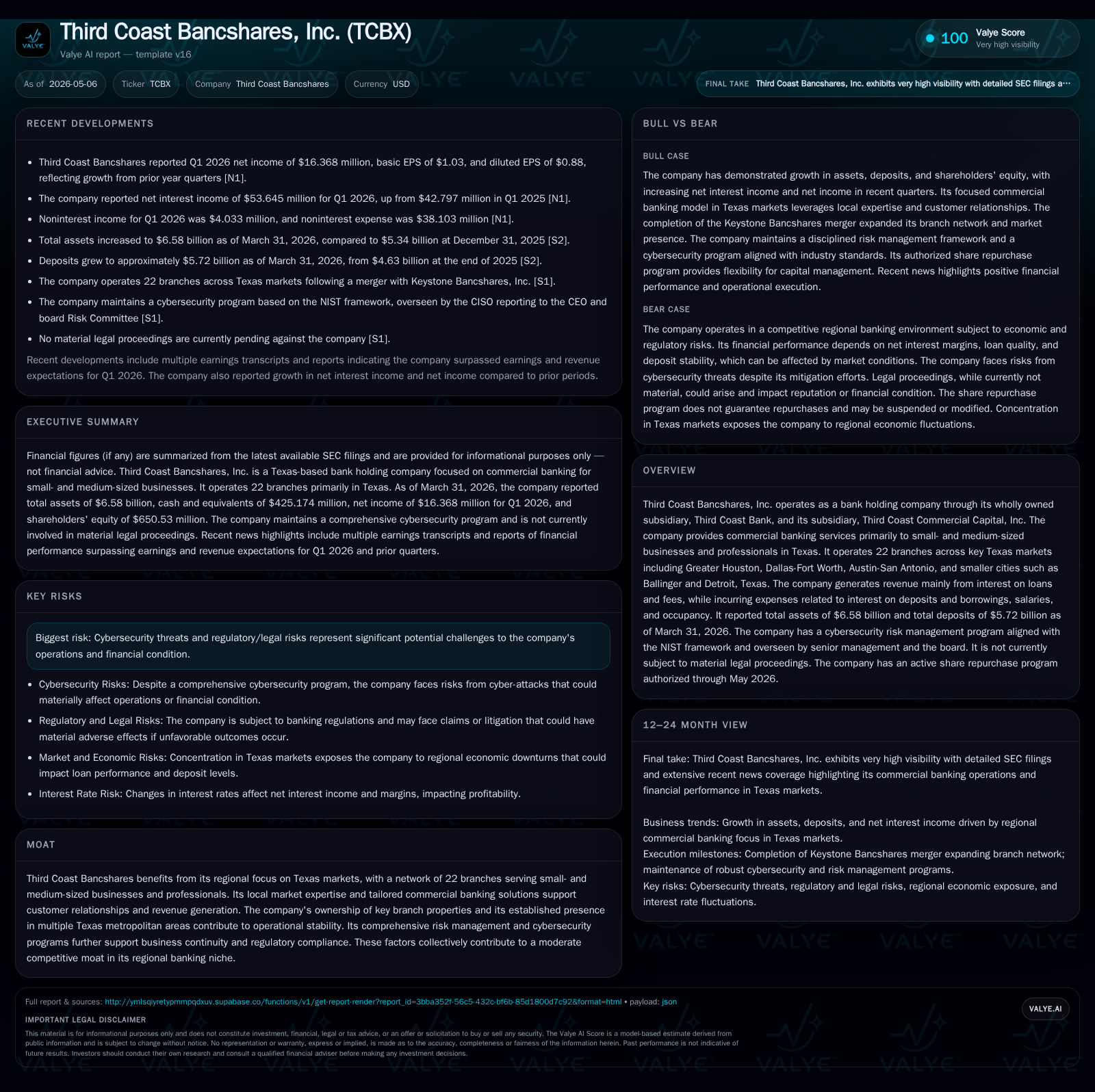
Third Coast Bancshares reported substantial loan growth to $5.2 billion as of March 31, 2026, up from $4.35 billion at year-end 2025, supported by strong commercial and industrial lending. Deposits increased to $5.72 billion, reflecting a stable and growing core funding base amid expanding branch presence in key Texas markets. The company extended its senior line of credit facility and maintains a robust liquidity profile, with $425 million in cash and equivalents, while executing disciplined risk management grounded in an NIST-aligned cybersecurity program. These developments underpin Third Coast’s regional banking strategy focused on small- and medium-sized businesses in Texas, leveraging local market expertise and relationship-driven lending to sustain competitive advantages and growth opportunities.
Latest Quarterly Operating Highlights and What They Indicate
The company’s May 5, 2026 10-Q reveals a pronounced increase in net loans to $5.2 billion as of quarter-end from $4.35 billion at December 31, 2025 [S2]. This represents nearly a 20% expansion in just three months, primarily through growth in commercial and industrial loans which reached approximately $2.18 billion—a rise of over $270 million sequentially—alongside sizable gains in residential real estate loans totaling $543.8 million [S26]. Deposit balances also advanced robustly to $5.72 billion from prior levels, maintaining a healthy loan-to-deposit ratio above 90%. This deposit base consists predominantly of interest-bearing accounts (77.4% of deposits) with noninterest-bearing deposits steady near 9% [S16].
Liquidity remains strong with total cash and due from banks climbing substantially from approximately $181 million year-end to $425 million at quarter-end [S2], [F1]. Furthermore, the senior revolving credit facility was recently amended to increase capacity by $15 million to $70 million total with an extended maturity to March 10, 2028—providing additional funding flexibility without materially changing the fixed floor rate terms [S3], [S11]. The company holds significant available borrowing capacity through Federal Reserve Borrower-in-Custody arrangements ($1.7 billion) and Federal Home Loan Bank advances ($642 million), all currently undrawn [S16].
The allowance for credit losses increased commensurately with loan growth but no material uptick in nonperforming assets or credit deterioration was noted as of March 31 [S2]. Earnings surpassed consensus forecasts according to recent earnings transcripts indicating operational momentum is translating into profitability improvements [N1], [N2].
Business Model and Commercial Banking Product Strategy
Third Coast Bancshares operates principally as a bank holding company overseeing Third Coast Bank and Third Coast Commercial Capital (TCCC), focusing on comprehensive commercial banking services largely targeted at small- and medium-sized businesses (SMBs) plus professionals within Texas markets [S1]. Revenue drivers are concentrated in net interest income stemming from the bank's loan portfolio alongside fee income derived from lending services and treasury management solutions.
The company leverages its regional expertise across Greater Houston, Dallas-Fort Worth, Austin-San Antonio metropolitan areas plus smaller cities such as Ballinger and Detroit, Texas—markets that require local relationship banking with tailored financing solutions versus standardized large-bank products [S1], [F1]. TCCC’s factored receivables business further diversifies lending streams by providing working capital financing linked primarily to accounts receivable from transportation and energy services sectors nationwide [S26].
The strategic emphasis on commercial real estate loans (including construction/development financing) and commercial & industrial loans underpins revenue stability while fostering customer switching costs through nuanced credit underwriting tied closely to borrower cash flows and asset collateral positions [S1], [S26]. This integrated product suite allows the bank to capture multiple touchpoints within client financial ecosystems thereby deepening wallet share.
Competitive Position within the Texas Regional Banking Market
Within a fragmented yet highly competitive Texas banking landscape featuring both national banks and smaller community players, Third Coast Bancshares maintains a moderate competitive moat anchored in localized knowledge and physical presence via its network of 22 branches strategically placed within key economic corridors [S1], [F1]. Owning critical branch properties enhances operational control over customer experience and cost structure.
Although scale disadvantages relative to megabanks exist, Third Coast’s relationship-driven approach underpinned by direct decision-making authority at local branches facilitates quicker response times to evolving SME needs—a notable differentiator amidst peer group rigidity. The company’s stable deposit mix emphasizes core funds rather than volatile brokered deposits or wholesale funding sources highlighting prudent liability management amidst interest rate volatility across the sector [S16].
Regulatory compliance requires adherence to federal standards particularly given ongoing examinations; however, capital adequacy metrics confirm the bank’s position well within ‘‘well-capitalized’’ thresholds ensuring regulatory resilience [S10]. Pricing power remains largely dependent on maintaining credit discipline balanced against heightened competition from fintech innovators offering niche lending alternatives.
Key Growth Drivers Supporting Continued Expansion
Several factors support sustainable expansion for Third Coast Bancshares including:
- Texas Economic Strength: The SMB segment within Texas benefits from favorable demographic trends and business-friendly policies that underpin credit demand particularly in commercial & industrial sectors.
- Loan Portfolio Momentum: Accelerated loan growth reflects tight alignment with borrower requirements for working capital financing and real estate investment; expanded underwriting capacity enables targeting of higher-quality credits supported by collateral.
- Deposit Base Stability: Growing deposits provide low-cost capital facilitating attractive net interest margins while enhancing balance sheet leverage effect.
- Capital Management Initiatives: Authorized share repurchases (up to $30 million) though not yet executed indicate management sees opportunity for accretive capital use pending market conditions [S13].
- Cybersecurity Safeguards: Robust cybersecurity measures anchored on NIST framework reduce operational risk which is crucial as digital banking adoption intensifies.
- Funding Flexibility: Modified revolving credit lines extended maturities enabling contingency liquidity buffers that can support opportunistic asset growth or weather short-term market disruptions [S3], [S11].
Risks and Constraints: Cybersecurity, Regulatory, and Market Pressures
While operating momentum is evident, key risks persist:
- Cybersecurity Threats: Despite mature defense-in-depth protections monitored continuously—including third-party managed detection & response services—and overseen directly by the board-level Risk Committee aligned with NIST standards, the potential for material cyber incidents remains non-negligible given the increasing frequency/severity of global attacks [S1].
- Regulatory Environment: Evolving regulatory frameworks may impose higher capital charges or compliance costs that compress margins or restrict risk appetite; ongoing FDIC/Fed oversight necessitates adaptability.
- Credit Risk Management: Rapid loan book expansion requires vigilance towards underwriting quality especially in construction/development loans that can be sensitive to economic cycles.
- Market Risks: Interest rate fluctuations influence net interest margin trajectories; failure to effectively hedge or price could pressure earnings.
- Limited Scale Relative to Large Banks: Scalability challenges restrict rapid digitization investments potentially impacting long-term competitiveness.
Monitoring Metrics and Upcoming Milestones for Third Coast Bancshares
Key indicators that warrant close observation include:
- Sequential loan growth rates each quarter reflecting underlying SME demand strength.
- Deposit inflow/outflow dynamics coupled with shifts between noninterest-bearing vs interest-bearing categories influencing cost of funds.
- Delinquency/nonperforming asset ratios assessing asset quality trends post rapid portfolio build.
- Quarterly earnings releases scrutinizing net interest margin stability amid rising funding expenses.
- Progress against share repurchase authorizations revealing capital allocation discipline.
- Updates on any regulatory examinations or changes in capital requirements affecting strategic options.
- Status/frequency of drawdowns against Federal Reserve discount window facilities illustrating liquidity contingency usage [S2], [N1], [S3].
Concise Financial Summary from Latest Reports
As of March 31, 2026, total assets stood at approximately $6.58 billion supported by a robust deposit base of $5.72 billion underscoring consistent core customer engagement [F1], [S2]. Cash & equivalents grew strongly sequentially to $425 million establishing ample liquidity cushions beyond immediate operational needs [F1], [S2].
Funding sourced predominantly through deposits (~90%) ensures lower cost relative to wholesale borrowings; shareholders’ equity represents about 10% of total capitalization providing regulatory buffer room amidst asset growth cycles [S16]. Cost-of-funds metrics improved slightly reflecting tactical balance sheet management without sacrificing loan yield capture.
This report synthesizes publicly available SEC filings dated through May 2026 alongside contemporaneous earnings disclosures without predictive assertions or investment recommendations. The analysis prioritizes transparent linkage between documented evidence and interpretive commentary contextualized within Texas regional banking dynamics.
Disclaimer: This is research-only, informational analysis and not investment advice. It may include AI-generated interpretation and general industry context. Always verify important details using primary sources.

Comments