
Commercial Vehicle Group Revives Growth Prospects with Q1 2026 Operating Momentum
A net income turnaround in Q1 2026 signals operational resilience for Commercial Vehicle Group amid a complex commercial vehicle market.
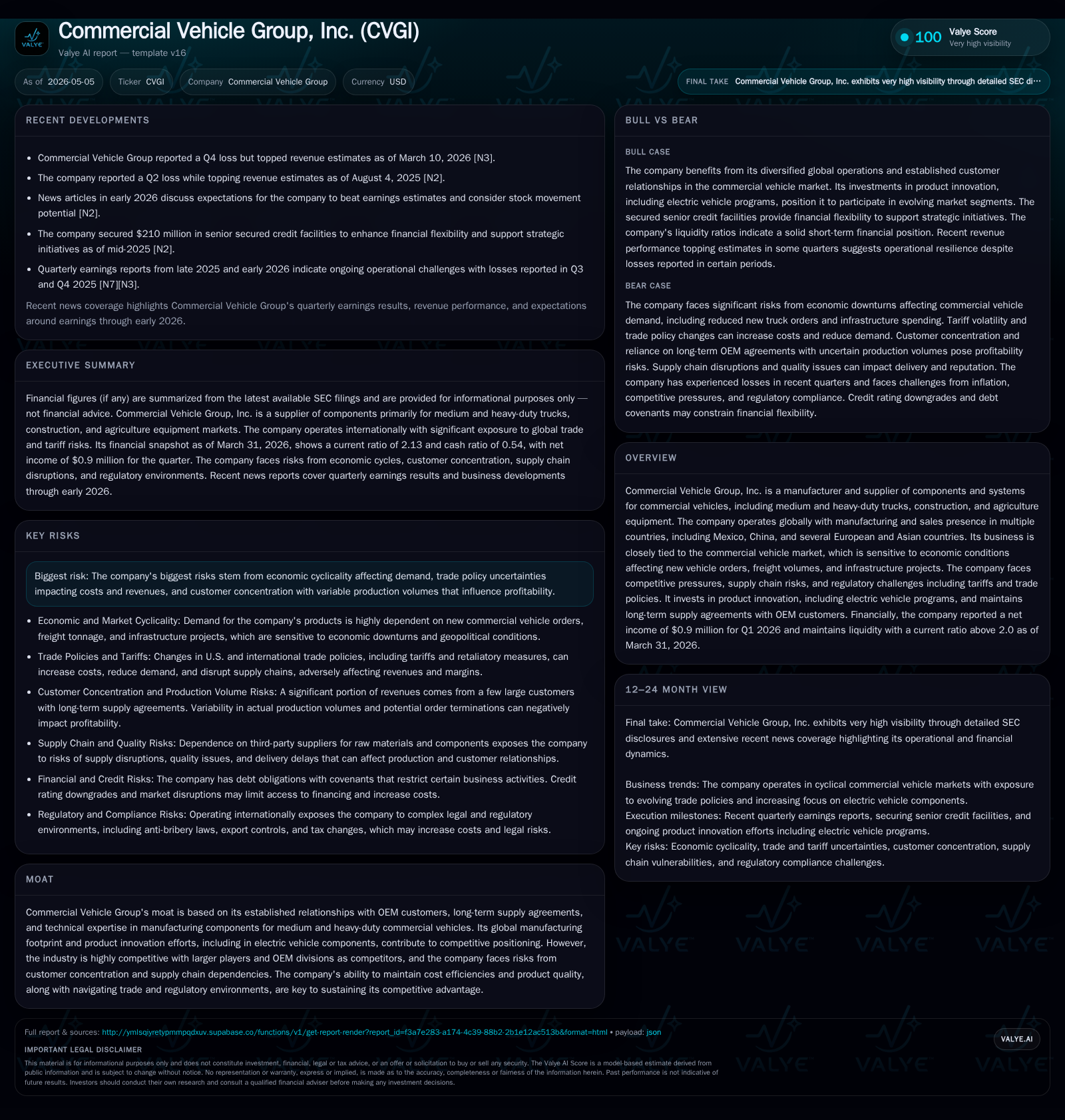
Commercial Vehicle Group, Inc. (CVGI) reported a positive net income of $0.9 million in the first quarter of 2026, reflecting an improvement from prior losses. This quarterly momentum comes as the company navigates cyclical demand sensitivities in medium and heavy-duty commercial vehicle markets alongside regulatory and tariff challenges. CVGI leverages its global manufacturing footprint, OEM supply agreements, and product innovation—especially in EV components—to underpin competitive positioning. Key risks include economic cyclicality, tariff volatility, and customer concentration. Near-term focus centers on execution of EV-related programs and managing trade policy impacts.
Q1 2026 Operating Update and Its Immediate Implications
Commercial Vehicle Group’s latest quarterly report filed on May 5, 2026 ([S2]) indicates a meaningful rebound in operating results highlighted by a net income of $0.9 million for Q1 2026. This positive performance contrasts with losses reported in prior quarters or annual periods leading up to this filing. The first quarter results reflect improved cost management and a stabilization in demand from its OEM customers amid a challenging commercial vehicle environment.
An accompanying Form 8-K ([S3]) reiterates the company's ongoing efforts to balance operational efficiency while addressing volatile trade conditions and supply chain disruptions. This quarterly improvement sets a cautiously optimistic tone about near-term operational resilience amidst macroeconomic uncertainties that have clouded year-over-year growth prospects.
Commercial Vehicle Group's Business Model and Product Portfolio Analysis
CVGI manufactures components integral to medium- and heavy-duty trucks as well as construction and agricultural equipment globally ([S1]). The company generates revenue primarily through long-term supply agreements with original equipment manufacturers (OEMs), which create stable contractual relationships underpinning recurring sales volumes.
The product portfolio spans seating systems under the Global Seating segment, electrical systems covering wiring harnesses and controls via Global Electrical Systems, and trim systems plus components under the Trim Systems segment ([S28]). Notably, CVGI invests strategically in electric vehicle (EV) component development aligned with shifting industry trends toward electrification ([N2],[S1]).
Its manufacturing and sales footprint extends across North America, Mexico, China, Europe, and other Asian countries ([S1]), providing flexibility to optimize production costs and serve diverse regional markets efficiently.
Competitive Environment and Industry Structure Insights
The commercial vehicle components industry is intensely competitive with large tier-1 suppliers and OEM-owned divisions as primary rivals ([S1]). CVGI’s niche lies in its technical expertise in component manufacturing combined with its ability to service major OEMs worldwide through long-term contracts.
However, pricing power is constrained by the commodity-like nature of some products and persistent tariff-driven input cost pressures ([S9]). The shifting tariff landscape—characterized by U.S. imposition of tariffs under Section 122 of the Trade Act of 1974—and international retaliatory actions expose CVGI to cost volatility that OEM customers often attempt to pass downstream through price adjustments or supply chain relocations ([S1],[S9]).
Customer concentration also raises risk; variability in order volumes from key OEMs can materially affect revenue cadence.
Drivers of Growth: Innovation, Global Expansion, and OEM Relationships
CVGI’s growth strategy centers on leveraging its deep relationships with OEM customers anchored by technical competence in specialized components essential to MD/HD trucks and construction vehicles ([S1]).
Product innovation particularly around EV programs forms a critical pillar for future expansion amid industry-wide electrification initiatives ([N2],[S1]). The company’s capability to introduce advanced electric seating systems or electrical harnesses targeting EV models enhances differentiation potential against commoditized suppliers.
Additionally, maintaining a distributed global manufacturing base enables CVGI to respond swiftly to regional demand fluctuations while managing tariff exposures through flexible sourcing strategies ([S1]).
Enhancing penetration within existing OEM accounts through contracts renewal is pivotal for sustaining baseline volume growth given cyclicality inherent in new truck production patterns.
Key Risks and Constraints Impacting Future Performance
Cyclicality remains the principal risk driver affecting CVGI’s top-line; demand ties closely to new MD/HD truck orders which fluctuate with economic cycles impacting freight tonnage moved and infrastructure investments ([S1]).
Trade policy uncertainty introduces cost risk via tariffs that not only raise input costs but may also compel OEM customers to alter production geographies away from tariffs impacted zones ([S9],[S1]). This dynamic compresses margins unless offset by pricing adjustments or cost-cutting measures.
Customer concentration risk exposes revenue streams to variability based on OEM production plans while product liability risks linked to warranty claims or recalls could lead to unplanned expenses harming profitability ([S20],[S22]).
Leverage constraints surfaced from debt covenants restrict operational flexibility for acquisitions or capital expenditures important for scaling growth initiatives ([S4],[S5]).
Near-Term Catalysts: What To Monitor Next
Key near-term indicators include management’s forthcoming guidance updates post-Q1 earnings which will illuminate demand trending beyond early 2026 ([S2],[S3]).
Tracking backlog levels or incremental booked orders from major OEM clients should provide measurable insights into sales momentum especially given the underlying cyclicality.
Tariff developments remain pivotal; any easing or tightening affects input cost structure materially thereby influencing pricing strategies.
Progress reports on EV component program rollouts signal CVGI's ability to capitalize on evolving vehicle technologies potentially unlocking longer-term growth corridors ([N2],[S2]).
Current Financial Position and Liquidity Overview
As of March 31, 2026 ([F1]), CVGI holds total debt approximating $90.7 million juxtaposed with current assets standing at $276.7 million against current liabilities of $129.8 million — producing a healthy current ratio of approximately 2.13x. Net debt computed at roughly $20.4 million reflects moderate leverage relative to liquidity reserves.
Disclaimer: This is research-only, informational analysis and not investment advice. It may include AI-generated interpretation and general industry context. Always verify important details using primary sources.

Comments