
ACRES Commercial Realty's Move to Internal Management Reshapes Its Strategic Outlook
ACRES’ April 2026 agreement to internalize management signals a strategic shift designed to boost operational control and align incentives amidst evolving commercial real estate finance dynamics.
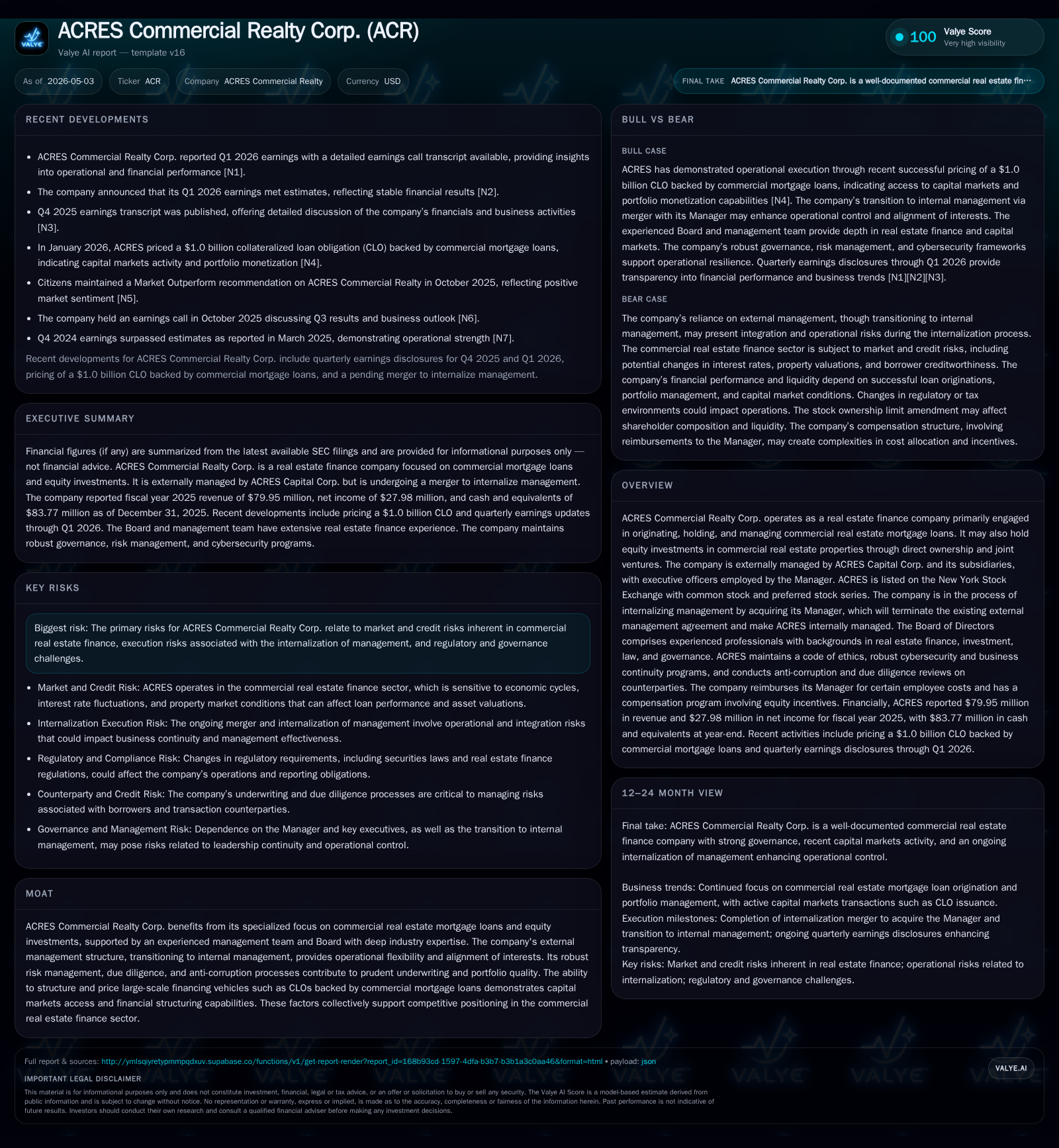
In April 2026, ACRES Commercial Realty Corp. announced an all-stock acquisition of its external manager, ACRES Capital Corp., marking its transition to an internally managed structure. This move is expected to reduce management fee drag, enhance operational efficiency, and better align management and shareholder interests. The company operates primarily by originating, holding, and managing commercial real estate mortgage loans, complemented by equity investments through ownership and joint ventures. Its competitive strengths include specialized CLO structuring capabilities and robust capital markets access. However, execution risks linked to the internalization process and inherent credit risks in volatile real estate markets remain key considerations.
Recent Management Internalization Update and Strategic Implications
On April 27, 2026, ACRES Commercial Realty Corp. ("ACR") entered into a definitive all-stock merger agreement to acquire ACRES Capital Corp., its external manager responsible for day-to-day operations and investment management functions [S3], [S5]. This landmark transaction transitions ACR from an externally managed REIT model to an internally managed structure—a notable shift aligning operating control directly within the company. The merger eliminates the existing external management agreement, thus removing associated fees that historically reduced net income margins.
The special committee of independent directors reviewed and unanimously approved this transaction, underscoring confidence in better alignment of interests between shareholders and management [S21]. Governance enhancements accompany this change; ACR’s board has adhered strictly to NYSE independence standards with a majority of independent directors providing oversight [S1]. Strategically, internalization enables more agile decision-making around underwriting, asset origination, and portfolio allocation without reliance on approval from an outside entity.
Business Model Overview: Loan Origination, Equity Investments, and Managerial Structure
ACR’s primary revenue-generating activities revolve around originating commercial real estate mortgage loans anchored by thorough underwriting processes via their Investment Committee [S1]. This committee vets loan originations ranging broadly in size—from under $50 million approvals delegated internally within the manager’s committee to greater than $75 million investments requiring full board-level Investment Committee approval ensuring rigorous risk assessments.
Complementing mortgage lending are equity investments acquired either through direct property ownership or structured joint ventures with partners—providing ACR exposure beyond debt instruments into property-level upside potential. While externally managed by ACRES Capital Corp., this operation is in transition toward internal oversight post-merger completion which will consolidate accountability under ACR’s corporate structure.
This hybrid approach combines predictable interest income streams from loans with variable returns associated with equity investments. Risk controls are enforced via strict ethics codes alongside cybersecurity and business continuity protocols reinforcing operational resilience [S1].
Industry Positioning: Competitive Advantages within Commercial Real Estate Finance
ACR occupies a niche within commercial real estate finance characterized by specialization in structuring large-scale financing vehicles such as Collateralized Loan Obligations (CLOs) backed by commercial mortgage loans. This capability demonstrates sophisticated capital markets access uncommon among smaller specialty finance firms or traditional banks heavily reliant on deposit base funding or retail investors.
Experienced leadership—the senior officers are entrenched in CRE finance—and a deep bench of independent directors bring extensive legal, financial, and governance expertise to bear in portfolio oversight contributing to disciplined underwriting standards and prudent capital deployment, [S1]. Furthermore, transitioning to internal management is expected to sharpen incentive alignment across stakeholders allowing more focused execution against growth strategies without fee erosion.
Competitive intensity exists from REIT peers employing similar credit models as well as banks balancing risk-return tradeoffs constrained by regulatory capital requirements. However, ACR’s demonstrated ability in loan syndication structures supported by CLO securitizations provides differentiation enabling scale efficiencies.
Growth Drivers: Capital Markets Access, CLO Structuring Abilities, and Portfolio Expansion
Growth prospects hinge largely on leveraging ACR’s capital markets footprint to expand loan origination volumes while managing credit risk prudently amidst evolving real estate cycles. Stabilizing interest rate environments can stimulate demand for floating-rate CRE loans—mirroring ACR's product suite—especially as borrowers seek flexible refinancing solutions.
Internalizing management removes procedural bottlenecks allowing quicker decisions on underwriting new loans or committing equity capital thus potentially accelerating portfolio expansion trajectories post-transaction closure [S3],. Enhanced managerial control also supports experimentation with joint venture structures offering partnerships that mitigate balance sheet concentration risks while capturing fee income streams.
Measurable KPIs relevant for tracking growth include incremental portfolio size thresholds approved by Investment Committees (noted thresholds at $50 million-$75 million), margin profiles improvement from lowered fee expenses after internalization, along with pipeline visibility disclosed quarterly through earnings presentations [N1], [N2].
Risks and Execution Challenges in the Internalization and Market Environment
Despite strategic merits, key near-term risks merit scrutiny. Integration risks arise as core functions—investment origination, asset management—transition inward; cultural shifts or system harmonizations may temporarily disrupt workflow causing inefficiencies or control lapses if not closely managed.
Capital markets volatility also poses a danger; reliance on securitization vehicles like CLOs requires continued investor appetite which could wane with rising rates or macroeconomic stressors affecting deal pricing or renewals of warehouse lines funding originations,[S2]. Robust risk mitigation frameworks embedded in the Investment Committee review process seek to address these vulnerabilities but execution remains critical.
Near-Term Milestones and Market Catalysts to Watch
Several key events will offer visibility into successful execution post-internalization:
- The formal proxy statement filing initiating stockholder vote on the merger/internalization anticipated shortly after April 2026 announcements marks a primary catalyst for transaction completion timing [S5].
- Subsequent quarterly earnings reports will provide commentary on operational integration progress alongside portfolio composition changes reflecting early effects of enhanced managerial autonomy [N1], [N2].
- Monitoring shifts in broader commercial real estate credit metrics—delinquency rates on CRE loans backing CLOs alongside property market fundamentals—will serve as barometers of loan book quality influencing future originations.
Current Financial Position and Capital Structure Snapshot
Latest financial snapshot
| Metric | Value | Period |
|---|---|---|
| Cash & equivalents | $84mm | |
| 2025-12-31 | ||
| Total debt | $1,551mm | |
| 2025-12-31 | ||
| Net debt | $1,467mm | |
| 2025-12-31 |
Source: SEC companyfacts cache [F1].
At the close of fiscal year 2025 (latest available data), ACRES maintained $83.8 million of cash and equivalents against total debt approximating $1.55 billion yielding net debt around $1.47 billion—a leverage level consistent with sustaining ongoing loan book expansion but necessitating active liquidity management amid changes post-internalization [F1]. Revenue for 2025 stood at approximately $79.9 million with net income near $28 million suggesting profitable operations despite external management fee layers soon expected to diminish upon internalization completion.
This capital structure affords ACR flexibility in accessing refinancing opportunities or structured finance markets necessary to support growth levers tied to loan originations backed by asset quality validation from seasoned underwriting committees.
Disclaimer: This analysis is based solely on publicly available information as of early May 2026 from SEC filings (), company disclosures (), and financial snapshots ([F1]). It does not constitute investment advice or recommendations.
Disclaimer: This is research-only, informational analysis and not investment advice. It may include AI-generated interpretation and general industry context. Always verify important details using primary sources.

Comments