
Traws Pharma Accelerates Influenza Program with $60 Million Financing Boost
A significant financing round in April 2026 galvanizes Traws Pharma’s clinical-stage antiviral development, enabling expansion of its influenza-focused pipeline assets.
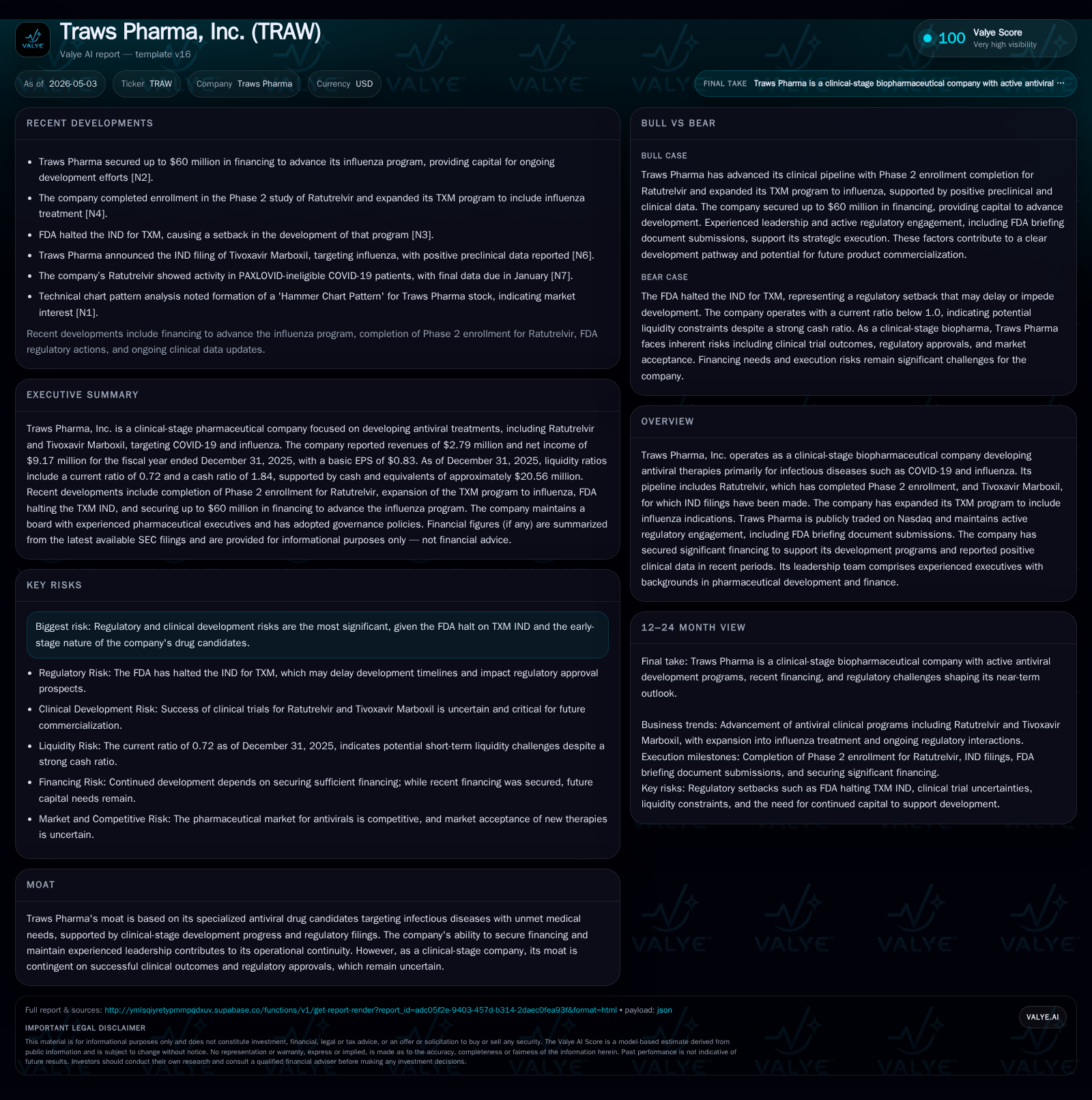
On April 15, 2026, Traws Pharma announced a $60 million private placement designed to bolster its influenza antiviral program, specifically supporting the advancement of tivoxavir marboxil and expansion of the TXM program. This capital infusion addresses a pivotal funding need following clinical progress with ratutrelvir and regulatory engagement, positioning the company to execute upcoming Phase 2 milestones and FDA interactions. While operating in a highly competitive antiviral space facing regulatory and clinical uncertainties, Traws Pharma’s pipeline diversification and leadership experience provide structural growth catalysts amid constrained liquidity reflected by a sub-1.0 current ratio.
Latest Developments: Financing and Regulatory Update
Traws Pharma’s April 15, 2026 Form 8-K reveals a material private placement that raised approximately $60 million through an aggregate offering consisting of nearly six million shares of common stock (or pre-funded warrants) along with multiple series of warrants exercisable for common shares [S3][S24]. The financing is structured with Series A, B, and C warrants, collectively providing incremental capital upon exercise. This capital injection explicitly targets advancing the company’s influenza antiviral program, notably expanding the TXM program’s scope [N2]. The timing is crucial: bolstering liquidity amidst ongoing costly drug development after ratutrelvir's Phase 2 completion and tivoxavir marboxil's IND filings enables continuation of clinical operations without delays or compromises.
The terms feature customary conditions and registration rights agreements but lack specific maturity or redemption constraints typical of debt instruments [S24]. Placement agents included Cantor Fitzgerald & Co., JMP Securities, and Tungsten Advisors LLC. Given prior FDA scrutiny—specifically an FDA halt on TXM-related IND activity—the fresh capital also supports compliance adaptation and further regulatory preparation efforts. The company accompanied this announcement with an earnings release incorporated by reference highlighting financial results through December 31, 2025 [S3].
Business Model Overview and Product Pipeline Quality
Operating as a clinical-stage biopharma entity, Traws Pharma centers its R&D on antiviral therapies directed against infectious diseases like COVID-19 and seasonal influenza [S1]. The revenue model predominantly depends on successful clinical advancement events because therapeutic products remain in development without commercial launch or product sales revenue beyond nominal licensing or milestone receipts.
The pipeline's flagship candidate, ratutrelvir—a ritonavir-free antiviral designed for mild-to-moderate COVID-19 patients—completed Phase 2 enrollment as of early 2026 [S7][S12], reflecting strategic positioning against competitor PAXLOVID® which contains ritonavir. Parallel to this is tivoxavir marboxil which has filed Investigational New Drug (IND) applications aiming at prophylactic indications in seasonal influenza [S12]. Notably, the TXM program’s expansion into influenza broadens therapeutic reach beyond coronavirus infections into endemic respiratory viral threats [N2]. Such diversification could mitigate concentration risk while aligning with public health priorities where unmet needs persist.
These assets remain purely investigational; profitability hinges on regulatory approvals following late-stage trials. With no marketed products yet, cash burn from R&D intensifies reliance on equity financing cycles. The intellectual property foundation appears domain-specific focusing on novel mechanisms potentially avoiding cross-resistance seen in existing nucleoside analogues or protease inhibitors — though explicit patent portfolio details are not available in recent disclosures.
Competitive Environment in Antiviral Development
Traws Pharma operates within a competitive arena dominated by major biopharma companies that launched first-generation antivirals such as Pfizer’s PAXLOVID® for COVID-19 and various licensed influenza antivirals like oseltamivir (Tamiflu). Barriers include stringent FDA efficacy/safety thresholds alongside market access controlled by governmental pandemic preparedness programs.
Pricing power is challenged by public sector purchasing frameworks that demand cost-effectiveness in addition to robust clinical benefit. Switching costs are moderate since large health systems could alternate between antiviral therapies if clinically justified. However, innovative oral formulations like ratutrelvir’s ritonavir-sparing profile may offer modest differentiation versus standard-of-care regimens burdened by drug-drug interaction concerns.
Capacity constraints primarily center around clinical trial enrollment competition rather than manufacturing bottlenecks at this stage due to outsourcing models typical among clinical-stage biotech companies. Regulatory dynamics require nimble responses to evolving FDA guidance on emergency use authorizations versus traditional approval pathways—a complexity heightened during pandemics or seasonal outbreaks.
Growth Catalysts: Pipeline Expansion and Regulatory Milestones
Traws Pharma's progress rests heavily on delivering positive topline data from Phase 2 trials of ratutrelvir and advancing tivoxavir marboxil through early development stages marked by IND acceptance and initiation of prophylaxis studies [S3][S12]. Successful full enrollment completion followed by interim analyses could validate safety/efficacy claims necessary for FDA engagement.
Moreover, ongoing submission of FDA briefing documents denotes interactive regulatory communication designed to refine trial designs or address agency concerns—critical inflection points potentially unlocking accelerated review mechanisms.
Beyond data readouts, exercising warrants from the recent financing round signals potential capital inflows enabling scale-up activities or new partnerships. Broader TXM program extension into other respiratory viruses could further enhance commercial opportunity breadth once initial indications advance beyond proof-of-concept.
Risks: Clinical, Regulatory, and Financial Considerations
Foremost risk centers on regulatory uncertainty evidenced by previous FDA-imposed halts on TXM-related IND filings requiring protocol revisions—illustrating how agency risk imposes timeline variability. Clinical risks include the failure to demonstrate sufficient antiviral potency or tolerability compared to effective market incumbents which would nullify commercialization prospects.
Financially, the company’s latest available balance sheet data from December 31, 2025 ([F1]) shows current assets of approximately $8.0 million against current liabilities of about $11.1 million, implying a current ratio near 0.72. This suggests short-term obligations exceed readily convertible assets, highlighting liquidity constraints typical for clinical-stage biopharma firms reliant on external funding. The recent $60 million equity raise reported in April 2026 [S3] is expected to support operational continuity and mitigate immediate runway risks. Operating losses totaled approximately $17.9 million at year-end 2025 despite nominal revenue ($2.79 million) likely from limited licensing or grants ([F1]). Dilution risk arises from warrant exercises necessary for cash inflows but detrimental to shareholder value unless matched by substantial enterprise value accretion.
Finally, commercial adoption depends not just on regulatory approval but also market penetration against entrenched antiviral therapeutics alongside evolving virus variants potentially reducing target vulnerability.
Near-term Catalysts: What Investors Should Monitor
Key upcoming indicators include:
- Publication dates for Phase 2 ratutrelvir clinical data informing safety/efficacy profiles.
- Status updates on tivoxavir marboxil IND progression including FDA feedback post briefing document reviews.
- Exercise levels and timing for Series A–C warrants providing capital extensions.
- Announcements regarding extension of TXM program indications beyond influenza.
- Potential strategic partnerships or licensing deals enhancing development capabilities or market reach.
- Monitoring FDA communications for shifts in regulatory stance especially related to prior IND holds.
These milestones could materially influence valuation benchmarks tied to drug product viability and financing sustainability.
Financial Profile and Liquidity Status
Latest financial snapshot
| Metric | Value | Period |
|---|---|---|
| Current assets | $8mm | |
| 2025-12-31 | ||
| Current liabilities | $11mm | |
| 2025-12-31 | ||
| Current ratio | 0.72x | |
| 2025-12-31 |
Source: SEC companyfacts cache [F1].
As reported in companyfacts data ([F1]), Traws Pharma held approximately $20.56 million in cash and equivalents as of December 31, 2023—a prior period figure preceding recent fundraising but indicative of baseline liquidity management. The operating loss magnitude (~$17.9 million in latest period) underscores heavy investment in R&D absent material operating income while net income shows a positive figure from non-operating gains reported critically close to period end which may not recur [F1].
Disclaimer: This analysis is based exclusively on available SEC filings and recent news related to Traws Pharma as of May 2026 without speculative assumptions beyond documented facts. It does not provide investment advice or recommendations.
Disclaimer: This is research-only, informational analysis and not investment advice. It may include AI-generated interpretation and general industry context. Always verify important details using primary sources.

Comments