
Oxford Square Capital Updates Strategic Position Amid Challenging CLO Yield Outlook
The company’s latest quarterly report reveals a zero effective yield on CLO equity investments, raising questions on portfolio returns amid sustained leverage.
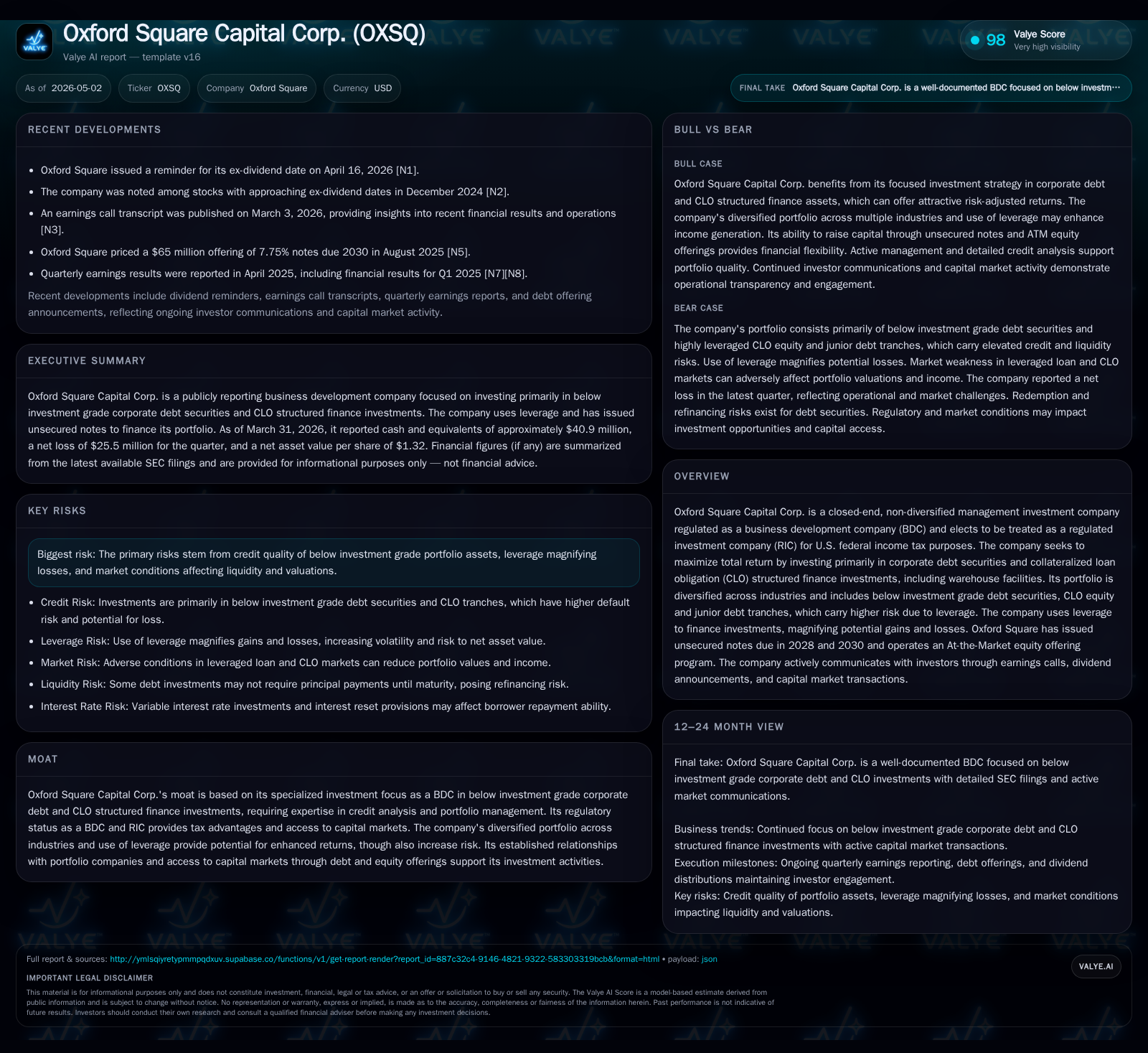
Oxford Square Capital's Q1 2026 filing shows an estimated zero yield on its CLO equity and subordinated notes, signaling pressure on income from key portfolio components. The company remains focused on below investment-grade corporate debt and CLO structures, leveraging its credit expertise in a challenging market with tightened loan prices and credit quality concerns. Leverage magnifies both upside and downside risks, requiring active management of refinancing and portfolio concentration. Upcoming quarters will be critical to gauge recovery paths through potential ATM equity issuance and debt restructuring dynamics.
Latest Quarterly Operating Update: Zero Yield Projection Raises Questions
Oxford Square Capital’s latest 10-Q filing dated May 1, 2026, reveals a notably grim projection for its portfolio segment invested in subordinated and income notes classified as CLO equity positions. These are considered residual claims entitled to the remaining cash flows after satisfying senior debt obligations within collateralized loan obligation structures. For Q1 2026, the company estimates an effective yield of approximately zero percent on these investments using prior quarter-end cost bases combined with future cash flow projections [S2]. This means the aggregate future distributions plus terminal principal are projected to fall short of the amortized cost of these holdings.
This valuation signals acute challenges to earnings generation from a critical source of return within Oxford Square's portfolio, which historically benefits from leveraged upside intrinsic to CLO equity tranches. Such a near-zero yield reflects multiple headwinds including compressed spreads in the syndicated loan markets, credit quality stress among sub-investment-grade issuers underlying the CLO collateral pools, or potentially structural impairments within specific CLO vehicles. It points to an urgent need for cautious recalibration across credit monitoring and capital allocation strategies.
Oxford Square’s Investment Portfolio: Structure and Credit Focus
At its core, Oxford Square operates as a closed-end BDC primarily focused on generating total return through investing in corporate debt securities alongside structured finance vehicles such as CLOs and warehouse financing facilities that precede CLO formation [S1]. The portfolio is diversified across industries with a target investment range typically between $5 million and $25 million per portfolio company, aiming for dispersed exposure with few single investments exceeding 5% of total assets.
The asset mix as of late comprises roughly $41.3 million principal amount in debt investments plus over eight million shares of preferred stock bearing active payment-in-kind (PIK) provisions—where dividends accrue as additional shares rather than immediate cash—highlighting reliance on subordinated instruments that reward risk tolerance but increase payment uncertainty during market stress periods [S2], [F1].
This niche focus demands granular due diligence capabilities evaluating collateral quality, indenture robustness, and proactive engagement with portfolio companies—particularly vital given the riskier nature of these assets paired with leverage magnification effects inherent to BDC operation.
Moreover, its election as a regulated investment company (RIC) under U.S. federal tax law confers advantageous pass-through tax treatment while obligating compliance with qualifying asset concentration tests that encourage diversified yet targeted deployment. These factors contribute both regulatory insulation and enhanced access to capital markets relative to generalized non-BDC credit managers dominating broader loan or high-yield markets, [S1].
Oxford Square prides itself on maintaining established sourcing channels including broker-dealers and collateral managers seasoned in identifying opportunities across primary issuance pipelines as well as secondary market dislocations—critical competencies providing differentiated deal flow amid tightening credit conditions [S9].
Industry Position and Competitive Dynamics in CLO and Corporate Debt
The competitive landscape for BDCs specializing in below IG corporate loans and structured finance is shaped by capital market accessibility, sophistication in underwriting layered securities such as CLO tranches, and resilience to cyclical volatility in syndicated loan pricing affecting secondary liquidity. Oxford Square navigates this terrain leveraging unsecured note issuances due in 2028 (at 5.50%) and 2030 (at 7.75%) alongside an At-The-Market (ATM) equity distribution program authorized up to $150 million allowing incremental share sales subject to market reception.
These funding channels provide operational agility against backdrop where primary issuance volume fluctuates based on macroeconomic factors—interest rate regimes plus issuer default rates dictate investor appetite for leveraged loans underpinning their CLO assets.
Any successful execution depends critically on maintaining balanced leverage levels consistent with expected risk/return trade-offs amid market volatility plus retaining diversified industry allocations minimizing sector-specific downshock amplification risks inherent within concentrated portfolios [S2].
Risk Factors: Leverage Exposure, Credit Quality, and Market Volatility
Additionally, the predominance of below investment-grade credits lacking robust covenant cushions exposes the firm’s NAV to meaningful volatility should default rates escalate or refinancing avenues narrow sharply due to interest rate spikes or systemic illiquidity episodes within leveraged loan ABS sectors including CLOs themselves. Market sentiment toward subordinated trancheholders can swing quickly impacting mark-to-market valuations even absent fundamental defaults complicating quarterly NAV stability.
Finally, existing senior unsecured note maturities concentrated mid-to-late decade necessitate prudent liquidity stewardship ensuring refinancing options remain viable notwithstanding episodic disruptions or tightening underwriting standards at securitization conduits or bank syndicates connected to warehouse facilities used previously for loan aggregations destined for future CLO issuance [F1], [S2].
Catalysts to Monitor: Investor Communications and Q2 Operational Signals
Upcoming periods will prove pivotal in signaling whether Oxford Square can stealthily navigate through currently constrained yield environment:
- Updates on recurring distributions paid from CLO equity tranches during Q2 will test assumptions underlying current zero-yield forecasts,
- The pace and success rate of common stock sold under the ATM program reveal market reception which impacts available growth capital,
- Management disclosures during next earnings call may clarify strategic adjustments addressing impaired cohort exposures or balance sheet optimization initiatives,
- Early signs of improving syndicated loan market technicals such as narrowing bid-ask spreads or secondary bid interest could presage better reinvestment returns commencing later this year.
Investor attentiveness should focus sharply around these discrete execution milestones that concretely portend reversal or stabilization relative to abnormally suppressed income-generating portfolio segments encountered presently [S3], [N1].
Financial Snapshot: Liquidity, Debt Profile, and Capital Awareness
As per the March 31st quarter report verified by companyfacts data and SEC filings:
- Cash & cash equivalents stood at approximately $40.9 million providing footing for near-term liquidity needs including servicing operational expenses plus interest obligations [F1].
- Total debt outstanding was approximately $127 million as of December 31, 2023, primarily comprising unsecured notes maturing in 2028 (5.50%) and 2030 (7.75%) [F1].
- Net debt after deducting cash approximates $86 million as of December 31, 2023 [F1].
- The portfolio includes approximately $41.3 million principal amount of debt investments and over eight million shares of preferred stock investments with active payment-in-kind (PIK) provisions as of March 31, 2026 [S2].
This blend affords some breathing room although fragile given constrained yield realizations warranting prudent capital deployment discipline alongside vigilant refinancing planning timed ahead of upcoming scheduled maturities avoiding any liquidity tightness scenario development potentially detracting from shareholder value preservation objectives [F1], [S2].
This analysis is based solely on public regulatory filings up to May 2026 without investment recommendations. It aims to provide objective insight into Oxford Square Capital Corp.’s recent operational developments within the broader complex leveraged corporate debt ecosystem.
Disclaimer: This is research-only, informational analysis and not investment advice. It may include AI-generated interpretation and general industry context. Always verify important details using primary sources.

Comments