
Digital Realty Trust Strengthens Growth Outlook with AI-Driven Leasing Surge
The latest quarter reveals Digital Realty’s accelerating leasing momentum driven by AI infrastructure demand, underpinning revenue stability and a bullish growth outlook.
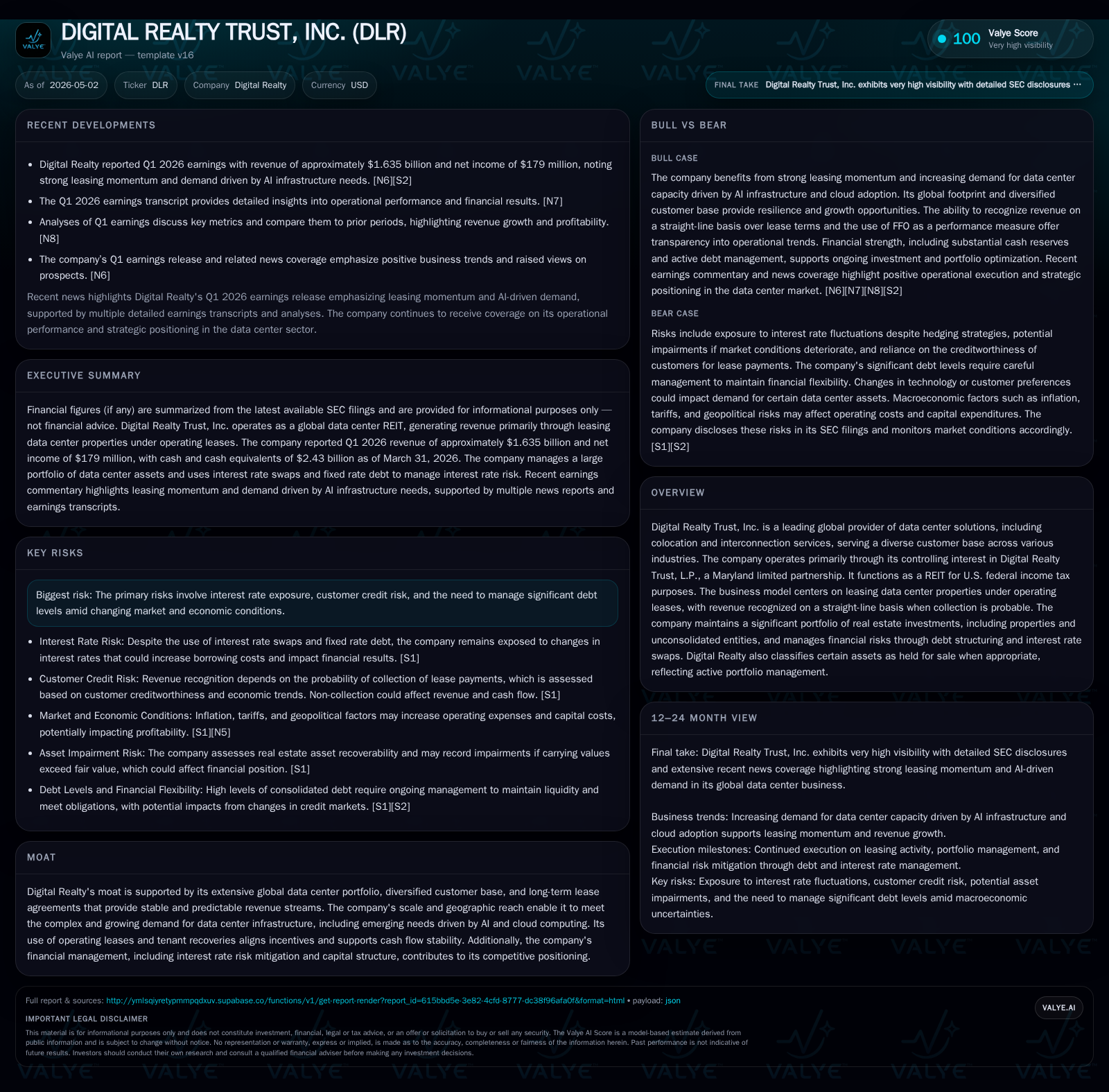
Digital Realty Trust’s Q1 2026 results spotlight robust leasing growth fueled by rapid AI-driven data center capacity demand, surpassing prior expectations and prompting raised guidance. The company’s core business of leasing large-scale, diversified global data centers under long-term operating leases provides resilient, predictable revenues supported by extensive tenant recoveries. Digital Realty benefits from its scale, global footprint, and strong positioning amid cloud and AI infrastructure expansion. Key risks include interest rate sensitivity and high leverage within a capital-intensive industry. Monitoring lease pipeline conversion and asset deployment in AI hotspots will be critical near-term indicators.
Latest Quarterly Operational Update: Accelerating Leasing and AI Demand
Digital Realty’s Q1 2026 filing (10-Q dated May 1, 2026) underscores a material acceleration in leasing momentum attributable predominantly to intensified demand for data center infrastructure supporting artificial intelligence workloads [S2]. This surge materially outpaced prior expectations communicated in the annual filing earlier this year. The April 23 earnings release further details this uplift with commentary emphasizing robust new lease signings and expansions tied to hyperscale cloud clients investing heavily in AI capabilities [S3][N1].
Revenue continues to be recognized on a straight-line basis over operating leases when collectability is reasonably assured—a core foundation providing stable, predictable income streams despite episodic demand fluctuations typical of the tech sector [S1][S2]. This model smooths revenue recognition over longer lease tenors characteristic of Digital Realty’s portfolio.
Business Model Overview: Leasing Data Centers across a Global Platform
Digital Realty functions primarily through its controlling equity interest in Digital Realty Trust, L.P., a Maryland limited partnership through which it owns and operates a large portfolio of highly specialized data centers worldwide [S1]. These facilities provide colocation services—renting physical space to tenants who install their own servers—and offer extensive interconnection options enabling network traffic exchange between cloud providers, enterprises, and carriers.
Revenue mechanics revolve around long-term operating leases; tenants typically sign contracts lasting multiple years that generate rent under fixed or inflation-linked escalators. Tenant recoveries—where customers reimburse for property operating expenses—enhance gross margins by offsetting maintenance costs. This ties customer incentives to maintain tenancy while stabilizing cash flows [S1].
Customers span hyperscalers (like Amazon AWS, Google Cloud), enterprise IT departments modernizing infrastructure footprints, social media platforms demanding low latency connectivity, financial institutions needing secure resilient networks, and emerging edge compute applications requiring distributed infrastructure closer to end users. Such mix mitigates demand cyclicality inherent solely to one vertical.
Operating as a REIT confers favorable U.S. federal income tax treatment allowing the company to distribute majority of taxable income as dividends while avoiding double taxation on earnings generated within the partnership structure. This structure supports capital recycling into acquisitions or development without heavy tax drag [S1].
Competitive Positioning within Data Center REIT Industry
Digital Realty competes with other major data center REITs such as Equinix (EQIX) and CyrusOne but distinguishes itself through sheer scale—its portfolio covers key global markets across North America, Europe, Asia Pacific—and breadth of service offering including colocation combined with robust interconnection ecosystems [S1][N3].
This scale affords negotiating power on land acquisition and construction costs amid supply chain challenges affecting new builds globally. It also enables customer retention via multi-region occupancy strategies critical for multinational corporations managing global workloads. Its geographic diversification tempers local economic or regulation shocks prevalent in single-market players.
Fierce competition exists given the booming cloud/AI infrastructure demand driving pricing improvements; however Digital Realty’s integrated lease-management approach—including tenant incentive structures aligning interests—and investment in capacity expansions at AI hotspot locations reinforce its moat.
Growth Drivers: AI, Cloud Adoption, Long-Term Lease Structure
The dominant growth vector remains structural adoption of AI requiring vast compute power hosted in specialized data centers delivering stringent performance and power density standards familiar only to top-tier providers like Digital Realty [N1][S3]. This drives significant incremental leasing velocity primarily from hyperscale cloud providers upgrading capacities.
Additional drivers include multi-cloud strategy proliferation among enterprises increasing interconnection services usage; the rise of edge computing nodes closer to end-users particularly relevant for latency-sensitive AI algorithms; plus sustained secular shifts towards outsourcing IT infrastructure from owned facilities to trusted data center operators.
The long-term nature of leases (often exceeding five years) entrenches revenue visibility and reduces renewal risk even as market pricing strengthens. Tenant recoveries continue expanding as operational cost pass-through mechanisms effectively enhance margin profiles.
Risk Factors and Constraints Affecting Growth Trajectory
The industry’s capital intensity manifests in a reliance on substantial debt financing—Digital Realty reported approximately $17.5 billion in total debt at end-2023 with net debt around $15.1 billion after cash offsets [F1]. While recent liquidity remains strong with ~$2.4 billion cash equivalents at March-end 2026 [F1], exposure to rising interest rates poses refinancing cost risks impacting net spreads given floating-rate components.
Concentration risk arises as sizeable revenues come from hyperscalers; any shift in their capital spending or credit profile could disrupt collections. The company's impairment policies require monitoring especially if valuation declines occur due to technological changes or oversupply affecting future cash flows [S1][S2].
Supply side overbuilding could temper pricing power if not balanced carefully though current capacity shortages related to AI accelerate demand beyond short-term availability.
Upcoming Catalysts and Execution Milestones to Monitor
Investor focus should track ongoing lease-up rates at newly developed or expanded facilities targeting AI workloads potentially conveyed via quarterly supplemental presentations [S3][N1]. Progress on capital recycling through selective dispositions paired with tactical acquisitions will indicate portfolio optimization efficacy.
Execution against ATM (at-the-market) equity issuance programs approved recently enhances financial flexibility supporting opportunistic growth or accelerated deleveraging strategies [S7]. Updates to guidance incorporating Q2 pipeline conversion provide leading market indications.
Monitoring regulatory developments around energy use and sustainability linked financing features embedded within credit agreements could affect cost curves or access to preferred capital forms.
Contemporary Financial Snapshot and Capital Structure Insight
As of quarter-end March 31, 2026, Digital Realty held $2.43 billion in cash equivalents providing ample liquidity against near-term obligations [F1][S2]. Although latest total debt reported was as of December 31, 2023 at $17.54 billion with net debt approximately $15.11 billion after factoring cash balances [F1], stable credit ratings have enabled diverse borrowing through unsecured senior notes complemented by revolving credit lines subject to covenant maintenance requirements detailed in recent filings [S11–S15].
Interest rate swaps employed mitigate variability from floating-rate debt tranches helping stabilize interest expense amidst tightening monetary policies [S12]. Capital allocation continues balancing share repurchases alongside dividends optimized within REIT payout mandates reflecting cautious stewardship amid evolving macroeconomic conditions.
This analysis synthesizes information solely from permitted SEC filings dated through May 2026 alongside relevant contemporaneous news reports without speculative forecasts or conjectures beyond disclosed facts. It aims to present an informed understanding of Digital Realty Trust's operating environment and strategic positioning relevant for industry professionals assessing sector dynamics.
Disclaimer: This is research-only, informational analysis and not investment advice. It may include AI-generated interpretation and general industry context. Always verify important details using primary sources.

Comments