
IRadimed Expands MRI-Compatible Device Adoption With MRidium 3870 Launch and Robust Q1 2026 Sales
IRadimed's latest quarter marks continued growth driven by MRI-safe infusion technologies amid a niche yet crucial acute care market segment.
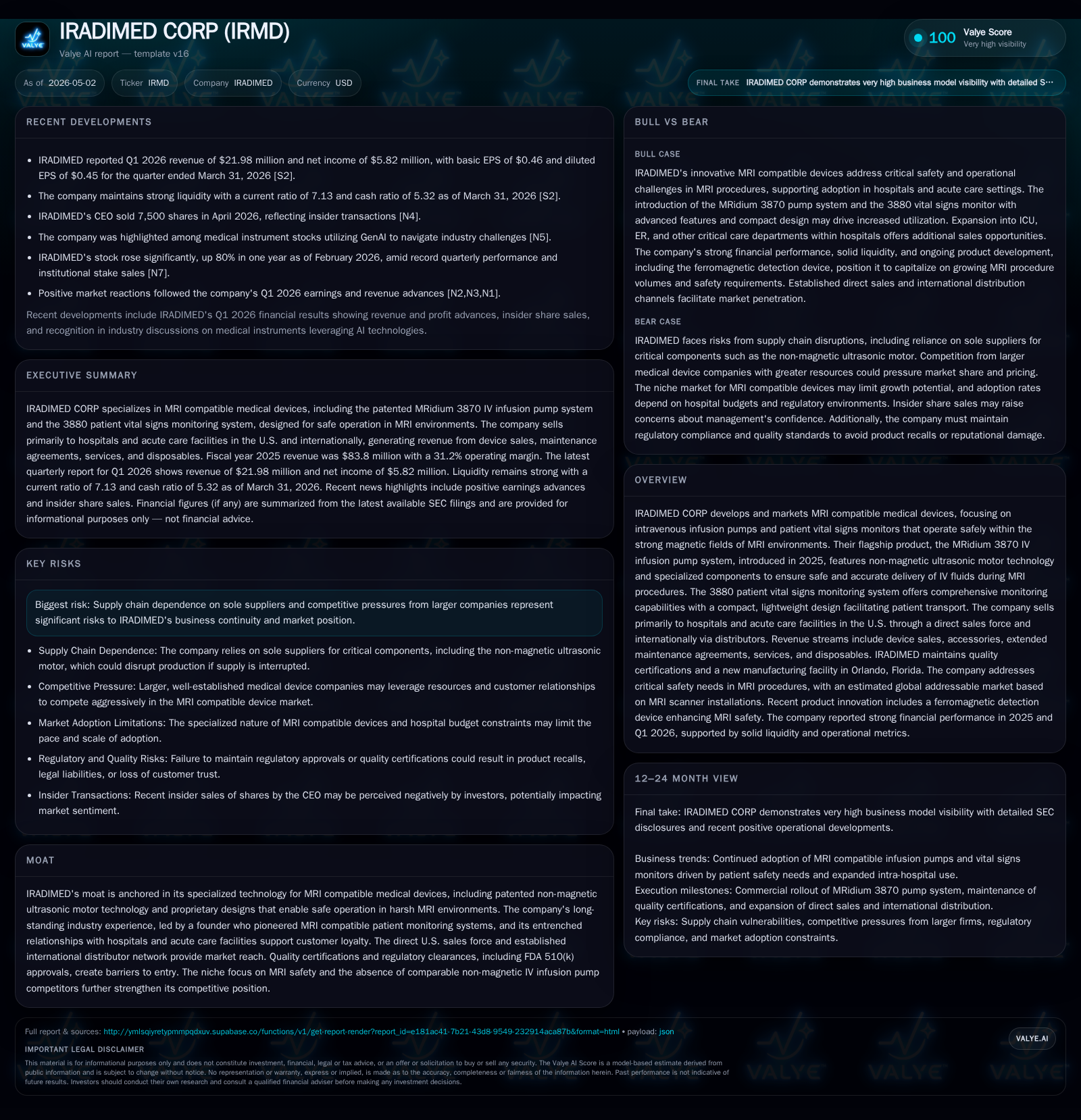
IRadimed Corp (IRMD), a leader in MRI-compatible medical devices, reported solid operational progress and financial results in its Q1 2026 filing. The company’s flagship MRidium 3870 IV infusion pump, launched in 2025 featuring proprietary non-magnetic ultrasonic motor technology, drives deeper hospital adoption with its ability to safely administer IV fluids during MRI procedures. IRadimed’s business model centers on specialized device sales complemented by consumables and maintenance services, supported by direct U.S. sales and global distributors. The company benefits from high regulatory barriers and limited competition in its niche but faces supply chain concentration risks. Growth hinges on expanding installed base penetration and international market development, while watchpoints include component sourcing and regulatory environment shifts.
Recent Operating Update: Q1 2026 Financial Results Anchor Continued Expansion
In its latest 10-Q filing dated May 1, 2026 [S2], IRadimed Corporation disclosed a strong start to fiscal year 2026 driven by ongoing demand for its leading MRI-compatible intravenous infusion systems. Supported by a complementary press release filed concurrently via Form 8-K [S3], the company reported revenue acceleration attributable to the adoption of the MRidium 3870 IV infusion pump system introduced in 2025. This new flagship product's differentiated technology contributed materially to near-term growth momentum amid a modestly growing but highly specialized market niche.
Market reception has reinforced compounded revenue contributions from device sales and associated consumables such as proprietary disposable tubing sets. The integration of the optional MRidium 3875 Remote Display Unit enhances clinical usability by allowing nurses and technicians to monitor infusion parameters remotely from the MRI control room. This feature addresses a critical workflow gap previously limiting broader clinical uptake of MRI-safe IV pump systems.
Complementary patient vital signs monitoring offerings under the IRadimed brand also maintained steady deployment levels, sustaining cross-selling efficiencies from the company’s direct salesforce within U.S. hospitals and acute care facilities supported by established international distributor partnerships [S1][S19]. Management emphasized stable risk profiles consistent with previous quarters without new material changes in risk factors [S2].
Business Model: Specialized MRI-Compatible Device Ecosystem
IRadimed's revenue model revolves around marketing and selling highly specialized medical devices — primarily MRI-compatible intravenous infusion pumps and patient vital signs monitors tailored for use inside the challenging magnetic resonance imaging environment. Standard IV pumps typically contain ferromagnetic components susceptible to hazardous magnetic attraction or electromagnetic interference during MRI scans; IRadimed’s patented designs circumvent these issues through non-ferrous materials combined with an ultrasonic motor engineered for safe operation under magnetic fields up to 15,000 gauss [S1].
Customers—largely hospitals and acute care units—procure complete systems including the base pump unit, dedicated non-magnetic mounting poles, disposable IV tubing sets (a recurring revenue component), and remote display modules enhancing clinical workflow safety.
Revenue drivers include:
- Device Sales: Base cost of infusion pump systems such as the MRidium 3870 serving initial installation needs.
- Consumables/Disposables: Proprietary tubing sets required for each patient procedure replenish recurring demand.
- Maintenance & Services: Extended warranty packages and technical support agreements contribute to predictable service revenues.
The company's go-to-market strategy combines an experienced direct U.S. sales force focusing on building long-term hospital relationships alongside contracts with group purchasing organizations (GPOs) that negotiate bundled pricing across healthcare networks. International sales deploy via distribution agreements that account for regulatory variances across approximately 80 countries including major markets governed by Health Canada, European regulatory agencies, UK MHRA, and Australian TGA oversight [S20][S21].
Industry Structure and Competitive Position
The market for MRI-compatible medical devices is highly specialized due to intrinsic technological barriers created by MRI physics—predominantly the powerful magnetic fields requiring stringent safety standards absent in conventional infusion technology. IRadimed occupies a near-monopoly position as the sole known provider of non-magnetic intravenous infusion pumps designed specifically for safe operation during MRI—a substantial moat protected by strong IP rights encompassing non-magnetic ultrasonic motor technology as well as proprietary part designs [S1].
FDA clearance through rigorous premarket approval pathways (including extensive human factors data per FDA guidance publications) raises entry costs substantially for potential competitors [S7]. The company's quality certifications further buttress product credibility essential for hospital adoption.
Competitive threats arise principally from larger diversified medical device companies potentially entering the niche or from alternate technologies aiming at MRI-safe fluid delivery; however, IRadimed’s entrenched relationships with key accounts supported by clinical application specialists provide significant switching costs given patient safety imperatives.
Geographically concentrated operations at a single Orlando manufacturing facility optimize production control but create supply chain vulnerability especially given some sole-source component dependencies flagged as risks [S25].
Growth Drivers
Product Innovation & Installed Base Expansion: Since launching the MRidium 3870 in late 2025, increasing penetration across U.S. hospitals focusing on advanced acute care settings presents clear volume upside as facilities replace legacy equipment or adopt new protocols requiring continuous IV therapy during MRI diagnostics or sedation.
International Market Opportunities: Though strongest domestically presently, growth opportunities exist in wider geographic expansion leveraging distributor networks amidst rising global demand for sophisticated imaging support equipment facilitated by broadened access to diagnostic technologies outside the U.S.
Recurring Revenue From Consumables & Services: Proprietary disposable IV tubing sets secure repeat purchase patterns tied tightly to device usage volumes. Extended warranties increase customer stickiness while servicing generates additional margin layers over time.
Regulatory Environment Evolution: More stringent infusion pump safety frameworks globally can catalyze upgrades or replacements favoring IRadimed’s FDA-cleared solutions adhering to newest standards—a structural revenue tailwind if capitalized efficiently.
Customer Relationships & Salesforce Effectiveness: Direct engagement with hospital clinicians supported by field application specialists improves product uptake rates relative to less specialized vendors competing broadly across many medtech categories [S19]. Negotiated GPO contracts offer scale advantages despite associated fees reducing margins slightly.
Risks and Watchpoints
Supply Chain Concentration: Dependency on sole-sourced key components essential for the non-magnetic motor assembly creates risk of interruptions impacting production schedules—a salient concern given global component procurement challenges amplified recently within medical device sectors [S21].
Regulatory Compliance Complexity: Increasingly burdensome FDA requirements for infusion pumps including demands for clinical validation data could delay future product launches or require costly redesigns impacting R&D resource allocation [S7][S15]. Product recalls or adverse events pose reputational risks affecting client trust.
Competitive Pressure From Larger Medtech Firms: While IRadimed currently enjoys moat protection, emerging initiatives by better-capitalized firms targeting compatible technology bundles could compress pricing power or erode market share gradually.
Market Concentration Dependence: A small number of large hospital accounts represent significant portions of sales; loss or slow renewal cycles among these clients may disproportionately impact revenues given long selling cycles averaging three to six months [S19].
Trading Volatility: Stock price subject to fluctuations reflecting news flow around operational results, patent disputes or macro healthcare sector sentiments may impact cost-effective capital raising flexibility in future periods [S9].
What to Watch Next
- Q2 and Beyond Financial Updates: Monitoring continued stability or acceleration in MRidium 3870 order pipeline will gauge market acceptance trajectory.
- Regulatory Filings & Approvals: Any new clearances especially internationally would unlock incremental markets.
- Supply Chain Developments: Disclosures relating to sourcing robustness or diversification efforts of critical parts are key operational risk indicators.
- Competitive Landscape Moves: Announcements by major medtech players moving toward MRI-compatible solutions warrant scrutiny.
- GPO Contract Renewals / Expansions: Changes affecting pricing or distribution reach could materially alter demand forecasts.
- R&D Pipeline Activity: Visibility on product roadmap enhancements beyond infusion pumps including expanded monitoring capabilities could set stage for mid-term growth leap.
- Dividend Policy Decisions & Capital Allocation Strategy: Given recent quarterly dividend increase, board statements about sustaining payouts versus reinvesting in innovation merit attention.
Financial Profile Snapshot (Q1/FY end March/December)
Latest financial snapshot
| Metric | Value | Period |
|---|---|---|
| Cash & equivalents | $56mm | |
| 2026-03-31 | ||
| Current assets | $86mm | |
| 2026-03-31 | ||
| Current liabilities | $12mm | |
| 2026-03-31 | ||
| Current ratio | 7.13x | |
| 2026-03-31 |
Source: SEC companyfacts cache [F1].
Sources reflect high liquidity levels supporting ongoing operations without reliance on debt financing given no recent indications of leverage changes reported [F1][S2]. Operating margins appear robust aligning with technologically defensible premium positioning in acute care imaging accessories categories.
This analysis is based on available filings as of early May 2026 and relevant news disclosures pertaining to IRadimed Corporation (IRMD). It aims solely to provide an informed business perspective without offering investment advice or recommendations.
Disclaimer: This is research-only, informational analysis and not investment advice. It may include AI-generated interpretation and general industry context. Always verify important details using primary sources.

Comments