
TTM Technologies Bolsters Quick-Turn PCB Capabilities to Sustain Growth Momentum
TTM Technologies’ Q1 2026 results reflect operational improvements amid strategic technological investments in a highly competitive printed circuit board industry.
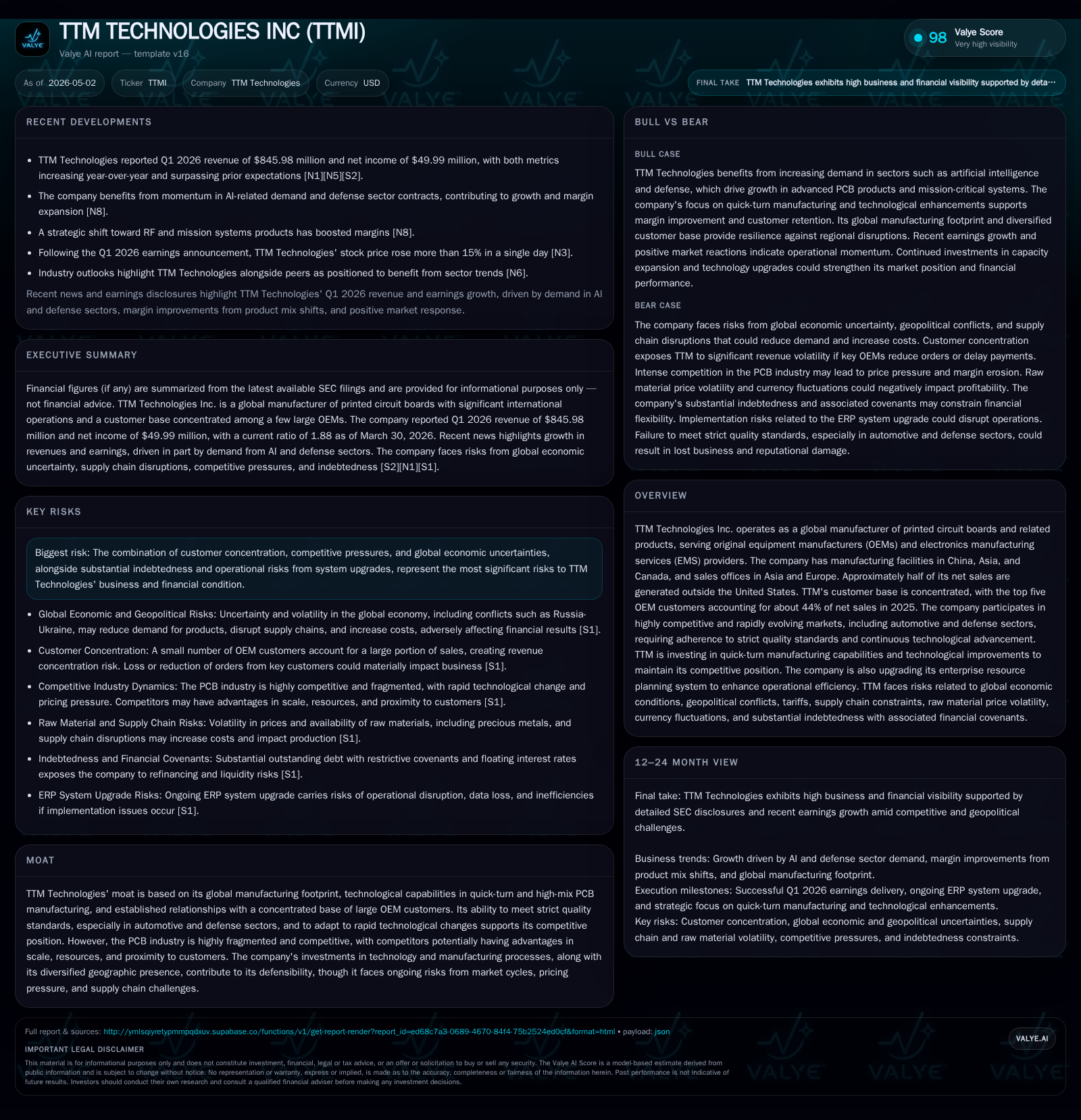
In its latest quarterly filing dated May 1, 2026, TTM Technologies demonstrated revenue and earnings gains driven by enhanced quick-turn manufacturing capabilities. The company continues to leverage its global footprint and focused OEM customer relationships to navigate competitive pressures. Strategic investments targeting AI, automotive, and defense sectors position TTMI for sustainable growth despite risks from customer concentration and supply chain volatility. Liquidity remains adequate with a current ratio of 1.88, though leverage requires careful management given ongoing capital expenditure plans. Key near-term indicators include backlog trends and technology integration progress.
Latest Quarterly Operating Results Propel Confidence
TTM Technologies reported first-quarter fiscal year 2026 results in its May 1, 2026 Form 10-Q filing showing solid financial performance marked by revenue and earnings beats relative to estimates [S2], [S3], [N1]. While exact revenue for the quarter is not specified in the latest release, year-end figures suggest continued top-line strength supported by growing demand for quick-turn printed circuit boards (PCBs) particularly from automotive, defense, and AI sectors.
Management commentary from the April 29 earnings call emphasized progress in operational efficiencies and technological upgrades that underpin improved gross margins and order fulfillment speeds [N2]. Updated guidance for Q2 indicated optimism around sustained demand but tempered expectations to account for ongoing supply chain uncertainties.
This quarterly update signals effective execution on TTMI’s strategy of leveraging its global capacity and customer relationships amid a challenging macroeconomic backdrop. The company's ability to maintain quality standards demanded by large OEM customers during volatile conditions affirms operational resilience.
Business Model: High-Mix Quick-Turn PCB Manufacturing
TTM Technologies operates as a global manufacturer specialized in complex printed circuit boards and related products tailored primarily for original equipment manufacturers (OEMs) and electronics manufacturing services (EMS) providers [S1],. The core value proposition lies in its ability to deliver high-mix, short lead-time PCBs meeting strict quality requirements essential for safety-critical applications such as automotive electronics and defense systems.
Revenues are driven by contracted volumes from these OEMs who outsource PCB production reflecting their broader electronic assembly strategies. Pricing depends on product complexity, turnaround requirements, volume commitments, and geographic sourcing decisions. Half of TTMI’s sales originate outside the U.S., reflecting both production facilities spread across China, Asia at large, Canada, and sales offices in Asia and Europe—providing scale benefits but also exposure to global trade dynamics.
The company’s significant focus on quick-turn manufacturing enables it to capture orders needing rapid prototyping or small-batch runs that larger low-cost competitors may not serve efficiently. This approach creates switching costs linked to technical expertise and certifications required by clients operating in regulated environments.
Customer concentration is significant; the top five OEMs accounted for approximately 44% of net sales in 2025 with two customers alone comprising 23% of sales [S10], [S11]. This underscores dependence on maintaining deep OEM relationships but also concentrates exposure to their capital spending fluctuations.
Competitive Landscape: Navigating Fragmented Global Markets
The PCB industry remains fragmented globally with intense competition ranging from large multinational incumbents offering scale advantages to regional players leveraging cost efficiencies. Markets served by TTMI see rapid product innovation cycles demanding continuous technology adoption.
TTM’s moat rests largely on its operational flexibility—particularly quick-turn production—and adherence to rigorous quality standards demanded by automotive and defense sectors that function as barriers to entry for less sophisticated suppliers. Production footprint diversification helps mitigate geopolitical risks but introduces complexity.
However, pricing pressure is persistent due to EMS providers’ increasing purchasing power who also represent roughly 30% of TTMI’s sales—creating a dual dynamic where EMS firms source globally yet have potential vertical integration capabilities threatening supplier volume stability [S11],. Larger competitors may exert cost advantages through scale or closer proximity to OEM R&D hubs.
Operational excellence in supply chain management plus innovation roadmap adherence remains key for TTMI’s market position preservation amid these structural industry forces.
Growth Drivers: Technology Upgrades and AI-Demand Tailwinds
Key growth drivers emerging are anchored in TTMI’s strategic investments to expand quick-turn capabilities critical for emerging end-markets such as AI hardware platforms where rapid iteration speed is essential [S2], [N6]. Defense sector momentum continues via heightened procurement cycles requiring secure high-spec PCBs.
Management highlighted plans to ramp capacity selectively while upgrading enterprise resource planning (ERP) systems aiming at better operational transparency and efficiency gains—a pivotal enabler for scaling without proportional cost increments [S25].
Backlog trends reportedly show improved visibility into OEM demand pipelines which could translate into incremental volume gains if sustained utilization surpasses mid-80%s range frequently cited in industry discussions of this segment’s capacity constraints.
Geographically diversified production capability also allows TTMI to capture evolving regional semiconductor ecosystems particularly within Asia-Pacific where consumer electronics growth persists alongside automotive electrification expansions.
Risk Factors and Operational Constraints
Several risk vectors warrant close monitoring. Customer concentration exposes revenues significantly to fluctuations in orders from few large OEMs; economic downturns or supply chain interruptions affecting these customers could lead to material adverse effects on sales and cash flow predictability [S1], [S10].
Global economic uncertainties—including inflationary impacts, interest rate volatility, geopolitical tensions especially affecting China operations—add complexity to raw material sourcing and logistics reliability potentially disrupting timely fulfillment schedules [S1],.
TTM is currently navigating an ERP system upgrade that bears execution risk from possible operational disruptions impairing order processing or data accuracy; prior disclosure acknowledges this could materially affect business continuity if not flawlessly implemented [S25].
Debt load stands elevated with total indebtedness approximating $923 million against cash reserves near $410 million resulting in net debt around $513 million nearing quarter-end March 2026; while liquidity appears sufficient with a current ratio around 1.88, leverage constrains financial flexibility especially as capital expenditure requirements increase for modernization efforts moving forward 9[S4],[F1]9.
Interest rate exposure mitigated partly via swaps still leaves some variability in debt service costs given floating rate borrowings embedded within term loan facilities.
What Investors Should Monitor Next
Given the current operating momentum balanced against system upgrade risks and external uncertainties, monitoring forthcoming quarterly guidance will be instructive—particularly updates regarding order book health, margin trajectory improvements linked to technology adoption, and capacity utilization metrics disclosed during earnings calls or investor events 9[S2],[N2]9.
Progress on ERP implementation milestones should be tracked given the criticality of this infrastructure investment for scaled operations with minimal disruption.
Supply chain resilience actions including alternative sourcing strategies amid geopolitical tensions represent another focal area given their direct impact on order fulfillment reliability.
Finally, indications of new client additions within high-growth AI or defense verticals alongside expansion or reallocation plans for manufacturing capacity would signal successful capture of evolving demand pockets 9[N6]9.
Latest Financial Snapshot
Latest financial snapshot
| Metric | Value | Period |
|---|---|---|
| Cash & equivalents | $410mm | |
| 2026-03-30 | ||
| Total debt | $923mm | |
| 2026-03-30 | ||
| Net debt | $513mm | |
| 2026-03-30 | ||
| Current assets | $1914mm | |
| 2026-03-30 | ||
| Current liabilities | $1015mm | |
| 2026-03-30 | ||
| Current ratio | 1.88x | |
| 2026-03-30 |
Source: SEC companyfacts cache [F1].
| Metric | Value (USD) | Period End |
|---|---|---|
| Cash & Equivalents | $410.0 million | |
| 2026-03-30 | ||
| Total Debt | $923.2 million | |
| 2026-03-30 | ||
| Net Debt | $513.2 million | |
| 2026-03-30 | ||
| Current Assets | $1.91 billion | |
| 2026-03-30 | ||
| Current Liabilities | $1.02 billion | |
| 2026-03-30 | ||
| Current Ratio | 1.88 | |
| 2026-03-30 |
This snapshot underscores adequate near-term liquidity supporting ongoing operations while highlighting leverage levels necessitating vigilant cash flow management amidst capex growth initiatives.
This analysis is based solely on publicly available filings and disclosures through May 2026 without providing any investment advice or price forecasts.
Disclaimer: This is research-only, informational analysis and not investment advice. It may include AI-generated interpretation and general industry context. Always verify important details using primary sources.

Comments