
RingCentral Advances Unified Communications with AI-Driven Platform Innovations
RingCentral’s latest filings highlight strategic AI enhancements and the evolving role of channel partnerships amid persistent debt leverage challenges.
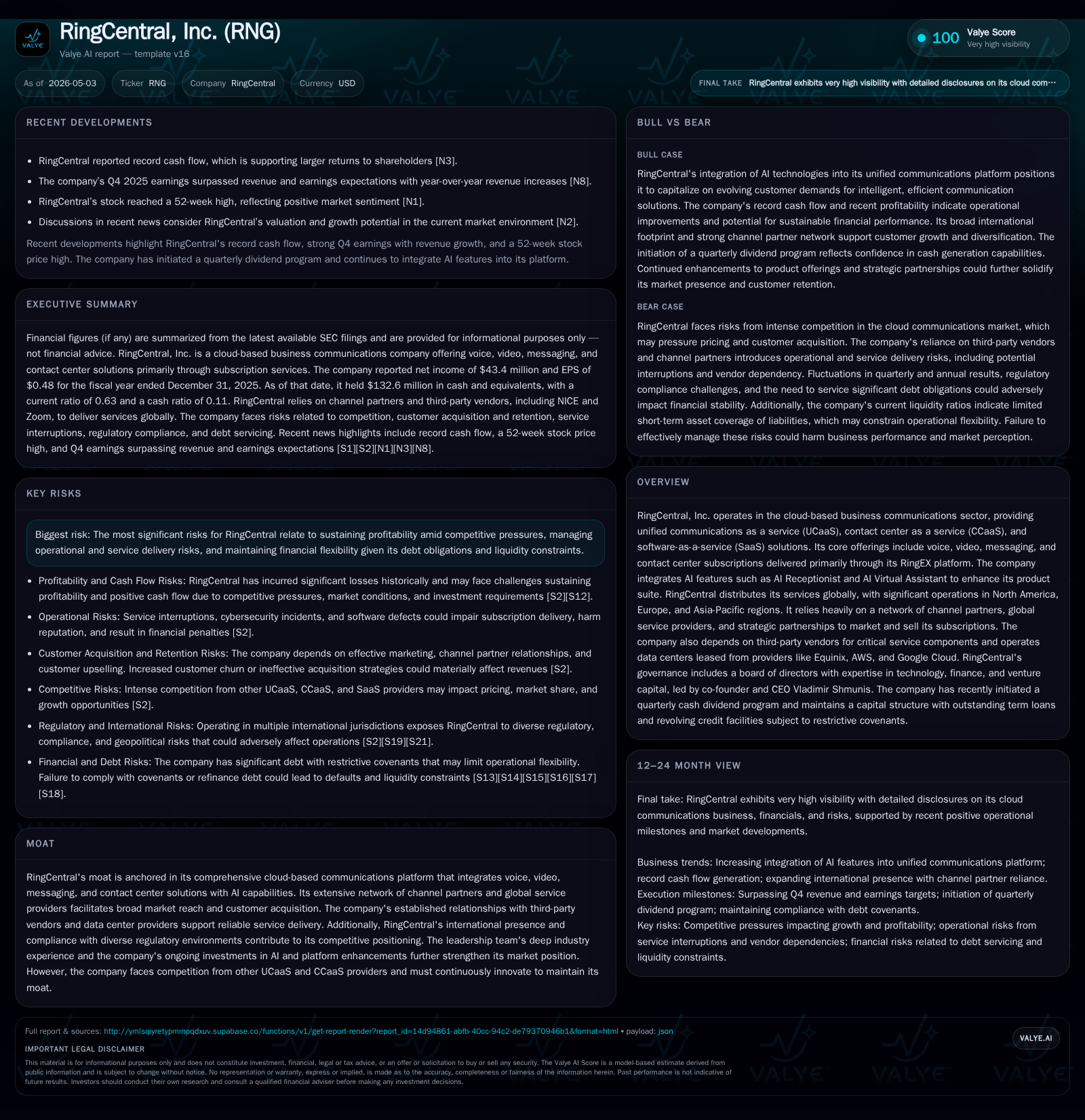
In its latest quarterly and event filings, RingCentral demonstrates material progress in integrating AI capabilities within its RingEX platform, reinforcing its UCaaS and CCaaS offerings. This innovation complements its extensive global partner network to fuel expansion, especially internationally. However, the company continues to navigate significant financial leverage with tight covenant constraints, underlining a persistent risk to operational flexibility. Sustained growth will depend on effective execution of AI-driven product upgrades and managing capital structure risks amid intense sector competition.
Latest Operational Developments and Strategic Updates
RingCentral's Q3 2025 10-Q [S2] surfaces tangible progress on its AI-driven platform enhancements anchored by the RingEX environment. Specifically, the company expanded features of its AI Receptionist and AI Virtual Assistant capabilities that automate call handling, routing, scheduling, and agent support functions. This reflects a strategic pivot to embed artificial intelligence deeply into core UCaaS/CCaaS offerings for differentiation in an increasingly commoditized space. The recent February 2026 8-K [S3] further underscores management’s confidence by announcing initiation of a quarterly cash dividend program payable from March 2026 onward—an indicator of stabilized cash flows despite legacy leverage constraints.
RingCentral’s Business Model and Product Portfolio Quality
RingCentral monetizes predominantly through recurring subscription fees for its unified communications-as-a-service (UCaaS) solutions integrating voice calls, video meetings, team messaging, and contact center functionality (CCaaS). Its flagship RingEX platform aggregates these communication channels into a seamless enterprise-grade SaaS experience enhanced by proprietary AI modules such as AI Receptionist (automated interactive voice response) and Virtual Assistant tools designed to improve user workflow efficiency [S1]. Revenue expansions hinge on two levers: volume growth via new customer acquisition supported by channel partnerships; and average revenue per user (ARPU) growth driven by upselling AI-enhanced features.
The product suite sells primarily through an extensive network of channel partners and global service providers who resell or white-label subscriptions across key geographies including North America, Europe, and Asia-Pacific. The reliance on third-party cloud infrastructure providers—AWS, Google Cloud Platform, Equinix data centers—while affording scalability advantages also imposes operational dependencies impacting uptime SLAs. Switching costs embedded in multi-module subscription bundles coupled with integration depth bolster customer retention but demand continuous innovation given competitive pressures.
Competitive Environment: Industry Dynamics and Positioning
The UCaaS/CCaaS industry landscape where RingCentral operates is fiercely competitive with rivals such as Cisco, Five9 (now part of Zoom), Microsoft Teams (via Office365), Salesforce’s Service Cloud Voice among others [S25]. Many competitors possess longer-established brand equity, deeper R&D budgets, broader service bundles including broadband or CRM platforms that challenge RingCentral’s value proposition. Pricing sensitivity in this sector remains elevated as market entrants deploy aggressive pricing or freemium models to gain share.
RingCentral’s moat resides in its integrated RingEX platform combining UCaaS and CCaaS with embedded AI functionalities alongside an expansive channel ecosystem enabling broad go-to-market reach. However, cost structures are pressured by capex-light but op-ex heavy reliance on third-party cloud vendors which affects gross margins relative to more vertically integrated peers. International regulatory compliance adds operational complexity but also serves as a barrier for less-equipped competitors [S26].
Growth Catalysts: AI Features, Channel Expansion, and Geographic Reach
The company identifies rollout of advanced AI features within its communication platform as a critical growth vector. The AI Receptionist automates front-office interactions reducing manual agent load while Virtual Assistant augments agent productivity—both positively influencing customers’ willingness to pay for premium tiers. Enhanced product stickiness from these innovations drives better retention metrics amid cyclical churn.
Geographically, RingCentral targets accelerated penetration beyond North America leveraging localized product adaptations (language customizations, billing currencies) paired with an extensive global partner network [N4]. Channel partners enable low-cost customer acquisition particularly in regulated international markets where direct sales may prove cost-prohibitive. This international focus requires navigating complex data privacy laws exemplified by evolving EU Data Act mandates effective since September 2025 [S27], demanding continuous contractual adjustments.
Success here will be measurable by subscription bookings growth in Asia-Pacific / EMEA regions alongside sustained upsell rates fueled by expanded AI feature adoption [N6]. These factors combine structural secular tailwinds from ongoing digital transformation trends favoring cloud-based unified communications.
Risks and Constraints: Profitability Pressure and Debt Leverage
Despite operational advances, RingCentral faces notable pressure sustaining profitability partly attributable to ongoing investments in R&D for AI capabilities amid competitive pricing pressures detailed in the Q3 risk disclosures [S2]. Elevated churn risk persists given commoditized nature of basic communication services juxtaposed against newer entrants offering aggressively priced alternatives.
Financially the company manages high leverage levels: as of December 31, 2025, total debt stood at $1.26 billion versus cash & equivalents of $132.6 million yielding net debt roughly $1.13 billion alongside a constrained current ratio of 0.63 [F1]. The amended Credit Agreement entered September 2025 imposes restrictive covenants including caps on additional indebtedness, lien creation, asset disposals, dividend payments etc., limiting capital allocation flexibility amid uncertain macroeconomic conditions [S4][S5][S7].
Capital markets volatility exacerbates refinancing risk considerations for upcoming maturities especially related to the zero-coupon convertible notes due 2026 that require careful cash flow planning for potential conversion/repurchase events [S8][S9][S13]. Thus financial discipline coupled with consistent EBITDA generation is critical to avoiding costly restructuring or dilutive equity issuance.
Key Upcoming Milestones and Indicators to Watch
Investors should monitor near-term progress against planned phases for rolling out enhanced AI capabilities centered on improving automation ratios within existing customer bases per management commentary [S3]. Channel partner expansion metrics—particularly successful onboarding and initial subscription bookings from new territory partners—serve as leading indicators for international revenue uplift potential.
Subscription booking trends quarter-over-quarter coupled with sequential churn rate improvements will reveal the effectiveness of product upgrades in combating attrition amidst heightened competition. Liquidity position updates ahead of convertible note maturities alongside covenant compliance disclosures will provide crucial signals regarding balance sheet health [N6][S3]. Market response over subsequent quarters will clarify if declared dividend programs become sustainable or require recalibration based on cash generation.[N1]
Financial Overview: Liquidity, Debt Profile, and Profitability Snapshot
Latest financial snapshot
| Metric | Value | Period |
|---|---|---|
| Cash & equivalents | $133mm | |
| 2025-12-31 | ||
| Total debt | $1261mm | |
| 2025-12-31 | ||
| Net debt | $1129mm | |
| 2025-12-31 | ||
| Current assets | $765mm | |
| 2025-12-31 | ||
| Current liabilities | $1219mm | |
| 2025-12-31 | ||
| Current ratio | 0.63x | |
| 2025-12-31 |
Source: SEC companyfacts cache [F1].
At fiscal year-end 2025 RingCentral reported operating income of $120.6 million with net income $43.4 million evidencing profitability on a GAAP basis consistent with recent quarters indicating improving operating leverage [F1].[S3] Cash & equivalents totaled $132.6 million against total debt obligations near $1.26 billion leaving net debt approximately $1.13 billion. The current assets at year end were $765.2 million versus current liabilities of $1.22 billion resulting in a current ratio of about 0.63 denoting tight short-term liquidity positioning [F1].
The Company successfully amended its credit facility in late 2025 granting some temporary relief but maintaining strict covenants that limit incremental capital deployment options including acquisitions or increased distributions to shareholders [S4][S5][S7]. Despite these constraints management expressed confidence reflected by initiating quarterly dividends starting March 2026 signaling belief in free cash flow sustainability through disciplined growth investments plus prudent cost control measures.[S3]
Overall financial health remains highly sensitive to macroeconomic fluctuations impacting subscription demand trends as well as interest rate environments affecting refinancing costs.
Disclaimer: This analysis is based solely on publicly available SEC filings ([S1]-[S27]) and company facts cache ([F1]) as of May 3rd, 2026 without any forward-looking investment advice or proprietary inside information.
Disclaimer: This is research-only, informational analysis and not investment advice. It may include AI-generated interpretation and general industry context. Always verify important details using primary sources.

Comments