
International Money Express Sets Path Toward Strategic Consolidation
Intermex’s latest filings confirm operational stability and outline merger-driven strategic shifts reshaping its omnichannel remittance business.
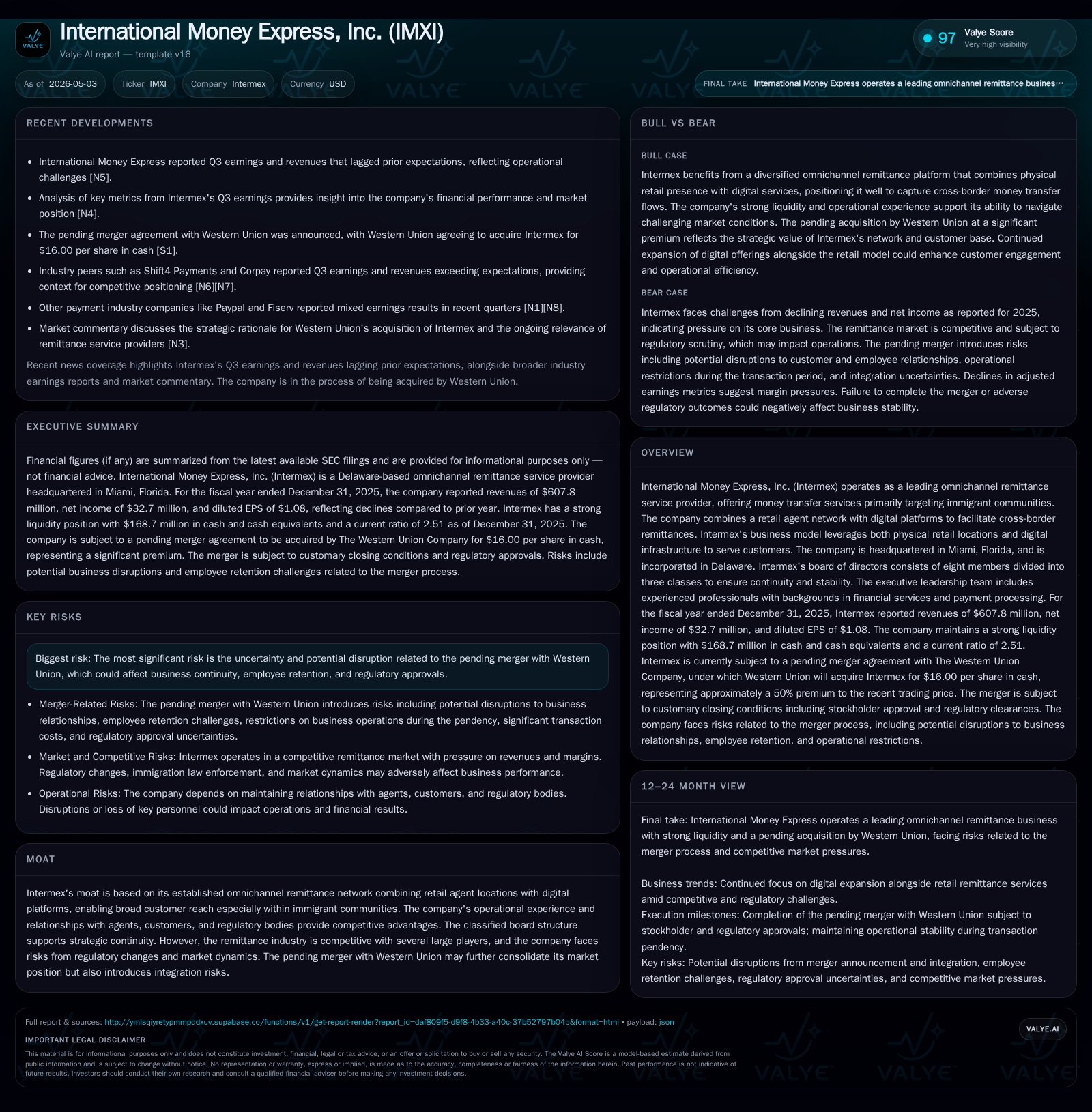
International Money Express, Inc. (Intermex) reported steady third-quarter operations in late 2025, underscoring a resilient omnichannel money transfer platform focused on immigrant communities. The company’s pending merger with Western Union, expected to close by mid-2026 pending regulatory approvals, stands as the defining catalyst, promising scale benefits and expanded digital reach but accompanied by typical integration and regulatory risks. Intermex’s business model, based on combining retail agent networks with digital infrastructure, offers competitive advantages in customer access and regulatory navigation within a fragmented remittance landscape. Monitoring transaction milestones and integration execution will be critical to assessing post-merger value creation.
Quarterly Performance and Operational Developments
In its latest quarterly filing dated November 10, 2025, International Money Express (Intermex) reported that there have been no material changes to its principal risk profile compared to prior disclosures. The report highlights continued stable operational execution despite the ongoing complexities of the pending merger with Western Union. There were no flagged disruptions or negative impacts on the core remittance business during Q3 2025, illustrating resilience in Intermex’s omnichannel platform even as management attention is increasingly focused on merger-related activities [S2].
Business Model: Leveraging Omnichannel Remittances
Intermex's core offering centers on cross-border money transfers primarily serving immigrant communities—a customer base that relies heavily on accessible and affordable remittance services. Its business model blends a broad physical retail agent network with an expanding digital infrastructure. This dual-channel strategy enables Intermex to capture customers preferring traditional cash payout methods while simultaneously appealing to digitally savvy users.
Revenue primarily stems from fees charged per transaction, driven by volume of transfers negotiated through agents or digital platforms. Margins depend on transaction pricing power balanced against competitive market conditions and compliance costs. Intermex leverages deep relationships with local agents across sending corridors, strengthening customer reach through trusted in-person service points—a crucial moat given culturally specific preferences in remittance behavior.
Simultaneously, Intermex invests in digital offerings aiming to grow wallet share among underbanked populations who seek convenient mobile or online transfers without requiring physical visits. Regulatory expertise plays a pivotal role here; navigating complex licensing regimes across multiple jurisdictions enables Intermex to maintain compliant operations while scaling digital market penetration effectively [S1].
Industry Structure and Competitive Dynamics
The cross-border remittance industry remains highly fragmented globally but features several dominant players such as Western Union, MoneyGram, and newer fintech entrants pushing digital alternatives. Pricing pressure is persistent due to competition and regulatory mandates driving transparency and fee reductions.
Intermex’s competitive advantage lies in its established omnichannel network—its agent footprint offers localized convenience surpassing app-only competitors who face challenges building trust among immigrant clientele. This hybrid model helps mitigate switching risk as customers often prefer multiple payment options.
However, market consolidation is accelerating—evidenced by Western Union’s acquisition of Intermex—which signals strategic attempts to combine scale benefits with digital innovation capabilities. Such moves intensify rivalry but also create potential for efficiencies through integration of complementary assets [S1].
Growth Drivers: Merger Synergies and Digital Adoption
The August 2025 announced merger agreement positions Intermex inside Western Union’s global infrastructure ecosystem. Expected to close mid-2026 following satisfactory regulatory review, this deal aims to unlock revenue synergies through cross-selling across overlapping customer bases and expand digital offerings faster leveraging Western Union's broader tech stack.
Further growth depends on successful migration of customers onto enhanced platforms while maintaining low churn in existing retail channels. Digital adoption rates are a critical medium-term lever; increasing app usage among first-time immigrants or younger demographics expands total addressable market beyond traditional corridor limitations.
Economies of scale should reduce compliance costs per transaction amidst increasing regulatory complexity. Additionally, product innovation potential arises from integrating payment rails for wallet funding or payout alternatives such as mobile wallets or bank deposits enhancing ease-of-use for recipients in emerging markets.
Regulatory approvals remain substantive gating factors for closing and realizing these synergies but early antitrust hurdles have been cleared with HSR expiration in October 2025 [S9].
Risks and Constraints: Regulatory and Integration Challenges
The foremost risk centers around the pending merger itself—regulatory delays or disapproval could adversely affect strategic plans. Even if completed, integration introduces execution risk including possible management distraction away from current operations which could erode service quality or market momentum.
Employee retention is another concern; key personnel may leave amid uncertainty impacting continuity especially in compliance or agent relationship roles that require specialized expertise. Customer attrition remains plausible if service disruption occurs during IT or operational system consolidations.
Moreover, shifts in immigration policy may influence remittance volumes structurally given that Intermex’s client base largely consists of migrant workers sending funds home. Compliance burdens are intensifying worldwide over anti-money laundering controls adding cost layers potentially squeezing margins.
Competition continues evolving as fintech startups innovate lower-cost models challenging incumbents’ pricing power while customers increasingly demand frictionless experiences that require continuous investment.
Monitoring Points: Transaction Milestones and Market Signals
Key upcoming milestones include final regulatory approvals from jurisdictions beyond HSR clearance needed for early-to-mid-2026 closure date confirmation. The proxy statement filings already show strong shareholder support.[S19]
Post-deal integration progress will be pivotal—metrics tracking customer retention rates across combined platforms, active users on digital channels versus legacy systems migrations, cost-saving realization timelines compared to original synergy targets will provide actionable insights.
Management’s success in retaining critical talent through retention programs tied to merger outcomes will also be an important gauge for operational continuity.
Watching competitive responses from other large remittance players and fintech disruptors will shed light on pricing dynamics post-merger.
Financial Overview: Historical Performance and Capital Allocation
Historical performance (annual)
Capital returns and efficiency (annual)
Intermex generated revenues of $607.8 million for fiscal 2025, representing approximately 11% year-over-year growth reflecting solid transaction volume pickup.[F1] Nonetheless, operating income declined by over 41% year-over-year to $55.7 million indicating margin compression attributable partly to elevated expenses related to the merger process.[F1]
Net income similarly decreased by nearly 44% year-over-year to $32.7 million.[F1] Operating cash flow moderated to $36.9 million while capital expenditures were reduced modestly to $21.1 million,[F1] underscoring prudent capex management during this transition period.
Balance sheet strength remains evident with cash & equivalents of $168.7 million against total debt near $156.6 million as of end-2024,[F1] positioning Intermex with a net cash stance that supports financing flexibility throughout merger completion phases.
[F1], [S1]
This analysis is based on publicly available SEC filings as of early May 2026 and does not include any forward-looking investment advice or price targets regarding International Money Express, Inc., but aims solely at providing an informed overview grounded in disclosed evidence.
Disclaimer: This is research-only, informational analysis and not investment advice. It may include AI-generated interpretation and general industry context. Always verify important details using primary sources.

Comments