
Pediatrix Medical Group Advances Maternal Care Growth With Solid Q1 Execution
Strong Q1 results highlight Pediatrix’s momentum in specialty maternal care and prudent capital management amid evolving healthcare dynamics.
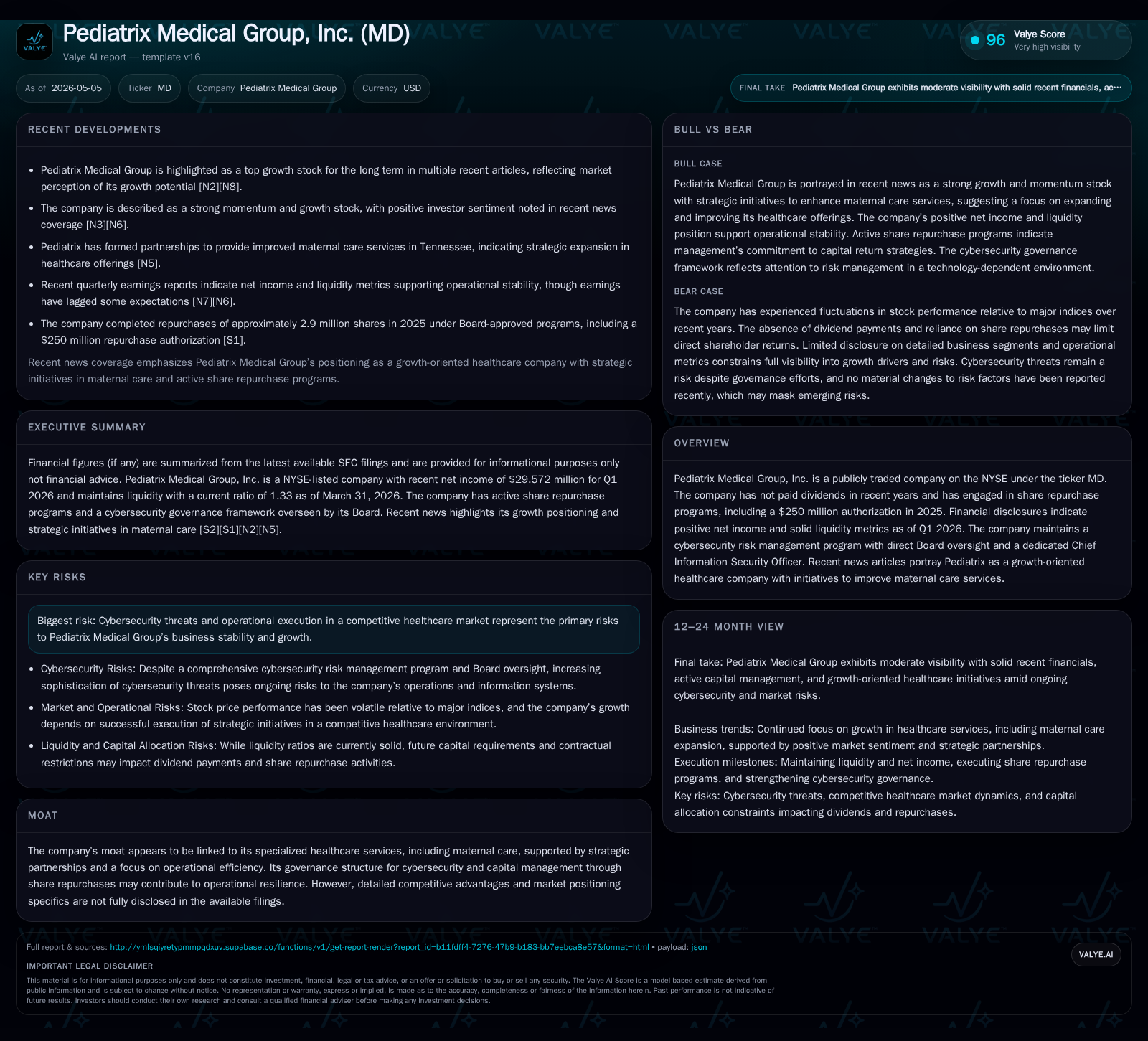
Pediatrix Medical Group reported a first quarter that exceeded revenue and earnings expectations, reflecting operational strength in its core specialty healthcare services, particularly maternal care. The company continues to expand its geographic footprint through partnerships and leverage technology-driven service enhancements. Governance emphasis on cybersecurity risk management and active share repurchase programs indicate disciplined capital allocation supporting shareholder value. Key risks include cybersecurity threats and competitive pressures in an evolving outpatient healthcare market.
Key Highlights From the Latest Quarterly Filing
On May 5, 2026, Pediatrix Medical Group disclosed its financial results for the first quarter ending March 31, exceeding market expectations both top-line and bottom-line [S2][N1]. This recent disclosure underscores continued operational momentum within its specialty care segments, especially maternal care services. Revenue growth was supported by higher patient volumes and expanded contractual arrangements with hospital partners. The filing confirms no material changes to previously disclosed risk factors but reinforces ongoing strategic initiatives that contributed to the quarter's outperformance.
Additionally, Pediatrix reported solid operational efficiency metrics without adverse regulatory developments or major litigation impacting near-term execution [S2]. Press releases coinciding with this filing spotlighted expansion efforts and service line enhancements designed to elevate quality outcomes for mothers and newborns.
Understanding Pediatrix’s Business Model and Service Quality
Pediatrix operates principally as a provider of specialized clinical services focused on maternal-fetal medicine, neonatology, pediatric cardiology, among others. The company typically contracts with hospitals under outsourcing or professional services agreements. Hospitals pay Pediatrix for clinical staffing and management expertise to support high-acuity maternal and neonatal units alongside related specialty areas [S1][N7].
Revenue is driven by service volume—number of deliveries or neonatal admissions—and reimbursement rates negotiated with payers indirectly via hospital contracts. This makes Pediatrix's top line sensitive to hospital outpatient service demand cycles but buffered by recurring contract structures.
Quality of service is emphasized through continuous clinical innovation and adherence to evolving standards of care. Operational efficiency across multiple geographies allows for margin optimization while delivering high-quality outcomes, which is critical given hospitals’ cost containment pressures [S1]. Recent strategic partnerships—in Tennessee notably—have enhanced Pediatrix’s referral networks and increased patient access to specialized maternal care services via integrated delivery models [N7].
Competitive Position and Industry Structure in Specialty Healthcare
The outpatient specialty healthcare services market where Pediatrix competes is characterized by fragmentation among regional medical groups alongside larger health systems expanding their scope vertically. Pediatrix's scale in maternal-fetal medicine and neonatology provides certain advantages in negotiating hospital contracts due to comprehensive clinical expertise and standardized protocols [S1][N4].
Pricing power remains moderate; hospitals balance outsourcing benefits against internal capabilities amid tight operational budgets. Regulations on physician staffing ratios and quality mandates create barriers but also necessitate ongoing compliance investments.
Emerging telehealth entrants introduce competitive dynamics around prenatal monitoring innovations, although Pediatrix has begun leveraging telemedicine as a complementary offering rather than purely as a disruptive entrant [N6]. Switching costs for hospital clients include integration effort and clinical outcome consistency required from providers like Pediatrix.
Growth Drivers: Expanding Maternal Care and Strategic Initiatives
Several distinct growth vectors emerge from the latest disclosures:
- Geographic expansion through new partnerships (e.g., the Tennessee initiative) extends Pediatrix's footprint into emerging markets with growing demand for high-quality maternal services [N7][S2].
- Enhancement of clinical delivery models incorporating telemedicine advances improves convenience and monitoring capabilities for prenatal patients, potentially driving higher utilization rates [N4][S2].
- Increasing overall patient volumes are supported by favorable demographic trends including birth rates in key regions served.
- Operational efficiencies from consolidated service delivery models allow margin improvements despite pressure on reimbursement settings.
These drivers are linked explicitly to management commentary highlighting targeting of specific KPIs such as patient encounter growth rates and improved length-of-stay metrics within neonatal intensive care units [N7] which directly affect revenue expansion.
Risks and Challenges: Cybersecurity and Market Competition
The sophistication of cybersecurity threats remains a salient risk factor with heightened importance due to healthcare data sensitivity. While there have been no material breaches impacting Pediatrix’s operations or strategy historically, the increasing threat landscape demands continuous vigilance. The Board's decision for direct oversight of cybersecurity with biannual reporting from the Chief Information Security Officer evidences proactive governance aimed at mitigating this risk vector [S1][S23].
Market competition also poses challenges: expanding health systems may internalize services previously outsourced; cost inflation pressures hospitals' budget allocations affecting third-party provider spend; regulatory changes affecting scope of practice or reimbursement frameworks add complexity to growth planning.
Execution risks related to integrating new geographic partnerships or scaling telemedicine offerings warrant monitoring as they can influence customer retention and revenue trajectory.
Upcoming Catalysts and What Investors Should Watch
Looking ahead, key developments include forthcoming quarterly earnings reports following the established cadence that will provide updates on volume trends, margin progression, and any adjustments in management outlooks [S2][S3].
Potential new clinical partnerships or expansions into adjacent specialty lines could serve as growth accelerators if announced imminently. Additionally, progress on executing the $250 million share repurchase authorization initiated in August 2025 will be closely watched by the market given its impact on shareholder returns [S6].
Changes in regulatory environments or reimbursement landscapes would need careful evaluation due to their possible influence on contract economics.
Latest Financial Overview: Liquidity, Leverage, and Capital Deployment
Latest financial snapshot
| Metric | Value | Period |
|---|---|---|
| Cash & equivalents | $206mm | |
| 2026-03-31 | ||
| Total debt | $597mm | |
| 2025-12-31 | ||
| Net debt | $391mm | |
| 2025-12-31 | ||
| Current assets | $587mm | |
| 2026-03-31 | ||
| Current liabilities | $443mm | |
| 2026-03-31 | ||
| Current ratio | 1.33x | |
| 2026-03-31 |
Source: SEC companyfacts cache [F1].
As of March 31, 2026, Pediatrix held cash & equivalents totaling approximately $205.8 million with current assets at $587 million against liabilities of roughly $443 million resulting in a sound current ratio of 1.33, indicating solid short-term liquidity positioning [F1]. Total debt remains elevated near $597 million with net debt approximated at about $391 million factoring cash balances—highlighting moderate leverage common within specialty medical groups balancing growth investments with capital flexibility [F1].
Capital allocation priorities have clearly favored share repurchases geared toward offsetting dilution from equity compensation plans and enhancing shareholder value under stable cash flow generation assumptions. Approximately $83.8 million had been repurchased under the latest program through end-2025 with continued activity expected during 2026 subject to market conditions [S6][F1].
This disciplined approach reflects confidence in operational cash flow resiliency coupled with prudent balance sheet stewardship amidst ongoing industry dynamics.
Disclaimer: This analysis is based solely on publicly available SEC filings dated through May 5, 2026 (), company facts snapshots ([F1]), and cited news reports (). It does not constitute investment advice or recommendations.
Disclaimer: This is research-only, informational analysis and not investment advice. It may include AI-generated interpretation and general industry context. Always verify important details using primary sources.

Comments