
Spyre Therapeutics Advances Long-Acting Antibodies Pipeline with SKYLINE Phase 2 Momentum
Spyre progresses its engineered antibody platform through pivotal Phase 2 SKYLINE trial updates and strengthens liquidity via a recent $435 million public offering.
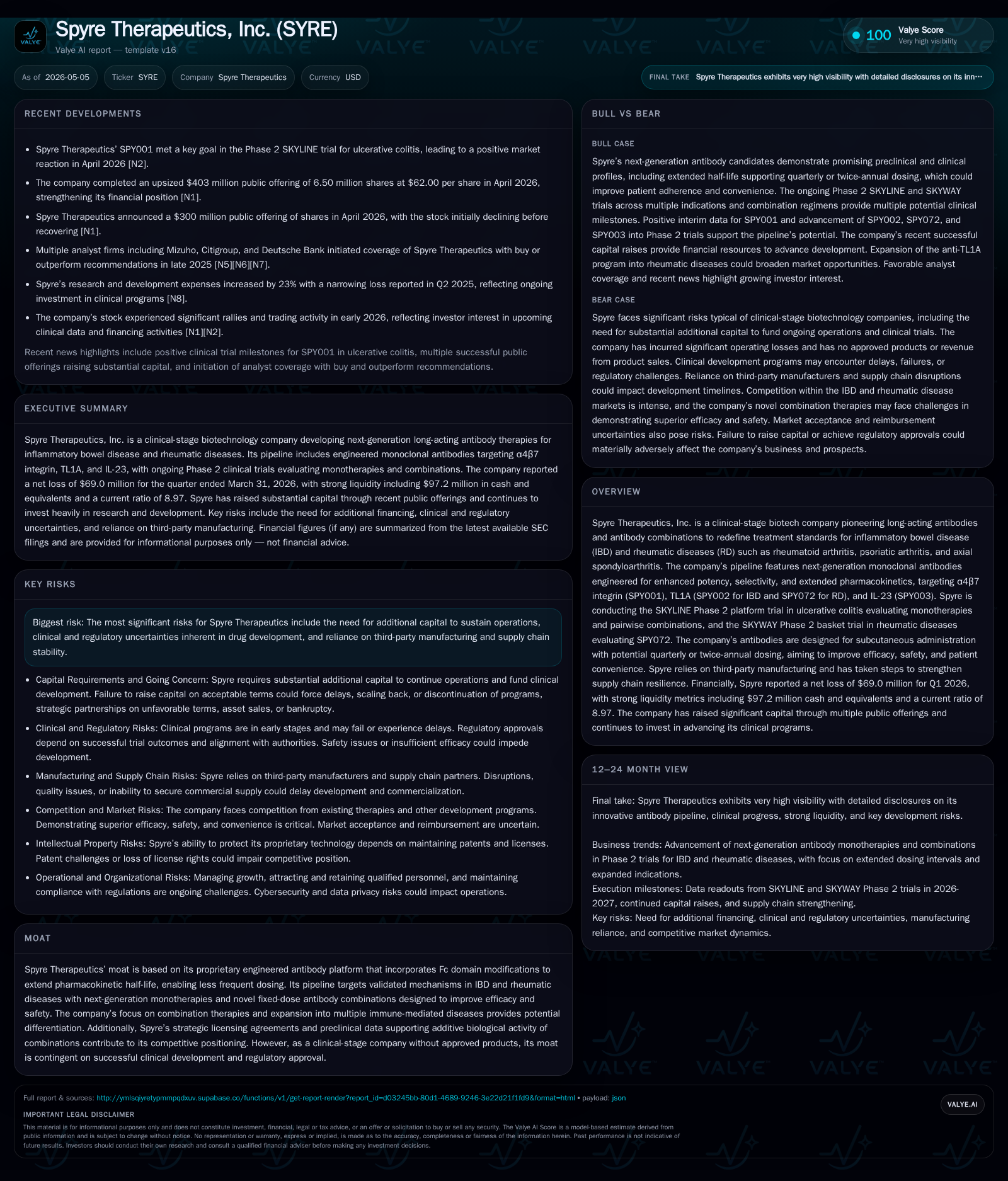
Spyre Therapeutics, a clinical-stage biotech innovating long-acting monoclonal antibodies for inflammatory bowel disease (IBD) and rheumatic diseases, released positive interim data on SPY001 from its ongoing SKYLINE Phase 2 trial. The company advanced SPY230 into Part B of the trial and exercises licensing options expanding its portfolio. Supported by a robust cash position post a $435 million equity raise, Spyre is well-capitalized to fuel its development programs targeting α4β7 integrin, TL1A, and IL-23 pathways. Its next-generation antibody engineering focuses on enhanced pharmacokinetics enabling quarterly or biannual dosing, potentially reshaping treatment paradigms in immune-mediated diseases.
Latest Operational Milestones and Trial Progress
In the first quarter ending March 31, 2026, Spyre Therapeutics announced important progress in its clinical pipeline anchored around the multi-arm SKYLINE Phase 2 platform study in ulcerative colitis (UC). Notably, SPY001 achieved positive initial topline induction results from Part A of SKYLINE, validating the company’s strategic engineering of a next-generation α4β7 integrin monoclonal antibody. This milestone preceded progression of the secondary candidate SPY230 (TL1A targeting) into Part B randomized controlled evaluation within the same trial framework [S2].
Concurrently, Spyre has actively leveraged its Paragon license option agreements to secure exclusive rights across multiple development programs—exercising options for SPY001 (July 2023), SPY002 (December 2023), and SPY003 (June 2024)—thus strategically expanding its intellectual property control over a suite of proprietary antibodies designed for IBD and rheumatic diseases [S2].
Capitalizing on this operational momentum, Spyre successfully completed an upsized public offering in April 2026 that netted approximately $435 million in proceeds. This infusion significantly bolsters the firm’s runway to advance pivotal data readouts expected throughout mid- to late-2026 for SPY002 and SPY003 monotherapies as well as combination evaluations scheduled for subsequent years [N4], [S2].
Business Model and Proprietary Antibody Platform
Spyre’s business is anchored in the discovery, development, and planned commercialization of engineered long-acting monoclonal antibodies targeting immune-mediated conditions. The underlying value creation hinges on novel Fc domain modifications—specifically YTE substitutions—that extend pharmacokinetic half-life, permitting less frequent subcutaneous administration potentially quarterly or twice annually [S1], [S2].
The current portfolio prioritizes three molecular targets: α4β7 integrin (SPY001), TL1A (SPY002/SPY072), and interleukin-23 (SPY003), each implicated in IBD pathophysiology or rheumatic disease mechanisms. These next-generation candidates demonstrate in vitro potency matching or exceeding first-generation comparators while maintaining selectivity and are formulated without citrate to mitigate injection discomfort [S1].
Distinct from first-generation biologics, Spyre aims not only to offer convenience through dosing frequency but also enhanced efficacy potential via sustained pharmacokinetic exposures informed by published dose-response relationships. Moreover, their product design contemplates fixed-dose antibody combinations intended to deliver paradigm-shifting improvements in risk-benefit profiles over standard monotherapies [S1].
Revenue generation remains prospective; as a clinical stage entity without approved products or commercial sales yet, financial returns depend critically on achieving successful clinical outcomes followed by regulatory approvals. Licensing arrangements with Paragon represent near-term access to foundational intellectual property minimizing external R&D risk exposures while preserving optionality across therapeutic indications [S2].
Competitive Landscape in IBD and Rheumatic Diseases
Spyre operates amidst a competitive field dominated by established biologics such as vedolizumab (α4β7 blocker) and risankizumab (IL-23 inhibitor). While these agents have secured market positions based on validated pathways, unmet needs persist related to dosing convenience, safety profiles, and incomplete response rates.
The company’s strategy to engineer extended half-life antibodies targets these deficits by coupling familiar mechanisms with improved pharmacokinetic attributes that could reduce patient burden through less frequent injections—an increasingly valued attribute as payors pressure for cost-effective adherence-supportive therapies [S1], [N3].
Additionally, Spyre’s emphasis on combination therapies may carve a differentiated niche by addressing the multifactorial immunopathology of IBD beyond single-target blockade. However, early-stage status means substantial regulatory milestones must be cleared before commercial competition can be fully evaluated.
Dependency on third-party contract manufacturing organizations introduces supply chain vulnerabilities typical to early clinical-stage biotech companies but consistent with industry norms [S2]. The interplay between novel biologic design, regulatory scrutiny especially under EMA's PRIME scheme considerations, and market acceptance will define Spyre’s longer-term competitive standing.
Growth Drivers: Combination Therapy Paradigm and Cross-Indication Expansion
Integral to Spyre's growth thesis is the SKYLINE clinical platform’s adaptive design permitting parallel assessment of monotherapies and pairwise antibody combinations in UC patients—a sizable market where innovation beyond current standards offers meaningful commercial opportunity [S2].
The anticipated clinical readouts throughout 2026–2027 furnish critical inflection points that can validate synergistic therapeutic effects hypothesized preclinically. Extended half-life formulations coupled with improved risk-benefit metrics position these combinations favorably against incumbent treatments which often require more frequent administration or entail complex immunogenicity concerns.
Complementing gastrointestinal indications, Spyre's anti-TL1A agent (SPY072) is being explored across three rheumatic diseases (RA, PsA, axSpA) in the SKYWAY Phase 2 basket trial. This cross-indication strategy leverages shared inflammatory signaling pathways offering scalable expansion avenues within immune-mediated disease categories characterized by robust patient populations with persistent unmet needs [S2].
Beyond pipeline breadth, success here could prompt strategic collaborations or bolster valuation ahead of commercialization efforts.
Risks and Execution Challenges Ahead
Spyre transparently acknowledges substantial risks consistent with its development stage [S10], [S12]. The company has yet to generate product sales revenue while incurring ongoing operating losses driven by extensive R&D investment—an intrinsic characteristic of biotech innovators progressing novel modalities.
Capital requirements remain significant; despite recent fundraising success adding hundreds of millions to liquidity pools, sustaining operations through multiple years of clinical development implies periodic financing needs that could dilute existing shareholders or constrain operational flexibility [S2].
Clinical development risks include potential delays due to recruitment challenges or unfavorable regulatory feedback regarding data sufficiency. Furthermore, safety issues or emergent adverse events revealed during trials could materially hamper or terminate programs.
Supply chain reliance on third-party manufacturers introduces potential disruption risks across development timelines. Additionally, pricing pressures influenced by evolving healthcare policies in major markets such as the U.S. Medicare reforms or European reimbursement ceilings inject another layer of uncertainty regarding eventual market access dynamics [S10], [S11].
Spyre’s genomic intellectual property licenses carry deferred milestone payment obligations which must be met upon achievement of developmental stages; failure could trigger renegotiations impairing financial projections or pipeline continuity [S14]. Litigation risks concerning patent infringement claims or compliance violations remain latent though unquantified exposures.
Upcoming Catalysts and Investor Watchpoints
Near-term attention centers on additional interim topline disclosures from the SKYLINE Phase 2 platform: notably SPY002 expected mid-2026 and SPY003 slated for third-quarter reporting. These data will illuminate monotherapy efficacy trajectories critical for building confidence heading into blinded Part B dose-ranging randomized assessments planned for induction evaluation during calendar year 2027 [S2], [N6].
Parallel developments include SKYWAY basket trial progress assessing TL1A inhibition utility across rheumatic conditions expanding Spyre’s therapeutic footprint.
Regulatory interactions under EMA PRIME or similar accelerated review schemes could expedite candidate appraisal timelines if granted based on compelling early clinical evidence—investors should monitor such designations closely given their impact on commercial launch timing.
Also of interest are any capital markets initiatives reflecting funding sufficiency perceptions along with insider activity signaling management conviction amidst volatile biotech environments exemplified recently by CEO stock sales following share price surges after positive announcements [N1], [N2].
Continued execution against these milestones alongside operational discipline around cash burn rates remain key metrics influencing enterprise valuation.
Financial Health and Liquidity Overview
Latest financial snapshot
| Metric | Value | Period |
|---|---|---|
| Cash & equivalents | $97mm | |
| 2026-03-31 | ||
| Current assets | $764mm | |
| 2026-03-31 | ||
| Current liabilities | $85mm | |
| 2026-03-31 | ||
| Current ratio | 8.97x | |
| 2026-03-31 |
Source: SEC companyfacts cache [F1].
As of March 31, 2026, Spyre Therapeutics reported cash and cash equivalents totaling approximately $97 million alongside current assets aggregating $764 million versus current liabilities near $85 million—yielding an exceptionally strong current ratio near 9x indicative of significant short-term liquidity buffers supporting ongoing operations without immediate refinancing pressures [F1], [S2].
Operating expenditures primarily reflect research and development outlays aligned with advancing multiple candidates through costly Phase 1/2 trials complemented by general administrative costs scaling modestly alongside headcount increases supporting executive functions.
It does not constitute investment advice nor an endorsement of any security. Readers should consider all filings directly from Spyre Therapeutics when forming their own opinions about the company’s prospects or risks.
Disclaimer: This is research-only, informational analysis and not investment advice. It may include AI-generated interpretation and general industry context. Always verify important details using primary sources.

Comments