
Paymentus Expands Network Reach and Product Features Driving Platform Adoption in Q1 2026
The latest 10-Q highlights Paymentus’ ongoing growth leveraging its cloud-native SaaS platform and expanding Instant Payment Network.
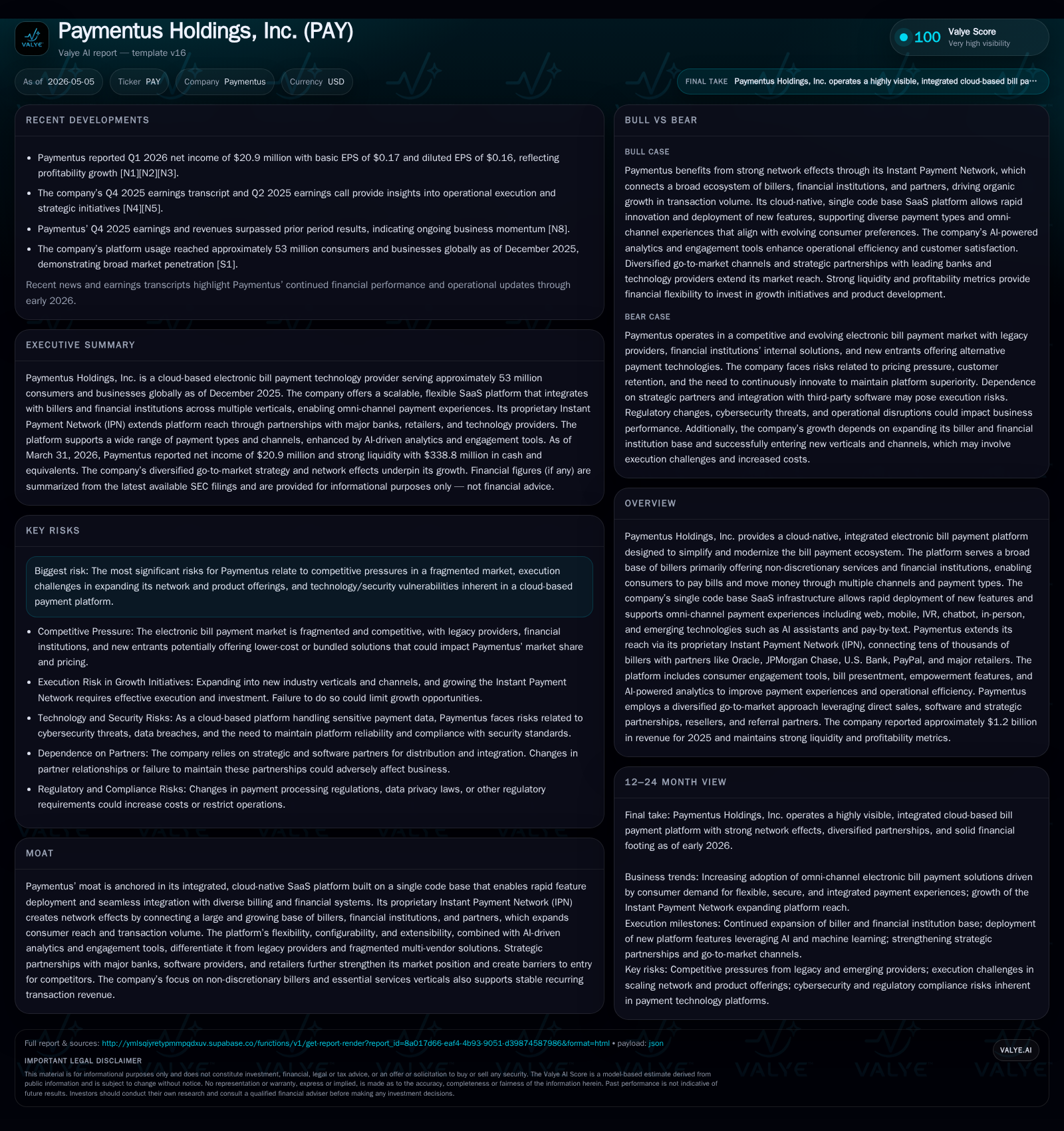
Paymentus Holdings, Inc. reported solid progress in Q1 2026 with increasing adoption by billers, financial institutions, and partners fueled by its integrated, cloud-based payment platform. The company’s proprietary Instant Payment Network continues to extend consumer reach while frequent platform enhancements drive deeper engagement and transaction volumes. Competitive differentiation remains rooted in Paymentus’ single code base SaaS architecture, omni-channel payment capabilities, and strategic partnerships with major financial and technology firms. Risks include competitive intensity, execution risks related to network expansion, and cybersecurity challenges inherent to cloud payments infrastructure.
Recent Operating Update: Q1 2026 Highlights
Paymentus Holdings released its latest quarterly report on May 5, 2026 (10-Q), complemented by a prior day’s 8-K event filing sharing operating commentary focused on solid first-quarter performance [S2,S3]. The company continues to expand its biller base alongside key financial institution partners while deepening transaction volumes within its Instant Payment Network (IPN). Revenue growth persists through increased electronic bill payment activity across multiple industry verticals with a focus on non-discretionary services such as utilities, insurance, government services, telecommunications, healthcare, and more [N1,S2].
The unified SaaS platform's single code base enables Paymentus to roll out new features rapidly across its entire client roster simultaneously. This technological agility allows it to maintain a competitive edge amid rising market demands for omni-channel payment experiences encompassing web portals, mobile applications, interactive voice response (IVR), chatbot interfaces, AI assistants, and emerging pay-by-text options [S1,S2].
In addition to organic growth with existing customers, strategic partnerships with industry giants like Oracle for enterprise billing integration; JPMorgan Chase and U.S. Bank providing banking channel access; PayPal expanding digital wallet reach; and leading retailers extend the company’s footprint across millions of consumers while facilitating broad payment method acceptance [S1,S3,N1].
Business Model Overview
Paymentus operates a cloud-native electronic bill payment platform delivered via SaaS infrastructure designed to modernize traditionally fragmented and legacy-laden bill payment ecosystems. Its revenue derives primarily from transaction fees generated as consumers pay bills through client billers or via the company’s IPN connected third-party platforms. The versatility of Paymentus’ platform accommodates credit/debit cards, eChecks, ACH transfers along with digital wallets across multiple channels — a critical element given evolving consumer preferences toward seamless digital finance interactions.
The core of Paymentus' offering is the IPN linking tens of thousands of billers to partner platforms; this proprietary network creates significant network effects as each expansion attracts more participants enhancing transaction density and platform monetization potential [S1,S7]. Clients derive benefits in faster revenue collection cycles due to integrated financial system connections coupled with data-rich analytics enabling improved customer billing insights.
Because Paymentus uses a single code base SaaS model deployed across diverse clients simultaneously rather than bespoke solutions per client or vendor-fragmented assemblies typical of legacy systems, it achieves cost efficiency while ensuring uniform security standards adherence. This approach enables accelerated innovation cycles — an important moat factor compared with legacy providers who struggle with costly maintenance and slow feature rollouts [S5,S6].
Industry Structure & Competitive Position
The electronic bill presentment and payments landscape is highly fragmented. Legacy incumbents often provide siloed or multi-vendor solutions that lack interconnectivity and breadth of payment methods demanded today. Financial institutions may have internal systems but these usually have limited bill presentment coverage or restrict payment types (e.g., only bank transfers) causing delayed settlements compared to Paymentus' real-time capabilities enabled by the IPN.
New entrants or technology vendors face scale challenges; competing vendors may offer point solutions without the integrated platform depth or do not benefit from network effects created by a large unified ecosystem like Paymentus’ IPN [S5,S6]. Pricing sensitivity remains relevant especially in lower-margin verticals but Paymentus counters through superior product quality delivering greater operational efficiency and improved consumer engagement outcomes.
Strategic partnerships enhance market moat by embedding Paymentus capabilities into major software suites (Oracle ERP modules), banking online portals (JPMorgan Chase), as well as retail e-commerce ecosystems driving high frequencies of transactions. The growing adoption of advanced AI-powered analytics further differentiates Paymentus from slower-moving competitors constrained by legacy technology stacks [S19,S26].
Growth Drivers
Network Expansion & Client Penetration
Paymentus plans continued investment in growing the IPN by onboarding additional billers—especially targeting larger enterprise accounts—and deepening adoption within existing clients including financial institutions utilizing its money movement solutions beyond traditional billing scenarios [S23]. Acquiring higher-payment volume clients improves gross margin dynamics due to economies of scale.
New Verticals & Channels
Expansion into adjacent verticals such as healthcare and insurance aligns well given these sectors' recurring billing characteristics akin to utilities—the company emphasizes pursuing sectors with predictable payment flows that support steady transaction revenue streams. Additionally, extending into new channels driven by partnerships (e.g., leveraging PayPal integration) unlocks incremental payments not captured before under legacy models.
Product Innovation & Feature Enhancements
Investment continues in R&D focusing on AI-driven tools for consumer insights, fraud detection enhancements maintaining security compliance standards (PCI-DSS), chatbot automation boosting self-service payments, and emerging technologies like voice assistants extending omni-channel accessibility [S15,S23]. This innovation funnel aims both at reducing customer acquisition friction on partners’ platforms while increasing retention through better user experiences.
Go-to-Market Strategy Optimization
A diversified GTM approach combines direct sales teams targeting high-value accounts plus tech partnerships (software integrators) plus reseller networks broadening reach cost-effectively. Monitoring operating margins relative to transaction mix shifts will be key given margin pressure potential from high-volume low-margin clients.
Continued innovation rollout metrics including launch cadence for AI-driven consumer engagement features or enhanced fraud prevention modules should be tracked as direct indicators of platform competitiveness evolution. Regulatory developments affecting payments processors may also affect risk profiles.
Management commentary around retention rates for large enterprise billers as well as any guidance on capital allocation plans for future R&D investments versus potential acquisitions will provide clarity on long-term strategic priorities.
Brief Financial Profile Context
Latest financial snapshot
| Metric | Value | Period |
|---|---|---|
| Cash & equivalents | $339mm | |
| 2026-03-31 | ||
| Current assets | $473mm | |
| 2026-03-31 | ||
| Current liabilities | $107mm | |
| 2026-03-31 | ||
| Current ratio | 4.41x | |
| 2026-03-31 |
Source: SEC companyfacts cache [F1].
As of March 31, 2026 (10-Q), Paymentus held $338.8 million in cash & equivalents supported by strong current assets totaling $472.5 million against current liabilities of $107.1 million yielding a robust current ratio above 4x indicating solid near-term liquidity ([F1], [S2]).
This liquidity underpins ongoing investment capacity in product development while supporting working capital needs aligned with transaction volume growth initiatives. Revenue trends remain supported by secular shifts toward digitization of essential service payments combined with multi-channel consumer demand that bodes well for sustainable growth opportunities despite sector cyclicality around seasonal billing patterns ([S10]).
This analysis is based solely on publicly available SEC filings dated through early May 2026 supplemented by recent transcripts and news sources cited herein without offering investment advice.
Disclaimer: This is research-only, informational analysis and not investment advice. It may include AI-generated interpretation and general industry context. Always verify important details using primary sources.

Comments