
TopBuild Corp Delivers Resilient Q1 Results Amid Supply Chain Challenges
TopBuild's Q1 2026 performance underscores operational resilience and strategic positioning despite supply constraints and competitive pressures.
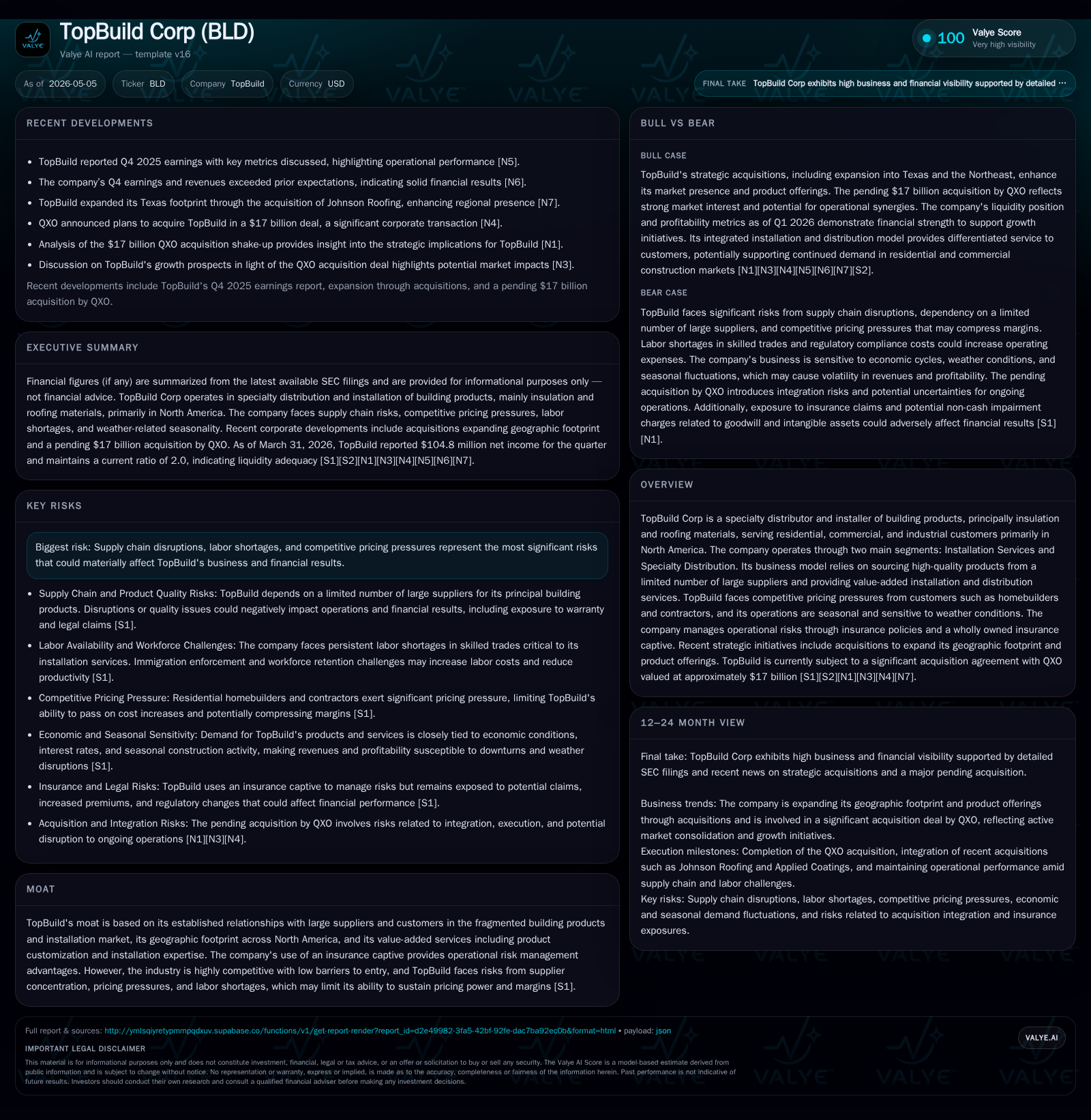
TopBuild Corp reported robust operating results in Q1 2026, demonstrating resilience amid ongoing supply chain challenges, particularly in key building materials like fiberglass insulation. The company’s core business—comprising Installation Services and Specialty Distribution—is supported by a broad North American footprint and value-added installation capabilities. Strategic acquisitions including Specialty Products & Insulation have expanded product offerings and geographic reach, positioning TopBuild ahead of its pending $17 billion acquisition by QXO. However, the firm faces risks from supplier concentration, labor shortages, and pricing lag that could pressure margins going forward.
Q1 2026 Operating Update: What Changed and Why It Matters
TopBuild Corp's first quarter ending March 31, 2026 presented a demonstration of operational resilience amidst ongoing supply chain challenges noted in the latest Form 10-Q filed May 5, 2026 [S2][S3]. While precise revenue figures for the quarter are not delineated in the filings, management commentary emphasized stable top-line trends driven largely by consistent demand in residential and commercial sectors. However, persistent supply allocations in core fiberglass insulation materially constrained volume growth potential during the period.
Margins faced typical quarterly pressures attributable to timing lags between surging input costs at suppliers versus realization of price increases at customer levels. Despite these factors, the company's Installation Services segment continued to capitalize on its high-touch service model to sustain contract volumes. Simultaneously, Specialty Distribution benefited from the recent acquisition of Specialty Products & Insulation (completed Q4 2025) which broadened product lines and geographic reach [S7]. This acquisition contributed positively to overall segment growth during Q1 as integration efforts proceeded on schedule.
A key near-term development is TopBuild’s agreement to be acquired by QXO in a transformative $17 billion deal announced in April 2026 [N2][N3][S24]. This pending transaction introduces opportunities for scale synergies but also execution scrutiny over integration complexities during existing market headwinds.
Business Model Analysis: Installation Services and Specialty Distribution
TopBuild operates through two intertwined segments: Installation Services — focused on specialty installation of building products such as insulation and roofing primarily for residential new construction—and Specialty Distribution — supplying building products directly to contractors with value-added services including localized product customization [S1][S19].
Revenue streams derive from fees charged for installation labor plus markups on distributed materials.
Several factors underscore their strategic strengths:
- Supplier Relationships: TopBuild sources chiefly from a concentrated set of large manufacturers with whom it maintains strong ties; this enables priority allocations albeit within an environment marked by fiberglass insulation supply volatility [S1].
- Value-Added Installation Expertise: The company differentiates itself through technical installation proficiency that enhances customer stickiness particularly among homebuilders demanding quality assurances.
- Geographic Reach: Extensive North American footprint facilitates regional responsiveness complementing the fragmented nature of the building products industry.
- Operational Risk Management: A wholly owned insurance captive mitigates insurable liabilities inherent in installation services across dispersed sites [S18].
Seasonality tied to construction cycles and weather conditions imposes variability on workload volumes though long-term demand trends favor energy-efficient building upgrades requiring specialized products.
Competitive Landscape and Industry Dynamics
TopBuild occupies a contested niche within a highly fragmented specialty distribution and installation marketplace characterized by:
- Low barriers to entry for regional competitors.
- Customer-driven direct purchasing reducing intermediary volumes.
- Supplier vertical integration attempts that could marginalize distributors [S9].
Despite this intensity, TopBuild's established scale across multiple regions provides leverage versus smaller players. Nonetheless, supplier concentration risks lead to episodic allocation shortages restricting supply-side flexibility notably in fiberglass insulation — a critical input heavily influencing operating cadence [S1][N6].
Competitive pricing pressure exerts continual downward force on margins as customers like homebuilders attempt to pass through cost savings or source directly from manufacturers [S1][N9]. Additionally, technological advances or alternative sourcing models could shift industry disintermediation trends over time.
Growth Drivers Fueling Demand and Margin Expansion
Several vectors are underpinning TopBuild's growth trajectory:
- Acquisition Strategy: The October 2025 purchase of Specialty Products & Insulation introduced expanded product sets beyond traditional insulation into broader specialty building supplies while also adding complementary geographic clusters [S7]. This bolsters cross-selling opportunities within existing customer bases.
- Pending QXO Acquisition: The announced $17 billion acquisition positions TopBuild for operational scale benefits including enhanced procurement leverage, distribution logistics optimization, and increased R&D investment capability [N2][N3][S24].
- Service Innovation: Investment in enhanced customization capabilities locks customers into higher-value niches less susceptible to commoditization — sustaining margins amid inflationary challenges.
- Construction Cycle Upside: While cyclical risks persist given macroeconomic uncertainties impacting housing starts or commercial build-outs, ongoing shifts toward energy efficiency improve demand durability for advanced insulating materials requiring professional installation expertise.
Risks and Constraints: Supply Chain, Labor, and Pricing Pressures
TopBuild navigates several potent risk factors that pose constraints on growth momentum:
- Supply Chain Disruptions: Concentrated supplier base combined with fiberglass insulation shortages impose volume caps and can result in sudden pricing spikes difficult to immediately pass through downstream [S1].
- Labor Shortages: Skilled installer scarcity elevates wage costs potentially throttling capacity expansion needed for peak seasonal demand windows [S9].
- Competitive Price Erosion: Customers increasingly source directly or seek enhanced fabrication internally eroding distributor market share; sustained cost inflation without commensurate pricing adjustments compresses profitability [S1][N9].
- Legal Exposure: Broad liability risks related to contracting activities necessitate significant insurance outlays despite captive insurance usage; adverse judgments or claims could strain financial resources unexpectedly [S18].
These factors emphasize that although TopBuild retains strategic advantages, operational execution must continuously adapt to volatile input markets alongside elevated labor expense profiles.
Upcoming Catalysts to Monitor: Acquisition Impact and Market Milestones
Key upcoming developments warrant close monitoring for implications on TopBuild’s positioning:
- QXO Acquisition Closing: Regulatory approvals and integration roadmap execution will significantly influence capital structure flexibility and margin improvement timelines; synergy capture will be vital post-close [N2][N3][S24].
- Acquisition Integration Progress: Assimilation of Specialty Products & Insulation remains ongoing; confirmation of realized accretive impacts beyond initial quarters will be indicative of management execution competence [S7].
- Housing Market Indicators: Metrics such as housing starts data, builder confidence surveys, contractor backlog figures can offer lead signals around underlying demand sustainability for core insulated installations [S19].
- Pricing Updates: Tracking pricing realization timelines relative to cost inflation cycles is crucial as inability to timely recoup input hikes could press margins further [S2].
These milestones collectively frame TopBuild’s near-term growth outlook anchored heavily on external conditions alongside internal integration capability.
Current Financial Snapshot
Latest financial snapshot
| Metric | Value | Period |
|---|---|---|
| Cash & equivalents | $269mm | |
| 2026-03-31 | ||
| Total debt | $2.86bn | |
| 2026-03-31 | ||
| Net debt | $2.59bn | |
| 2026-03-31 | ||
| Current assets | $1.76bn | |
| 2026-03-31 | ||
| Current liabilities | $880mm | |
| 2026-03-31 | ||
| Current ratio | 2x | |
| 2026-03-31 |
Source: SEC companyfacts cache [F1].
As of March 31, 2026, TopBuild maintains approximately $269 million in cash against nearly $2.86 billion in total debt resulting in net debt around $2.59 billion alongside a solid current ratio near 2x reflective of adequate near-term liquidity cushions supporting working capital requirements amid aggressive acquisition finance activity [F1].
Disclaimer: This analysis is provided solely for informational purposes grounded exclusively on publicly available SEC filings and news disclosures as of May 5, 2026; it does not constitute investment advice or recommendations.
Disclaimer: This is research-only, informational analysis and not investment advice. It may include AI-generated interpretation and general industry context. Always verify important details using primary sources.

Comments