
Shoals Technologies Advances EBOS Solutions with Strategic Facility Expansion Amid Solar Market Volatility
Shoals Technologies Group updates on Q1 2026 operations, showcasing manufacturing scale-up and ongoing innovation in solar and energy storage electrical systems.
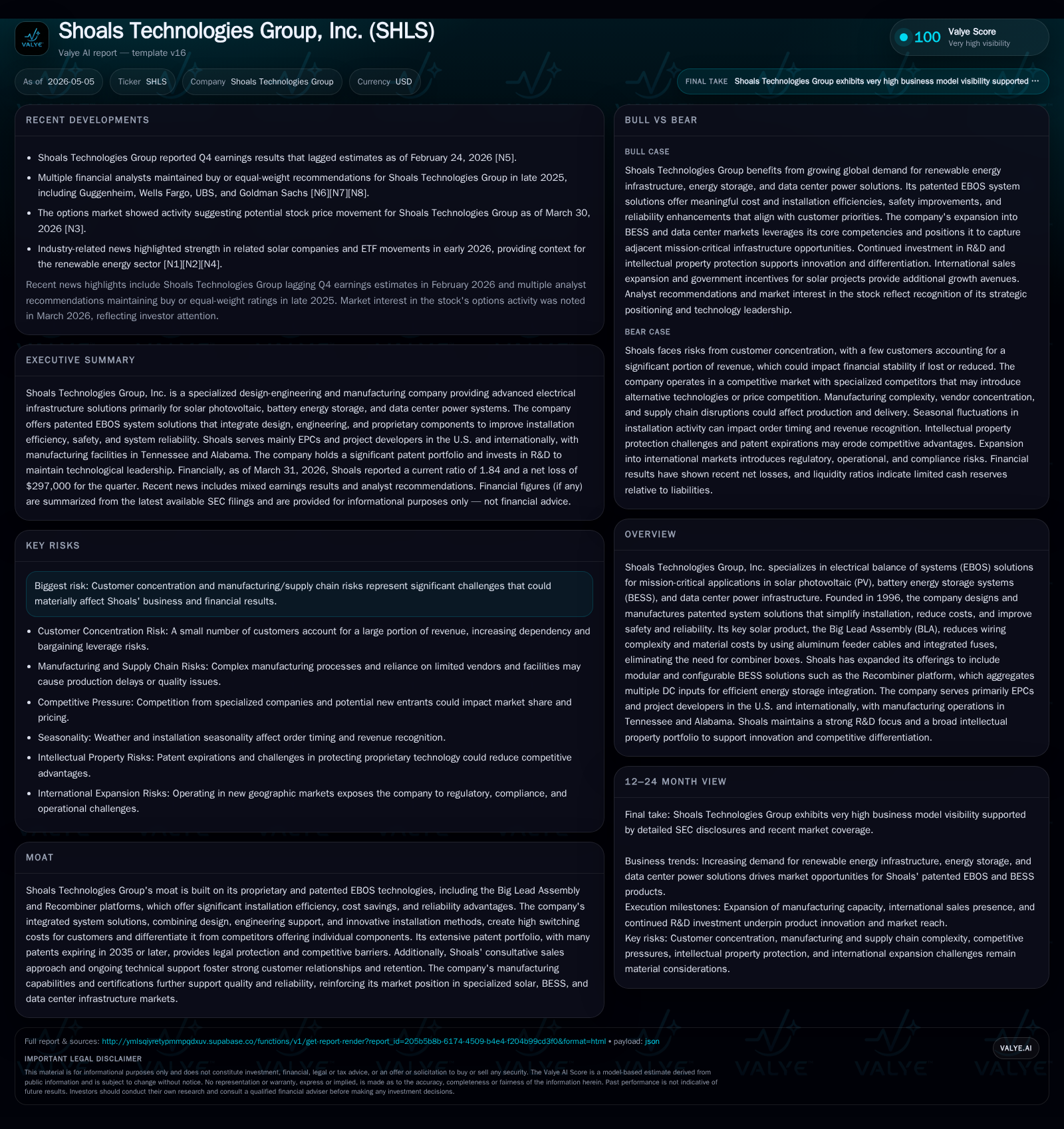
In its latest quarterly filing covering Q1 2026, Shoals Technologies Group reiterated its commitment to advancing its patented electrical balance of systems (EBOS) technologies amid cyclical solar industry demand. The company continues to execute on the consolidation and expansion of manufacturing operations in Tennessee, aiming to improve operational efficiencies. While facing typical industry headwinds such as project delays within the solar sector, Shoals is augmenting its strategic focus to include adjacent markets like battery energy storage systems (BESS) and data center power infrastructure. Its proprietary system solutions and consultative sales approach underpin a differentiated competitive position fortified by a substantial patent portfolio.
Recent Operating Update
Shoals Technologies Group’s latest quarterly filing for Q1 ended March 31, 2026 [S2] reiterates the persistence of certain headwinds that have characterized the solar industry since recent years—namely project delays that have compressed near-term demand. However, the company also reports a robust backlog combined with awarded orders totaling approximately $747.6 million as of December 31, 2025, signaling underlying demand resilience despite timing uncertainties [S28]. This backlog includes $326.2 million in signed contracts supported by take-or-pay provisions providing some revenue visibility.
Operationally, Shoals has made significant strides on its manufacturing front. The consolidation into a new larger facility in Portland, Tennessee was completed in the second half of 2025 [S7]. This consolidation is expected to enhance throughput capacity and manufacturing efficiencies necessary to support scaling volumes across both solar PV EBOS products and emerging offerings tailored for battery energy storage systems (BESS) and data center power markets.
Business Model
Shoals specializes in designing and manufacturing advanced electrical balance of systems (EBOS) solutions critically important to solar photovoltaic (PV), BESS, and increasingly mission-critical data center power infrastructure [S1]. Electrical balance of systems encompass all components responsible for carrying electrical current from PV panels or stored batteries to inverters and ultimately the grid or load centers.
Revenue generation stems primarily from selling proprietary system-level EBOS solutions rather than stand-alone components. These system solutions are custom-engineered for EPCs (engineering, procurement, construction firms) and developers focused on utility-scale projects above one megawatt capacity. Given the bespoke nature of each project, Shoals faces lead times commonly exceeding twelve months from order placement through engineering to delivery.
A core example of their product differentiation is the Big Lead Assembly (BLA), which reduces wiring complexity by integrating aluminum feeder cables with fuses—eliminating costly combiner boxes common in conventional setups. Similarly, the Recombiner platform aggregates multiple DC inputs optimizing BESS deployments.
The value proposition hinges on simplifying installation workflows reduce labor costs; improving safety via integrated design features; boosting system reliability; extending asset life cycles; all underpinned by comprehensive engineering support throughout design, installation, commissioning, and operations phases [S1][S26].
Industry Structure & Competitive Position
Shoals operates in a specialized segment where the intersection of deep electrical engineering expertise, patent-protected technology innovations, and mission-critical reliability requirements create high barriers to entry. Competitors include Construction Innovation, Hikam America Inc., Nextpower Inc., Premier PV, TerraSmart LLC (formerly SolarBOS), and Voltage LLC—all firms focusing on components or narrower EBOS offerings without Shoals’ level of system integration or extensive patent coverage [S7].
This integrated solution approach fosters high switching costs due to long project timelines coupled with close collaboration during site design optimization and ongoing customer technical support post-installation. Additionally, more than two dozen patents extend into the mid-2030s or later provide legally defensible technological moats that limit commoditization risks if enforced successfully [S1][S8].
However, intensifying competition is noted as new entrants attempt disruptive pricing or introduce modular products targeting segments within EBOS. Maintaining technical leadership via R&D investment—focused on cost reductions, enhanced reliability features, and adaptable modularity—remains imperative for Shoals [S7][S26].
Growth Drivers
- Solar Market Recovery & Expansion: Although solar remains cyclical with identified headwinds including permitting delays and subsidy uncertainty post-IRA modifications (), long-term trends favor continued growth as solar accounts for a growing share of new grid capacity installations worldwide.
- Battery Energy Storage Systems: BESS is evolving into a critical complement enabling grid stability; Shoals’ expanding portfolio targeting BESS system integration leverages existing EBOS expertise tapping into an early-stage but rapidly advancing market niche.
- Data Centers & Mission-Critical Infrastructure: Emerging opportunities arise as hyperscale data centers embed storage to manage AI-driven load growth demanding highly reliable DC power distribution where Shoals is developing tailored designs leveraging proven platforms like Recombiner.
- Geographic Expansion: International sales channels based in Spain (covering Europe/Latin America/Africa) and Australia (Asia-Pacific) provide a foothold for extending product reach beyond U.S-centric projects though foreign market adoption lags domestic demand density.
- Manufacturing Scale & Operational Efficiency: The newly consolidated Tennessee plant should enable lower unit costs per installation while supporting higher throughput volumes needed for anticipated demand spikes once current solar project slowdowns normalize.
- Consultative Selling Model: Collaborative engagement with EPCs fosters customer loyalty helping maintain contracts through volatile market phases alongside sustained aftermarket technical service opportunities.
Risks / Watchpoints / Growth Constraints
- Cyclicality & Project Delays: Short-to-medium term revenue forecasting remains challenging due to project timing uncertainties outside management control including permitting delays or financing constraints that can affect order flow realization timing significantly [S1][S28].
- Customer Concentration: Revenue dependency on a limited customer base introduces pricing pressure risk as top five customers accounted for about 54% revenue last year putting leverage in buyers’ hands potentially compressing margins or reducing volumes unexpectedly if any contract shifts occur [S16].
- Supply Chain Vulnerabilities: Reliance on specific raw materials like aluminum cables amid global supply chain disruptions carries risks of cost inflation or delivery delays impacting production schedules.
- Trade Policy & Tariffs: Exposure to import/export regulation fluctuations including anti-dumping duties could impact cost competitiveness especially for international sales sensitive to tariff changes [S18][S24].
- Intellectual Property Litigation: Ongoing patent enforcement exposes Shoals to potentially expensive legal proceedings which if forfeited may allow competitors to replicate key innovations eroding technological advantage [S8].
- Capital Intensity & Indebtedness: $137 million total debt relative to $1.9 million cash as of Q1 end indicates meaningful leverage requiring steady cash flow generation; restrictive covenants under credit agreements may limit financial flexibility for future investments or acquisitions [F1][S17].
What To Watch Next
Key operational indicators over coming quarters include:
- Conversion rate of backlog/awarded orders into recognized revenue reflecting project progress amidst variable timelines [S28].
- Effectiveness of expanded Tennessee manufacturing footprint in improving gross margins through scale economies and reduced downtime.
- Revenue contribution growth from non-solar verticals such as BESS system integrations and data center infrastructure enhancements [S26].
- Progress on patent enforcement outcomes which could materially impact competitive landscape.
- Any shifts in customer concentration dynamics or contract renegotiations particularly among largest clients influencing pricing trends.
- Responses to evolving trade tariffs or supply chain interruptions impacting input costs or availability.
- Updates on share repurchase programs or capital allocation policies that influence liquidity profile or shareholder returns [S21].
Financial Profile Snapshot (As of Q1 March 31, 2026 / Fiscal Year-end Dec 31)
Latest financial snapshot
| Metric | Value | Period |
|---|---|---|
| Cash & equivalents | $1.877 million | |
| 2026-03-31 | ||
| Total debt | $137 million | |
| 2025-12-31 | ||
| Net debt | $135 million | |
| 2025-12-31 | ||
| Current assets | $383 million | |
| 2026-03-31 | ||
| Current liabilities | $208 million | |
| 2026-03-31 | ||
| Current ratio | 1.84x | |
| 2026-03-31 |
Source: SEC companyfacts cache [F1].
The liquidity position reflects modest cash balances against substantial debt drawn under revolving credit facilities used largely for working capital tied to large-scale project executions [F1][S17]. Its recent facility consolidation represents a material step towards operational scalability needed amidst fluctuating solar project execution timings.
However, near-term growth trajectories remain tethered to cyclical demand patterns characteristic of the broader renewable energy sector alongside concentration risks inherent in its customer base and residual supply chain vulnerabilities. Sustaining leadership will require continued innovation protected by intellectual property enforcement combined with careful execution on backlog realization and geographic diversification strategies.
Disclaimer: This analysis is based exclusively on publicly available SEC filings dated up to May 5, 2026. It does not constitute investment advice or recommendations regarding Shoals Technologies Group stock or securities.
Disclaimer: This is research-only, informational analysis and not investment advice. It may include AI-generated interpretation and general industry context. Always verify important details using primary sources.

Comments