
NeOnc Technologies Boosts Capital to Advance Cancer Therapy Pipeline
Recent securities purchase agreements provide crucial funding for NeOnc’s clinical-stage oncology development leveraging patented monoterpene technology.
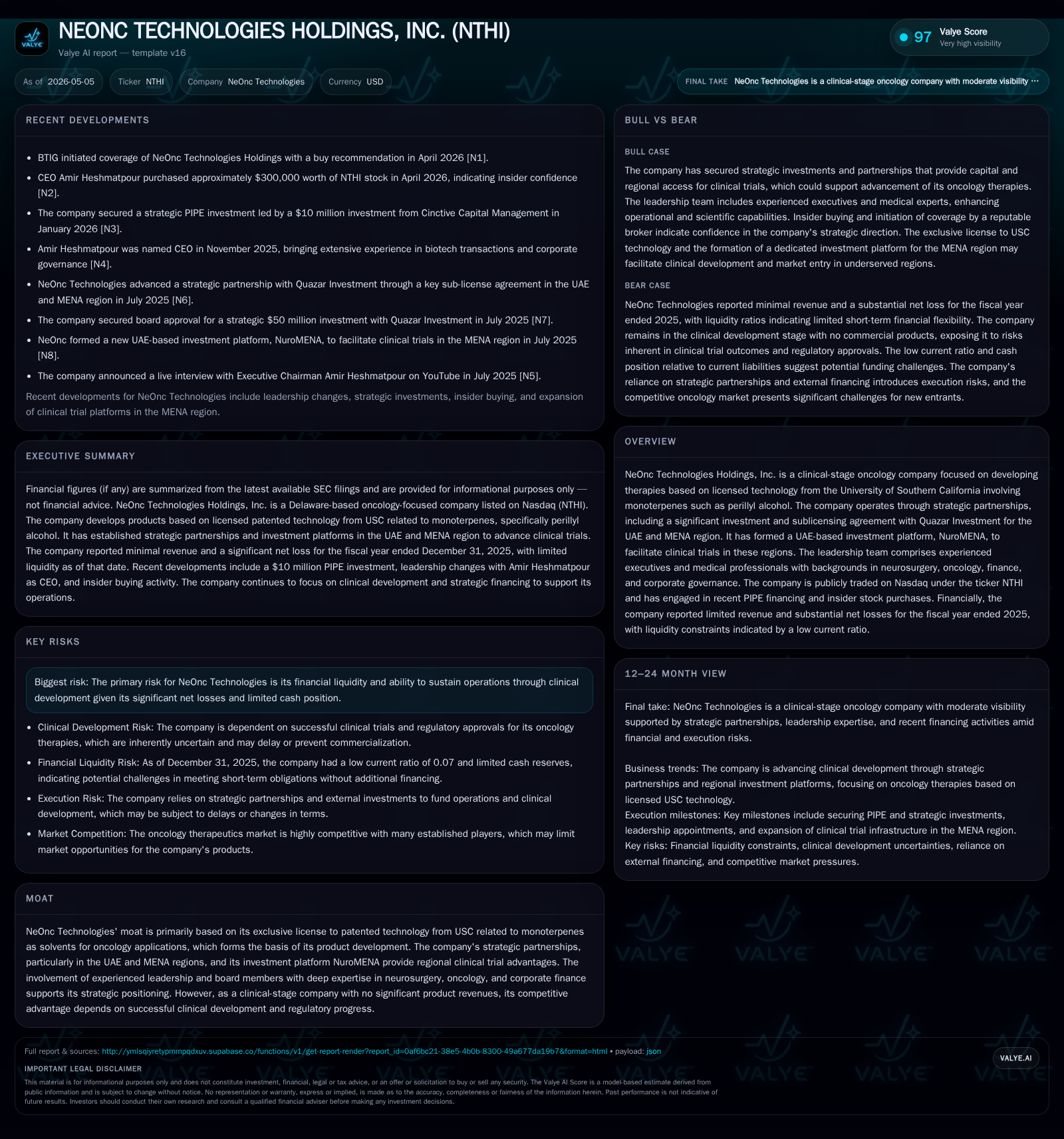
In the first four months of 2026, NeOnc Technologies Holdings, Inc. executed multiple securities purchase agreements that cumulatively raised over $14 million in gross proceeds to finance its preclinical oncology programs. The company’s business model centers on an exclusive license from USC for patented monoterpene-based technology with a strategic focus on regional clinical trials in the UAE and MENA markets via partnerships. While its product development progress and expansion through sublicensing offer growth avenues, NeOnc faces significant liquidity constraints and the inherent risks of clinical-stage biotech ventures. Upcoming clinical milestones and regulatory developments will be critical markers of operational execution and value creation.
Recent Capital Raises and Strategic Financing Updates
NeOnc Technologies Holdings entered the first half of 2026 with aggressive capital raising activities critical to sustaining its drug development operations. As documented in the Form 8-K dated April 24, 2026, NeOnc executed a fourth Securities Purchase Agreement following three earlier ones initiated since January 29, 2026. The cumulative authorized issuance under these agreements comprises up to approximately 4 million shares of common stock issued at $7.20 per share with attached five-year warrants exercisable at $9.00 per share. The initial closings under each agreement have been completed incrementally through April 20, 2026, collectively delivering over $14 million in gross proceeds.
Notably, the most recent fourth agreement closed an initial tranche of approximately $2 million by issuing about 277,777 shares plus warrants to one institutional investor. These transactions maintain consistent pricing terms across tranches, reflecting stable investor appetite for equity paired with long-dated warrant incentives. The net proceeds are earmarked specifically for funding planned preclinical trials for NeOnc's lead candidate NEO216—a monoterpene-based oncology therapy derived from their proprietary platform. This staged financing approach addresses immediate cash demands while bridging toward anticipated milestone events that could unlock further capital options or licensing revenues [S3][S8].
Additionally, in April 2026, NeOnc initiated an Equity Distribution Agreement for an "at-the-market" (ATM) offering program worth up to $75 million with BTIG LLC and A.G.P./Alliance Global Partners as placement agents. This framework provides flexible future access to public equity markets but has yet to generate proceeds at this stage [S16]. Consequently, near-term funding remains reliant on private placements like those executed early in the year.
Unique Business Model Centered on Licensed Monoterpene Oncology Technology
NeOnc’s business fundamentally rests on an exclusive license agreement entered into with the University of Southern California (USC) dating back to March 2009. This agreement grants NeOnc rights to utilize patented technology that harnesses monoterpenes—naturally occurring organic compounds like perillyl alcohol—as solvents within novel oncology therapeutic formulations.
The exclusivity of this patent portfolio represents an excellent intellectual property moat pivotal for product differentiation among oncology developers focused on novel mechanisms or delivery systems. The licensed technology is actively leveraged to develop clinical candidates including NEO216 via proprietary preclinical research pipelines managed under NeOnc's stewardship.
Revenue generation prospects stem primarily from royalty payments tied to future net sales upon successful commercialization. Under this structure, NeOnc agreed to pay USC upfront fees totaling $20,000 initially plus annual maintenance royalties escalating to $20,000 thereafter. To date, no earned royalties have been paid given absence of commercialized products; however future milestones are contractually defined including a 2% royalty rate on Net Sales once sales commence. Additionally, NeOnc issued USC over half a million shares common stock as part of compensation under their license agreement amendments executed through late 2023 [S1].
The company's development efforts are supplemented through strategic partnerships enhancing clinical reach and funding capabilities especially within Middle East/North Africa (MENA) regions. A key initiative is the formation of NuroMENA—an investment platform based in UAE—created specifically to facilitate localized clinical trials benefiting from streamlined regulatory environments distinct from Western markets. This regional expansion and sublicensing strategy exemplify how NeOnc integrates intellectual property value capture with market access considerations simultaneously.
Competitive Landscape and Regional Partnerships in Oncology R&D
Within the specialized segment of oncology therapeutics leveraging innovative solvent platforms like monoterpenes, NeOnc occupies a niche competitive position defined by limited direct peer overlap due to its patented IP plus focused geographic sublicenses. Few clinical-stage biotechnology firms combine such strong IP with a regional MENA trial facilitation vehicle backed by strategic investors such as Quazar Investment.
This dual advantage affords NeOnc accelerated operational timelines for trial conduct alongside protected commercial rights via sublicense arrangements—advantages less accessible to peers dependent solely on Western jurisdiction regulatory pathways or without comparable pipeline technologies.
Nonetheless, sustaining this moat critically depends on navigating standard clinical-stage risk factors endemic to oncology drug development: achieving positive safety/efficacy data recapitulated through multi-phase testing and securing regulatory approvals. Failure at any stage poses risk not only operationally but also dilutes IP-derived exclusivity benefits if competing technologies outpace market entry timelines.
Moreover, partnerships such as Quazar’s UAE regional investment represent both enablers and potential complexity points given cross-border governance requirements affecting trial design execution or royalties sharing agreements. Still strategically these alliances underpin value creation especially if regional reimbursement frameworks favor novel oncology modalities tested locally before broader global rollouts [S1].
Growth Drivers: Clinical Milestones, Regional Expansion, and Licensing Royalties
The primary growth vectors for NeOnc reside in advancing its NEO216 program through critical preclinical study phases culminating into planned IND submissions enabling human trials. Successful progression along this path would materially improve the company’s valuation basis by de-risking product viability narratives.
Clinical adoption catalysts also include leveraging the NuroMENA platform which optimizes trial site recruitment efficiencies across UAE/MENA jurisdictions—zones increasingly prioritizing biopharma innovation attracting vendor investments through streamlined ethics committees and patient access policies. This geographic focus may shorten timelines relative to typical Western sites enabling faster proof-of-concept data acquisition.
Additionally, licensing revenues underpin long-term growth as products mature toward commercialization stages generating sales-based royalties pursuant to licensing terms negotiated with USC or sublicensees like Quazar Investment.
Insider stock purchases reported in April 2026 reinforce confidence within senior management ranks regarding pipeline momentum aligning internal incentives with shareholder outcomes amidst pivotal trial initiations planned soonest [S3][N2].
Risks and Constraints: Financial Liquidity and Developmental Uncertainties
NeOnc's most pressing constraint remains its financial liquidity profile compounded by ongoing operating losses typical of clinical-stage biotech companies without product revenue streams yet established. The December 31, 2025 balance sheet indicates cash & equivalents standing at just under $59k alongside total debt approximating $320k resulting in an exceedingly low current ratio around 0.07 evidencing near-term working capital insufficiency versus current liabilities exceeding $20 million [F1].
This implies continued dependence on external capital raises such as those concluded in early-2026 securities purchase agreements or ATM offerings going forward to fund operations including costly preclinical/clinical activities central to pipeline advancement.
From an operational perspective, obscurities intrinsic to drug development—the substantial risk that candidates fail safety or efficacy endpoints or encounter regulatory setbacks—represent material uncertainties capable of derailing timelines intended to unlock licensing milestones or commercial revenues.
Furthermore, repeated equity financings inherently impose dilution risks confronting existing shareholders given expanded share counts amid volatile biotech market valuations typical during phase-dependent progression cycles [F1].
Key Upcoming Catalysts and Clinical Execution Milestones
Stakeholders should monitor several near-term events illuminating execution capabilities:
- Closing timeline for the remaining Securities Purchase Agreement shares targeted by April 30, 2026 provides clarity on capital sufficiency beyond immediate months [S3][S8].
- Initiation dates for NEO216 preclinical trials supported by recent financings signal forward movement toward first-in-human dosing applications.
- Regulatory submissions relating to IND filings marking transition from discovery/preclinical domains into formal clinical investigation stages.
- Additional SEC form filings regarding capital raises or warrant exercises which could provide transparency into dilution levels or investor participation trends.
- Insider stock purchases continuing around Q2–Q3 periods act as behavioral barometers reflecting management conviction internalized relative perceived developmental inflection points [N2].
Latest Financial Snapshot and Liquidity Position
Latest financial snapshot
| Metric | Value | Period |
|---|---|---|
| Cash & equivalents | $58729 | |
| 2025-12-31 | ||
| Total debt | $320000 | |
| 2025-12-31 | ||
| Net debt | $261271 | |
| 2025-12-31 | ||
| Current assets | $1388711 | |
| 2025-12-31 | ||
| Current liabilities | $20mm | |
| 2025-12-31 | ||
| Current ratio | 0.07x | |
| 2025-12-31 |
Source: SEC companyfacts cache [F1].
| Metric | Value (USD) |
|---|---|
| Revenue | $39,990 |
| Operating Income | -$58,240,445 |
| Net Income | -$62,146,210 |
| Cash & Equivalents | $58,729 |
| Total Debt | $320,000 |
| Current Ratio | 0.07 |
As of fiscal year-end December 31, 2025 per audited filings:
- Revenue remains negligible (<$40k) reflecting absence of commercial operations.
- Operating loss exceeds $58 million illustrating high fixed R&D/general expenses normal for pre-commercial clinical-stage companies.
- Net loss corresponds closely indicating no offsetting other income sources were significant last reported fiscal year.
- Cash position is critically low relative to obligations requiring fresh raise executions already underway early calendar year 2026.
- Total debt metrics approximate $320k modestly elevated but manageable given magnitude compared with accrued liabilities; however extremely limited short-term liquidity constrains operational runway severely pending capital inflows [F1].
Efficient conversion of recent financing into milestone progress will be crucial telemetry affecting subsequent capital market reception and long-term sustainability prospects.
Disclaimer: This is research-only, informational analysis and not investment advice. It may include AI-generated interpretation and general industry context. Always verify important details using primary sources.

Comments