
Sonos Advances Software Stability and Supply Chain Efficiency While Expanding Product Portfolio
Latest quarterly results highlight operational progress and strategic initiatives amid ongoing macroeconomic challenges.
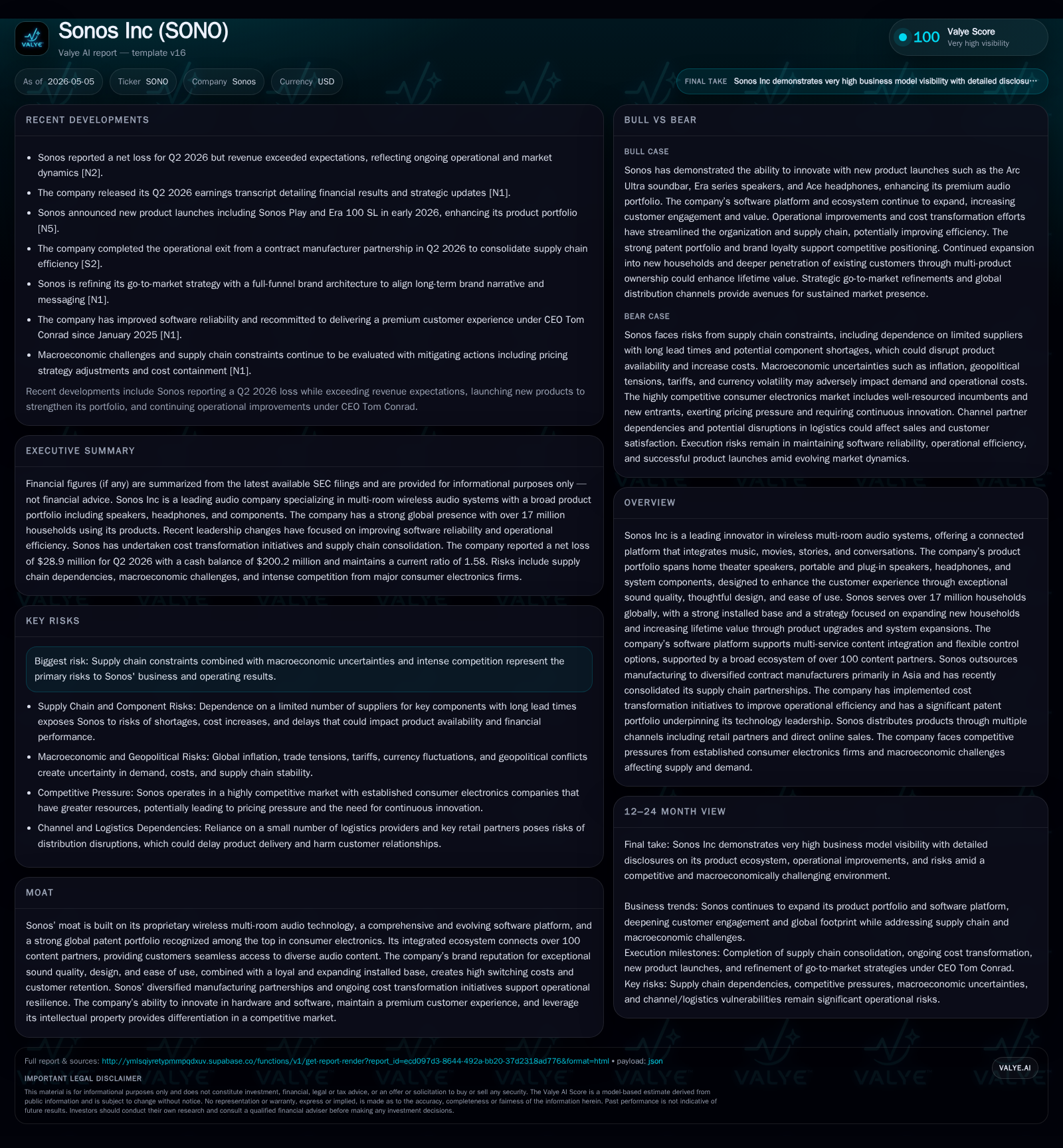
Sonos Inc reported its second fiscal quarter ended March 28, 2026, showcasing improvements in software reliability, completion of a key supply chain consolidation, and a refreshed product lineup including the Amp Multi and new Play and Era series speakers. Despite facing global macroeconomic headwinds such as inflation and memory component constraints, Sonos continues to refine its cost structure through restructuring and operational efficiencies. The company’s strong installed base of over 17 million households underpins growth opportunities by expanding new household adoption and increasing product attach rates. Risks remain chiefly tied to supply chain volatility and intense competition in premium wireless audio. Corporate leadership updates with Frank Barbieri as COO further position Sonos for streamlined execution.
Recent Operating Update: Q2 FY2026 Findings
Sonos' latest quarterly filing for the period ended March 28, 2026 [S2] reveals several pivotal developments that shape the company's near-term outlook. Key among them is the tangible progress in software reliability following prior challenges linked to their extensive app redesign launched in mid-2024. Management reports that current software stability now surpasses historical benchmarks, signaling resolution of earlier disruptions that had negatively impacted customer experience and sales.
Operationally, Sonos completed its planned exit from one contract manufacturer partnership during this quarter, a move initiated in Q3 FY2025 aimed at supply chain consolidation to enhance efficiency without substantial disruption [S5]. This transition aligns with prior restructuring efforts executed since fiscal 2024 that reduced workforce headcount by nearly 18% cumulatively across two separate plans [S5].
Product innovation momentum continues with the January announcement of Amp Multi — a versatile amplifier expanding system flexibility — followed by Play™ and Era 100™ SL speaker introductions in March 2026 [S5]. These launches underscore Sonos’ commitment to broadening its premium multi-room audio ecosystem.
Externally, macroeconomic challenges persist with inflationary pressures, geopolitical conflicts impacting global trade dynamics, unstable financial markets contributing to currency volatility, and constrained memory chip supplies due to AI-driven demand spikes [S6], [S7]. These factors contribute to uncertainty around material costs and demand trends.
Business Model Overview
Sonos operates a hardware-software integrated ecosystem centered around multi-room wireless audio solutions designed to unify sound experiences across music, movies, conversations, and stories. The revenue engine depends on product sales—home theater speakers, portable speakers, amplifiers, headphones—and software-enabled services enhancing usability and functionality [S1], [S14].
The business model relies heavily on expanding the installed household base while driving unit attach rates within existing customers to boost lifetime value. As of September 27, 2025, Sonos reportedly serves over 17 million households globally owning about 53.4 million products with an average ownership exceeding three devices per household—a clear indicator of customer affinity leading to recurring upgrade purchase behavior [S19]. Approximately 45% of new product registrations come from returning customers reinforcing cross-sell strength.
Product differentiation flows from proprietary wireless multi-room streaming technology combined with a comprehensive software platform—the Sonos App—which integrates seamless access to more than 100 content providers worldwide ranging from Spotify Connect to Bluetooth and Dolby Atmos formats [S1], [S14]. This open but curated ecosystem adds significant switching costs while fostering sustained engagement.
Manufacturing is outsourced primarily across diversified contract manufacturers in Vietnam, Malaysia, and China—a strategy balancing cost control with resilience. The recent consolidation effort aimed at partner rationalization reflects ongoing supply chain optimization important given the persistent component shortages impacting the broader consumer electronics industry [S1], [S5], [S24].
Industry Structure & Competitive Position
Sonos competes in the premium wireless home audio segment dominated by large diversified players like Apple (with HomePod), Bose, Amazon Echo devices at lower price points, and specialized audio brands deploying smart speaker capabilities combined with home entertainment integration. Sonos’ competitive moat arises principally from its early-mover advantage in wireless multi-room audio starting in 2005; an extensive patent portfolio recognized as one of the most valuable in consumer electronics confirmed by independent rankings such as IEEE Spectrum’s Patent Power program [S13], [S27].
The company differentiates via its unwavering focus on sound quality excellence compounded by thoughtful design aesthetics and a user-friendly app experience. It supports multiple streaming formats seamlessly bridging analog legacy inputs to cutting-edge digital services. Its open-platform approach also contrasts players locking consumers into proprietary ecosystems.
The user experience extends beyond hardware into continuous software enhancements enabling features like Trueplay tuning or voice control integrations—factors fortifying customer loyalty amidst an increasingly crowded marketplace [S13], [S14].
These drivers collectively position Sonos to capitalize on evolving consumer lifestyle trends favoring immersive connected home entertainment experiences anchored by quality sound systems.
Risks & Watchpoints
Despite strengths there are material risks requiring monitoring:
- Supply Chain Vulnerabilities: Dependency on limited suppliers for critical high-tech components like memory chips poses risk amid ongoing global semiconductor shortages causing elevated input costs or delayed shipments impacting customer fulfillment timelines [S20].
- Macroeconomic Headwinds: Inflationary pressures coupled with geopolitical uncertainties create demand volatility especially in certain international regions exhibiting low or negative growth or negative sentiment towards US tech brands [S2], [S6].
- Competitive Dynamics: Emergence of lower-priced alternatives bundled within smart home ecosystems may erode share if Sonos fails to clearly demonstrate premium value proposition.
- Software Reliability Risks: Historical issues post-app redesign emphasize ongoing necessity for flawless software updates—any regression could lead to brand damage reducing repeat purchase propensity.
- Customer Concentration & Channel Dependence: Use of few logistics providers poses risk if disruptions occur affecting timely delivery leading to poor customer experiences as well as inventory management challenges influencing working capital balance [S20].
- Patent Litigation Exposure: Ongoing patent enforcement litigation against major competitors like Alphabet/Google illustrates both a defensive moat premise but also operational distraction potential depending on outcomes [S27].
Management’s approach includes active mitigation strategies encompassing pricing optimizations, expense controls targeting cost containment programs already yielding ~$20 million savings post workforce reductions, flexible sourcing arrangements leveraging diversified contract partnerships plus continuous investment in IP protection.
What to Watch Next
Key near-term milestones offering insight into Sonos’ trajectory include:
- Execution success on new product ramp-up especially Amp Multi and Era lines gauged through unit shipments or customer registration growth statistics.
- Monitoring gross margin trends reflecting impact of input cost pressures vis-à-vis pricing strategy adjustments announced internally.
- Software platform update cadence sustaining functional stability while delivering competitive feature enhancements signifying value-add retention anchors.
- Supply chain status updates particularly any disruption indications post-contract manufacturer exit completion finalized Q2 FY2026 [S5].
- Adoption rates in emerging international markets serving as bellwethers for scaling potential beyond core North American/European bases.
- Integration outcomes pertaining to newly appointed COO Frank Barbieri’s influence on operational effectiveness measured via streamlined go-to-market alignment or cost efficiency improvements announced subsequently post May 4 appointment [S8], [S9].
- Litigation developments regarding patent enforcement actions which could materially influence competitive dynamics or result in licensing revenues.
Financial Profile (Latest Quarter Context)
A snapshot from latest companyfacts data reveals liquidity strength characterized by cash & equivalents totaling approximately $200 million as of March 28, 2026 balanced against current liabilities near $341 million producing a current ratio around 1.58 indicative of decent short-term coverage capability [F1]. Total debt is relatively low at $25 million reported as of early 2021 without more recent increases evident supporting conservative leverage posture; net debt remains strongly negative when factoring cash buffers implying substantial financial flexibility [F1].
The balance sheet robustness combined with steady investment emphasis in R&D underscores sustainable capacity for continued innovation against sector headwinds [F1],[S17].
This analysis is based strictly on disclosed public filings including SEC documents dated through May 5th, 2026 alongside corroborating news releases without speculative forecasts or investment recommendations.
Disclaimer: This is research-only, informational analysis and not investment advice. It may include AI-generated interpretation and general industry context. Always verify important details using primary sources.

Comments