
Pfizer’s Q1 2026 Update Highlights Pipeline Transition and Pricing Pressures
Pfizer’s latest quarterly results reveal growth challenges from patent expirations and pricing pressures, balanced against pipeline expansion and strategic acquisitions.
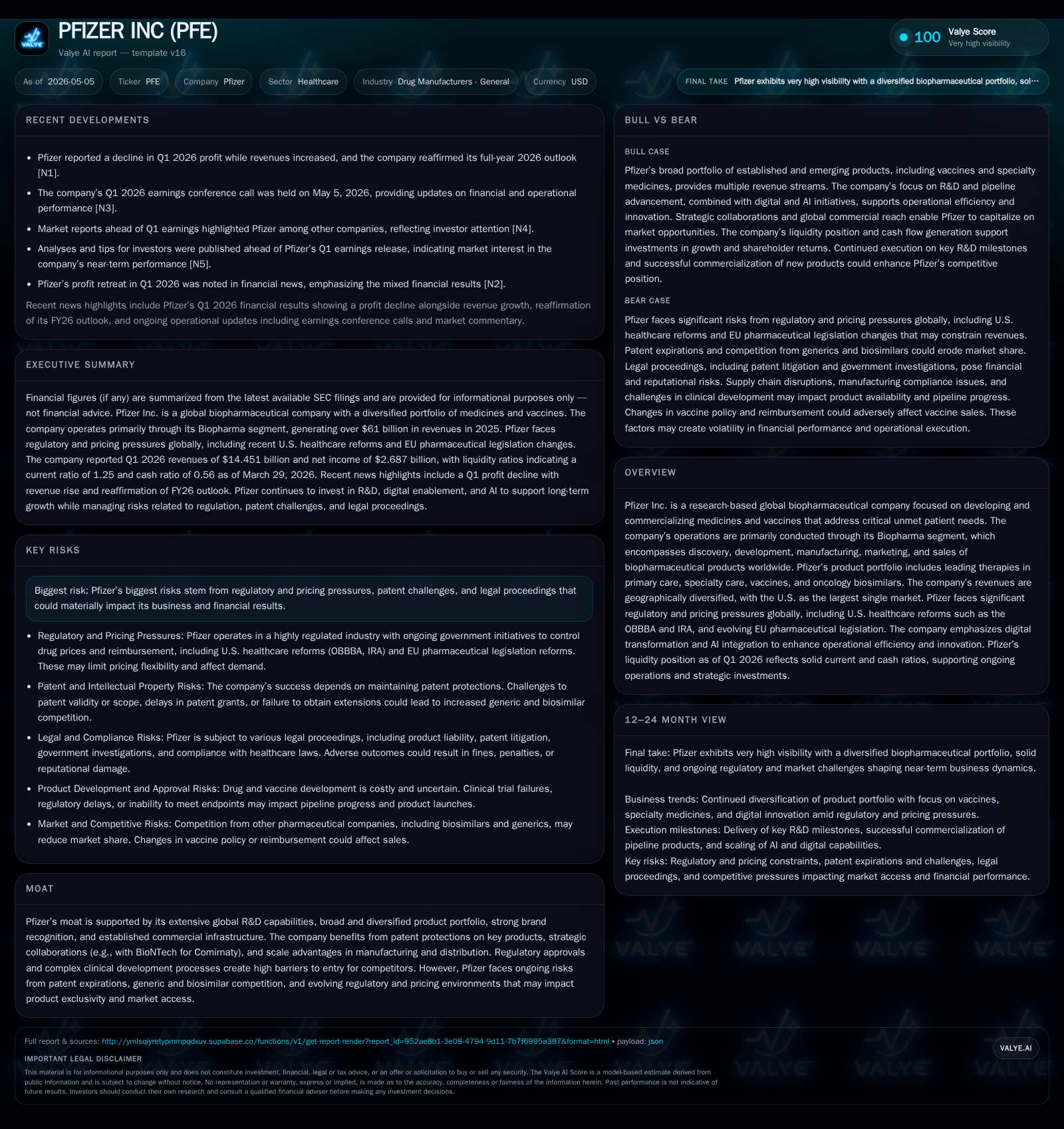
In Pfizer’s Q1 2026 earnings and 10-Q filing, revenue trends show pressures from patent expiries and increased competition, notably in its Biopharma segment which remains the core revenue driver. The company continues to expand via acquisitions such as Metsera, integrates digital innovation, and navigates evolving global regulatory constraints impacting pricing and market access. Growth hinges on successful development and commercialization of new therapeutics amidst a complex international landscape marked by healthcare reforms and biosimilar competition. Legal and regulatory risks persist but are managed within an established global infrastructure reinforced by scale, R&D capabilities, and portfolio diversification.
Recent Operating Update: Q1 2026 Earnings
Pfizer’s 10-Q filing dated May 5, 2026 [S2] coupled with the concurrent 8-K release [S3] provide the freshest snapshot of operational performance revealing a nuanced picture. The first quarter reflected continued revenue pressure largely driven by patent expirations impacting several established products—estimated to cost Pfizer roughly $1.5 billion in top-line impact this year [S8]. Nevertheless, revenues remain substantial underpinned by Pfizer’s Biopharma segment which encompasses their core vaccine portfolio (including COVID-related products), primary care medicines, specialty therapies, and oncology biosimilars. The company confirmed its full-year outlook despite these headwinds [N7][N8], signaling management confidence in offsetting factors such as pipeline launches and operational improvements.
The filings also reaffirm Pfizer's commitment to accelerating digital transformation initiatives aimed at embedding AI tools into drug discovery pipelines and commercial operations [S1]. These efforts seek to enhance clinical trial productivity and rapid identification of promising compounds amidst an increasingly competitive innovation landscape.
Business Model: Revenue Mechanics & Strategic Positioning
Pfizer operates chiefly through its Biopharma segment [S13], which drives nearly all commercial revenue via discovery-to-commercialization integration: discovery of molecules, clinical development through multiple phases, obtaining regulatory approvals worldwide, manufacturing at scale, then marketing globally through robust sales channels.
Revenue flows primarily from direct sales of patented pharmaceuticals and vaccines paid for predominantly by pharmaceutical benefit managers (PBMs), government programs like Medicare/Medicaid in the U.S., private insurers internationally, as well as direct government procurement in certain regions. Pricing power stems from product exclusivity secured by patents or regulatory protections; however, this is eroding with biosimilar entrants after exclusivity expiry. Product volumes are influenced by clinical adoption rates, disease epidemiology trends, insurance coverage dynamics, regulatory approvals/label expansions, and formulary positioning.
Key strengths lie in Pfizer’s broad product mix covering primary care drugs (e.g., cardiovascular agents), specialty pharmaceuticals (targeted biologics for rare diseases), innovative vaccines—including leadership in COVID-19 immunization—and oncology biosimilars benefiting from growing cancer treatment demand. The company leverages scale advantages in manufacturing capacity — including complex biologics production — logistical reach across critical markets such as North America—its largest revenue base—and emerging economies.
However, pricing strategies face increasing scrutiny from government reforms aimed at curbing drug costs both in the U.S. (OBBBA prescription drug boards; IRA pricing reforms) and Europe (new EU Pharma Package legislated reforms effective post-2027 setting stringent rules for authorization and market access) [S1][S26]. State-level initiatives intensify this trend along with payor focus on generics/biosimilars to generate system savings.
Industry Structure & Competitive Position
Pharmaceutical manufacturing is characterized by high barriers to entry: extensive R&D requirements typically costing billions over many years; regulatory approval complexities; patent-mediated exclusivity periods; capital-intensive manufacturing; and entrenched distribution networks requiring global scale.
Pfizer ranks among the top biotech/pharma firms globally with significant R&D spend supporting a diverse late-stage pipeline—the company emphasizes internal innovation supplemented by strategic acquisitions (e.g., Seagen for oncology biologics; recent acquisition of Metsera targeting novel GLP-1 receptor antagonist therapies) [S17][S18]. This bolsters Pfizer’s standing amid peers like Johnson & Johnson, Merck, Bristol Myers Squibb, Roche, and Eli Lilly who similarly consolidate portfolios through M&A.
Competitive dynamics also include accelerating biosimilar entry particularly in mature markets where original brands lose exclusivity; payors exert downward pressure on prices through formularies and reimbursement caps; plus evolving regulatory frameworks that prolong or limit market access duration for innovative drugs.
Pfizer’s moat derives not only from its R&D capabilities but also its commercial execution prowess—global footprint enables it to navigate diverse reimbursement landscapes while scaling production efficiently—a critical advantage for vaccines where tender processes dominate.
Growth Drivers
- Pipeline Advancement: Focused investment in high-potential therapeutic areas such as oncology biologics (Seagen portfolio integration), metabolic diseases (Metsera acquisition candidates MET-097i/233i), gene therapies, mRNA technology platforms leveraging earlier success with COVID-19 vaccines.
- Vaccine Expansion: Ongoing participation in global immunization programs via tenders across EU member states, emerging markets; leveraging EUA pathways during public health emergencies fostering rapid deployment;
- Digital & AI Innovation: Applying AI across drug development cycles promises accelerated identification of candidates lowering time-to-market;
- Strategic Acquisitions: Targeted M&A supplements internal pipeline gaps enhancing therapy breadth over medium term;
- Geographic Diversification: Strengthening presence beyond U.S. into Asia-Pacific/EU markets mitigates localized regulatory/payer risk;
- Manufacturing Optimization: Continuous improvements aiming to reduce per-unit costs underpin gross margin resiliency.
Risks / Watchpoints / Growth Constraints
- Patent Expiration Impact: With estimated $1.5B erosion expected in 2026 alone due to lost exclusivities [S8], sustaining revenue growth depends critically on new product approvals and launch execution;
- Pricing & Regulatory Pressure: Heightened governmental interventions worldwide challenge sustainable pricing; PFIZER faces intricate compliance landscapes including recent Medicare policy shifts reducing routine childhood immunizations recommended [S26];
- Biosimilar Competition: Increasing acceptance/regulatory approval of interchangeable biosimilars threatens flagship biological products;
- Legal Proceedings: Ongoing litigation risks including antitrust suits related to previously acquired Greenstone subsidiary generics business allegations [S16][S27], intellectual property challenges could disrupt market exclusivity;
- Operational Complexity Risks: Large-scale integrations (Seagen/Metsera), restructuring costs may induce transitional inefficiencies harming near-term profitability;
- Data Privacy & Compliance Risks: Increasing regulations around data protection complicate AI/data-driven R&D approaches [S15];
- Market Volatility & Reimbursement Changes: Shifts in payer formulary policies or government budget cuts may limit uptake even for new products.
What to Watch Next
Keep close tabs on quarterly updates bringing insights into:
- Pipeline trial milestones: FDA/EU approval status particularly of late-stage metabolic disorder candidates post-Metsera acquisition;
- Sales traction of recently launched vaccines or specialty drugs amid evolving immunization guidelines;
- Biological patent litigation outcomes or settlement developments affecting key revenue streams;
- Impact assessment of regulatory changes under IRA implementation phases affecting Medicare reimbursements;
- Any revisions to guidance reflecting emerging macroeconomic or geopolitical factors influencing supply chains or demand;
- Further announcements regarding AI/digital platform rollouts potentially driving incremental R&D productivity gains.
Financial Profile Snapshot
Latest financial snapshot
| Metric | Value | Period |
|---|---|---|
| Cash & equivalents | $1703mm | |
| 2026-03-29 | ||
| Current assets | $42.8bn | |
| 2026-03-29 | ||
| Current liabilities | $34.3bn | |
| 2026-03-29 | ||
| Current ratio | 1.25x | |
| 2026-03-29 |
Source: SEC companyfacts cache [F1].
Pfizer maintains a solid liquidity position supported by $1.703 billion cash and equivalents as of March 29, 2026 [F1] amidst current assets totalling $42.8 billion versus current liabilities of $34.3 billion yielding a current ratio around 1.25. Total debt reported at roughly $4 billion reflects conservative leverage relative to cash size though note this is best-effort data from late 2020 due to lagged disclosures [F1]. Operational cash flows remain a fundamental source supporting ongoing investments while capital structure flexibility is enhanced via access to credit lines detailed in prior filings [S4]. The company's total revenues stand near $62.6 billion (year ended December 31, 2025) underscoring massive scale yet reflective of modest declines year-over-year impacted by patent cliffs [F1]. Net income amounted to about $7.77 billion during the same period illustrating continued profitability albeit compressed compared to previous years due partly to restructuring charges and R&D spending ramp-up [F1][S20].
FY 2025 |
Disclaimer
This analysis is designed solely for informational purposes based on publicly available regulatory filings and news sources as of May 2026. It does not constitute investment advice or recommendations regarding Pfizer Inc.'s securities or business prospects.
Disclaimer: This is research-only, informational analysis and not investment advice. It may include AI-generated interpretation and general industry context. Always verify important details using primary sources.

Comments