
TVA Updates Operational Outlook with Leadership Transition and Environmental Compliance Focus
TVA’s Q2 2026 filing reveals key leadership changes and renewed emphasis on cost control and environmental compliance amid regulatory complexities.
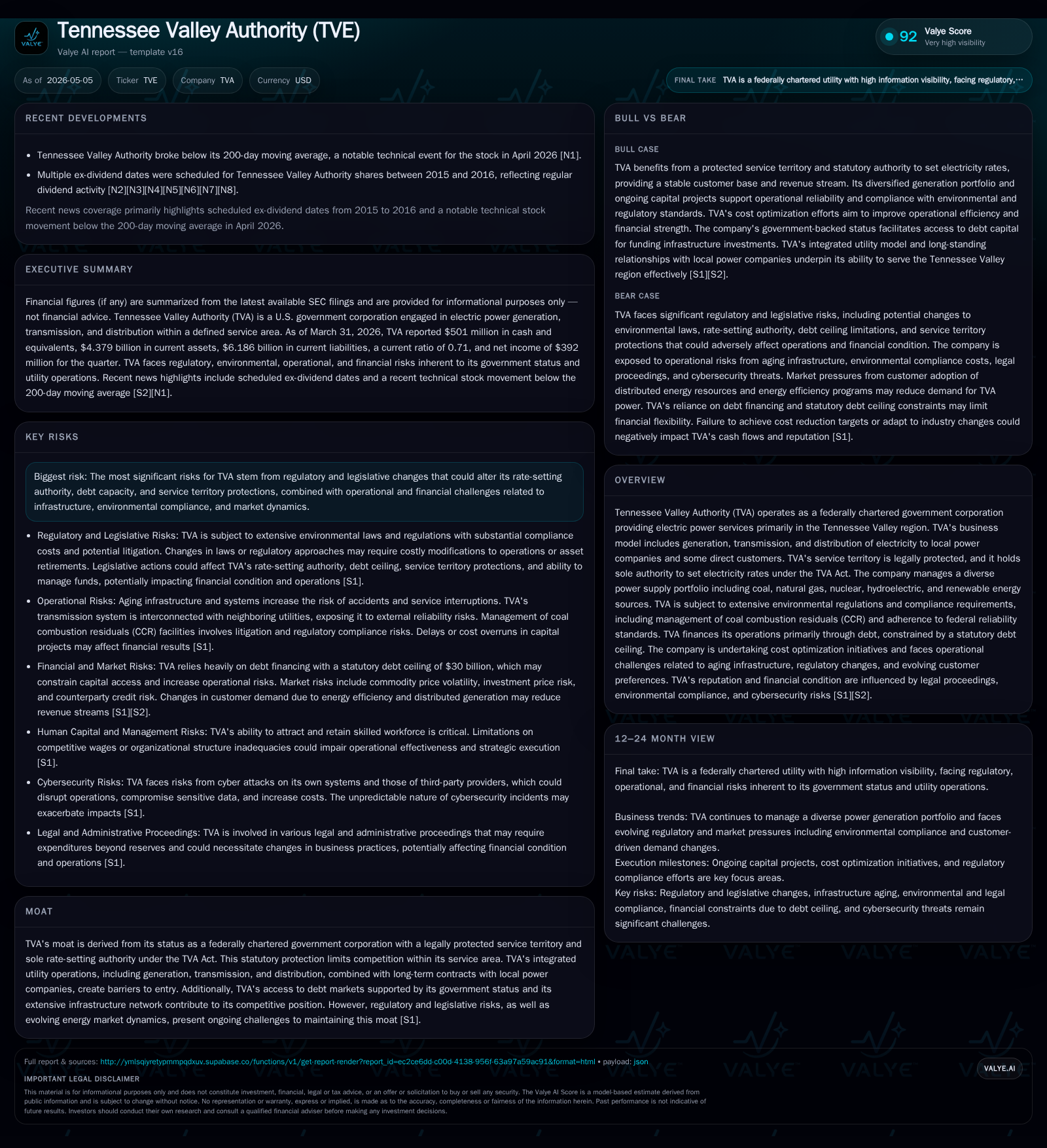
The Tennessee Valley Authority reported significant leadership transition with the appointment of an interim CEO following the forthcoming retirement of its prior chief. Its latest quarterly disclosure highlights ongoing cost optimization measures aligned with environmental compliance initiatives, particularly managing coal combustion residuals amid changing regulations. TVA's unique government corporation framework underpins its monopoly power in a legally protected service territory, even as it contends with evolving regulatory and financial constraints. The utility’s diverse energy portfolio balances legacy coal and nuclear plants with increasing renewable integration, shaping its operational and growth outlook.
Q2 2026 Operating Update: Leadership Shift and Cost Initiatives
In its May 5, 2026 quarterly report (10-Q), TVA disclosed the appointment of Michael D. Skaggs as Interim President and CEO effective April 24, 2026 through April 24, 2027. Skaggs will succeed Donald A. Moul who notified the Board of his retirement effective July 1, 2026. This leadership transition occurs amid intensified focus on operational efficiency and cost containment within a challenging regulatory environment characterized by heightened environmental compliance demands [S2], [S3].
The Q2 filing articulates that TVA continues to execute cost optimization programs designed to mitigate the financial impact of expensive environmental regulatory mandates. These initiatives are crucial given the capital-intensive nature of TVA's generation portfolio upgrades and remediation projects underway. The continuity from a seasoned interim executive suggests an emphasis on steady execution in navigating federal oversight complexities alongside mandated infrastructure investments [S2].
How TVA’s Government Corporation Model Shapes Its Monopoly Power
TVA operates uniquely as a federally chartered government corporation with a fixed service territory primarily covering the Tennessee Valley region. Under the TVA Act, it holds sole authority to set electricity rates for its local power company (LPC) customers and some direct industrial consumers. This statutory framework grants it a protected monopoly reinforced by legal restrictions known colloquially as "the fence" which limits third-party electricity sales within the area.
This regulatory moat confers durable pricing power absent traditional competitive pressures typical in private sector utilities. Integration across generation, transmission, and distribution further entrench barriers to entry by consolidating operational control over the regional power system. Moreover, TVA's government affiliation facilitates access to debt capital essential for funding its extensive infrastructure base even though this is constrained by a statutory $30 billion debt ceiling—a key structural limitation affecting flexibility [S1].
Power Supply Mix and Service Offerings: Managing Coal, Nuclear, Hydro, and Renewables
TVA's energy supply portfolio reflects a diversified generation mix balancing baseload reliability with incremental clean energy targets. Coal-fired plants remain significant but are increasingly costly due to stringent compliance requirements for coal combustion residuals (CCR) management—some facilities built before liner rules require substantial remediation or closure orders enforced by state regulators.
Its nuclear fleet continues operating under rigorous safety oversight with assets supported by a Nuclear Decommissioning Trust ensuring future decommissioning funding; however, shifting NRC standards or adverse market conditions could increase contribution needs unexpectedly.
Hydroelectric generation leverages abundant natural resource capacity providing low-emission baseload power complementary to intermittent renewables which TVA has steadily integrated into its portfolio. Nonetheless, escalating environmental regulations necessitate continuous adaptation of this mix to balance cost, reliability, and sustainability objectives [S1].
Industry Position: Regulatory Protections and Competitive Barriers
Within the U.S. energy landscape, TVA operates largely insulated from local competition due to its legislative protections but remains susceptible to evolving federal and state environmental mandates that can influence operational costs or asset viability.
Federal Energy Regulatory Commission (FERC) policies such as the anti-cherrypicking provision prevent external sellers from using TVA's transmission network to serve customers within TVA’s service area — reinforcing territorial exclusivity. Yet legislative proposals or judicial rulings could undermine these protections, incrementally exposing TVA to market competition or diluting rate-setting autonomy.
Compliance with North American Electric Reliability Corporation (NERC) standards imposes additional obligations on system reliability demanding ongoing investments in grid resilience and cybersecurity measures. These factors collectively elevate barriers against non-integrated entrants but also increase capital outlays required to sustain licensing compliance and operational excellence [S1], [S17], [S22].
Growth Catalysts: Environmental Compliance, Rate-setting Authority, and Infrastructure Investments
TVA's growth trajectory is anchored in leveraging its statutory rate-setting powers within its captive customer base while investing strategically in infrastructure modernization including grid enhancements aimed at improving reliability and facilitating integration of distributed energy resources.
Environmental remediation remains a focal point; particularly closure or beneficial reuse of CCR impoundments such as at Allen Fossil Plant which contribute materially to capital expenditures yet fulfill regulatory mandates mitigating legal risks.
The adoption of new LTIP performance metrics focused on Project Milestones reflects management's prioritization of disciplined execution on large-scale projects exceeding $200 million that are critical for extending asset life or meeting regulatory commitments — enabling better visibility into progress on growth-driving initiatives [S2], [S4], [S19].
Rates under long-term Partnership Agreements with LPCs offer stable revenue streams although they include provisions for renegotiation tied to rate increases or cost containment effectiveness underscoring tight operational execution requirements.
Facing Risks: Regulatory Uncertainty, Environmental Costs, and Debt Capacity Limits
The foremost risks confronting TVA arise from potential adverse legislative or regulatory shifts that could erode territorial privileges or limit rate-setting powers disrupting cash flow predictability.
Environmental liability penalties stemming from CCR facility management failures or premature generation unit retirements may escalate remediation costs beyond current forecasts stressing budgets.
Financially, TVA's reliance almost entirely on debt financing places significance on maintaining access to credit markets within its statutory $30 billion debt cap; approaching this ceiling reduces flexibility for new capital projects or emergency funding needs which could delay infrastructure investments or necessitate rate hikes creating political challenges.
Additionally, strained liquidity ratios (current ratio approximately 0.71) highlight tighter working capital buffers requiring close management especially amid volatile commodity prices affecting fuel expenses for coal and gas units [S1], [F1], [S17].
Upcoming Milestones: Monitoring Legislative Developments and Operational Execution
Key near-term points of attention encompass monitoring federal legislative proposals influencing anti-cherrypicking application or adjustments to TVA's service area protections which may alter competitive dynamics.
Operationally critical milestones include achieving timely completion of Board-approved environmental remediation projects influencing CCR compliance status as well as progress on transmission system upgrades tied to reliability enhancements.
Updates on rate schedules built around current Partnership Agreements will provide insight into margin sustainability given cost pressures.
Watch also governance developments following the leadership transition which may affect strategic direction relating to clean energy deployment pace or organizational restructuring efforts.
Financial Overview: Liquidity, Leverage, and Capital Constraints
Latest financial snapshot
| Metric | Value | Period |
|---|---|---|
| Cash & equivalents | $501mm | |
| 2026-03-31 | ||
| Current assets | $4.4bn | |
| 2026-03-31 | ||
| Current liabilities | $6.2bn | |
| 2026-03-31 | ||
| Current ratio | 0.71x | |
| 2026-03-31 |
Source: SEC companyfacts cache [F1].
As reported at quarter-end March 31, 2026 via companyfacts data corroborated with SEC filings:
- Cash & equivalents stand at $501 million reflecting liquid reserves supporting near-term obligations.
- Current assets total approximately $4.38 billion against current liabilities of $6.19 billion yielding a current ratio near 0.71 indicating modest short-term liquidity tightness.
- Total debt figure available is dated back to September 2014 at roughly $1.3 billion; precision here is limited by absence of newer explicit figures though net debt inferred around $799 million suggests steady leverage levels consistent with reported statutory constraints.
- Historical operating income exceeded $2.5 billion (as last annual reference) underscoring robust earnings capacity though impacted periodically by extraordinary environmental-related expenses.
These data points confirm that while TVA maintains sizeable operational cash generation ability supported by governmental backing for debt issuance, balance-sheet constraints require careful financial planning especially under tightening regulatory capital expenditure demands.[F1]
This analysis uses exclusively publicly available SEC filings up to May 5th, 2026 combined with structured numeric data provided without speculative commentary or investment recommendations.
Disclaimer: This is research-only, informational analysis and not investment advice. It may include AI-generated interpretation and general industry context. Always verify important details using primary sources.

Comments