
Neuronetics Drives Growth Through Integrated TMS Solutions Amid Cost Pressures
Neuronetics leverages FDA-cleared NeuroStar systems and its Greenbrook outpatient network to expand TMS therapy access, while managing ongoing financial challenges.
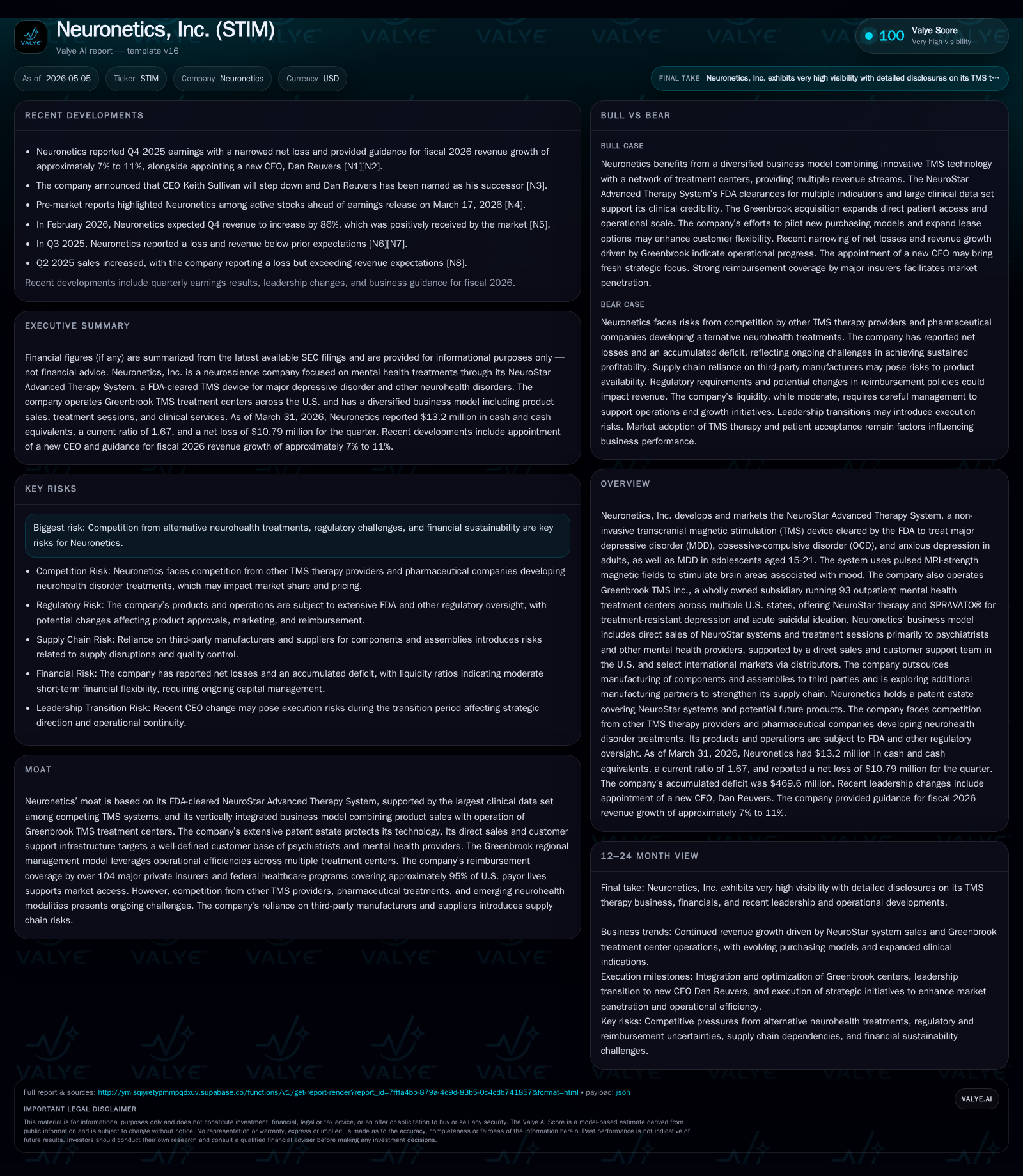
In Q1 2026, Neuronetics advanced its strategy combining direct sales of its NeuroStar Advanced Therapy System with operation of 93 Greenbrook mental health centers. While revenue growth shows progress, operating losses persist amid investments in sales and marketing and product development. The company’s moat derives from its FDA clearance, clinical data depth, and vertical integration of TMS delivery, supported by broad reimbursement coverage. Industry fragmentation and competitive pressures, alongside regulatory and financial covenant risks, remain important challenges as Neuronetics pursues sustainable growth.
Recent Operating Update
Neuronetics’ latest quarterly filing dated May 5, 2026 ([S2]) reveals key financial and operational developments underpinning its strategic trajectory. For the three months ended March 31, 2026 (Q1 2026), the company reported having $13.2 million in cash and equivalents with total debt standing at $65 million net of discounts ([F1], [S2]). During fiscal year ending December 31, 2025, Neuronetics raised approximately $8.3 million via its At-The-Market (ATM) equity offering program priced at an average of $3.68 per share. As of quarter-end March 31, it retains a significant capacity—$41.7 million—for further ATM issuances ([S2]).
The company continues to operate under a credit facility subject to liquidity and trailing twelve-month minimum revenue covenants ([S2]), with some uncertainty flagged around meeting revenue covenants for the March 2027 period ([S20]). Operating losses persist as Neuronetics invests heavily into sales/marketing initiatives and product development aimed at accelerating market penetration ([N1], [S2]). This operating cadence was reflected in Neuronetics reporting negative cash flows from operations totaling $9.4 million for Q1 2026 ([S8]).
Complementing these financial disclosures is an event filing on May 5, 2026 ([S3]) that includes the company’s earnings press release incorporated by reference ([N1]). The report highlights that revenue outpaced Street estimates despite continued net losses, underscoring partial success during ongoing profitability challenges.
Business Model Overview
Neuronetics generates revenue chiefly through two interrelated components: (1) sales of its NeuroStar Advanced Therapy System devices directly to psychiatrists and mental health providers; (2) delivery of treatment sessions primarily through its wholly owned subsidiary Greenbrook TMS Inc., which operates a network of outpatient mental health centers across multiple U.S. states.[S1],[S2]
The NeuroStar device uses transcranial magnetic stimulation (TMS), a non-invasive neuromodulation technology applying pulsed MRI-strength magnetic fields to targeted brain regions associated with mood regulation[S1]. It is FDA cleared for major depressive disorder (MDD), obsessive-compulsive disorder (OCD), anxious depression in adults, as well as MDD in adolescents aged 15-21 years[S1]. This regulatory clearance serves as a cornerstone moat element.
Greenbrook TMS enhances the end-to-end value chain by facilitating direct patient access to TMS along with adjunct use of SPRAVATO® nasal spray (esketamine) treatments for treatment-resistant depression or acute suicidal ideation ([S1], [S2]). This vertical integration from equipment manufacture through treatment delivery allows Neuronetics tighter control over clinical outcomes and payer engagement dynamics compared to pure hardware vendors.
The company’s direct sales force targets psychiatrists and mental health providers with comprehensive education on TMS benefits; post-sale customer support aids retention and repeat utilization[S1]. Revenue growth mechanics hinge upon device placements plus recurring treatment sessions sold either at Greenbrook centers or affiliated clinics utilizing NeuroStar units.
Industry Structure and Competitive Position
Neuronetics operates within a fragmented neuropsychiatric therapeutics market centered on neuromodulation devices for psychiatric conditions—a sector where adoption has grown but remains far from saturation[S1]. Competitors include other TMS device manufacturers as well as pharmaceutical companies pushing novel antidepressants or adjunctive treatments. Emerging digital therapeutics and neurofeedback modalities also vie for patient attention[S1].
Neuronetics' competitive strengths rest on:
- FDA clearance across multiple depression-related indications including adolescents—an uncommon regulatory achievement providing differentiation.[S1]
- The largest clinical data set supporting NeuroStar's efficacy bolstering physician confidence.
- Extensive patent protections limiting immediate threats from generic or copycat devices.
- A vertically integrated business model combining hardware sales with Greenbrook’s treatment network which is unique among peers primarily focused on product alone.[S1]
- Broad insurance reimbursement coverage encompassing over 104 major private insurers plus federal healthcare programs that cover roughly 95% of payor lives in the U.S., easing patient access barriers.[S1]
Nonetheless, challenges include considerable competition from other TMS providers gaining clinical traction; pharmaceutical pipelines developing next-gen antidepressants; limited physician awareness given psychiatry's historically slow uptake for device-based therapeutics; reimbursement landscape volatility; plus regulatory review complexities for expanded indications beyond current clearances.[S1][S20]
Growth Drivers
Key vectors driving Neuronetics' potential expansion include:
Clinical Indication Expansion:
Ongoing clinical trials aiming to enlarge label claims could capture additional patient populations suffering from OCD or other neuropsychiatric disorders beyond MDD.[S1] Broadening indications would deepen utilization within established customer networks.
Treatment Center Footprint:
Greenbrook’s network currently comprises 93 outpatient centers across many states,[S2] with room to expand geographically or via service diversification offering complementary therapies like SPRAVATO®. This increases penetration into underserved markets.
Provider Adoption Acceleration:
Salesforce investments aim to educate a physician base hesitant toward neuromodulation relative to drug prescriptions.[S2] Enhancing awareness reduces friction points around initial device purchases or referrals to Greenbrook facilities.
Increasing Treatment Session Volume:
Recurring revenue streams accrue from patients undergoing multiple TMS sessions per therapeutic course. Operational efficiency improvements at centers could boost throughput without proportional cost increments.
Reimbursement Stability & Payer Engagement:
Maintenance of broad coverage policies alongside advocacy efforts to secure higher reimbursement rates can improve monetization prospects.[S1]
Risks and Constraints
Several watchpoints merit attention:
Financial Sustainability:
The company continues operating at significant losses (e.g., $31.4 million operating loss for year-ended December 31, 2025)[F1], requiring capital raises evidenced by ATM issuances.[S2] Covenant risks under credit facilities introduce liabilities if revenue targets are missed.[S20]
Regulatory Environment:
Expansion or maintenance of FDA approvals governs growth pathways. Progress on growing the Greenbrook clinic network beyond current scale may serve as early validation of vertical integration benefits ([S2]). Updates around clinical trial outcomes could propel pipeline confidence extending NeuroStar’s addressable market ([S1]). Additionally, pricing actions or changes in reimbursement policy announcements will influence profitability trajectories.
Financial Profile Summary
Latest financial snapshot
| Metric | Value | Period |
|---|---|---|
| Cash & equivalents | $13mm | |
| 2026-03-31 | ||
| Total debt | $65mm | |
| 2026-03-31 | ||
| Net debt | $52mm | |
| 2026-03-31 | ||
| Current assets | $47mm | |
| 2026-03-31 | ||
| Current liabilities | $28mm | |
| 2026-03-31 | ||
| Current ratio | 1.67x | |
| 2026-03-31 |
Source: SEC companyfacts cache [F1].
| Metric | Value (USD) | Period Ending |
|---|---|---|
| Cash & Equivalents | $13.2 million | |
| 2026-03-31 | ||
| Total Debt | $65.0 million | |
| 2026-03-31 | ||
| Current Assets | $47.2 million | |
| 2026-03-31 | ||
| Current Liabilities | $28.3 million | |
| 2026-03-31 | ||
| Current Ratio | 1.67 | |
| 2026-03-31 | ||
| Net Debt (Debt - Cash) | ~$51.8 million | |
| 2026-03-31 |
Neuronetics maintains a balance sheet showing reasonable short-term liquidity with a current ratio above one but sizable longer-term debt obligations reflecting growth investments ([F1]). Operating losses continue to pressure cash flows despite rising revenues ([N1], [F1]). Ongoing capital market access via ATM offerings somewhat mitigates near term liquidity constraints ([S2]).
This analysis synthesizes the latest regulatory filings together with known industry dynamics but does not constitute investment advice or predict future performance. The company’s prospects depend heavily on successful execution amid evolving market conditions in neuropsychiatric therapy landscapes.
Disclaimer: This is research-only, informational analysis and not investment advice. It may include AI-generated interpretation and general industry context. Always verify important details using primary sources.

Comments