
Minerva Neurosciences Advances Schizophrenia Treatment Pipeline with Roluperidone Progress
Minerva’s Q1 2026 update spotlights clinical trial advancements and royalty income from seltorexant, underscoring strategic development and financial positioning amid capital needs.
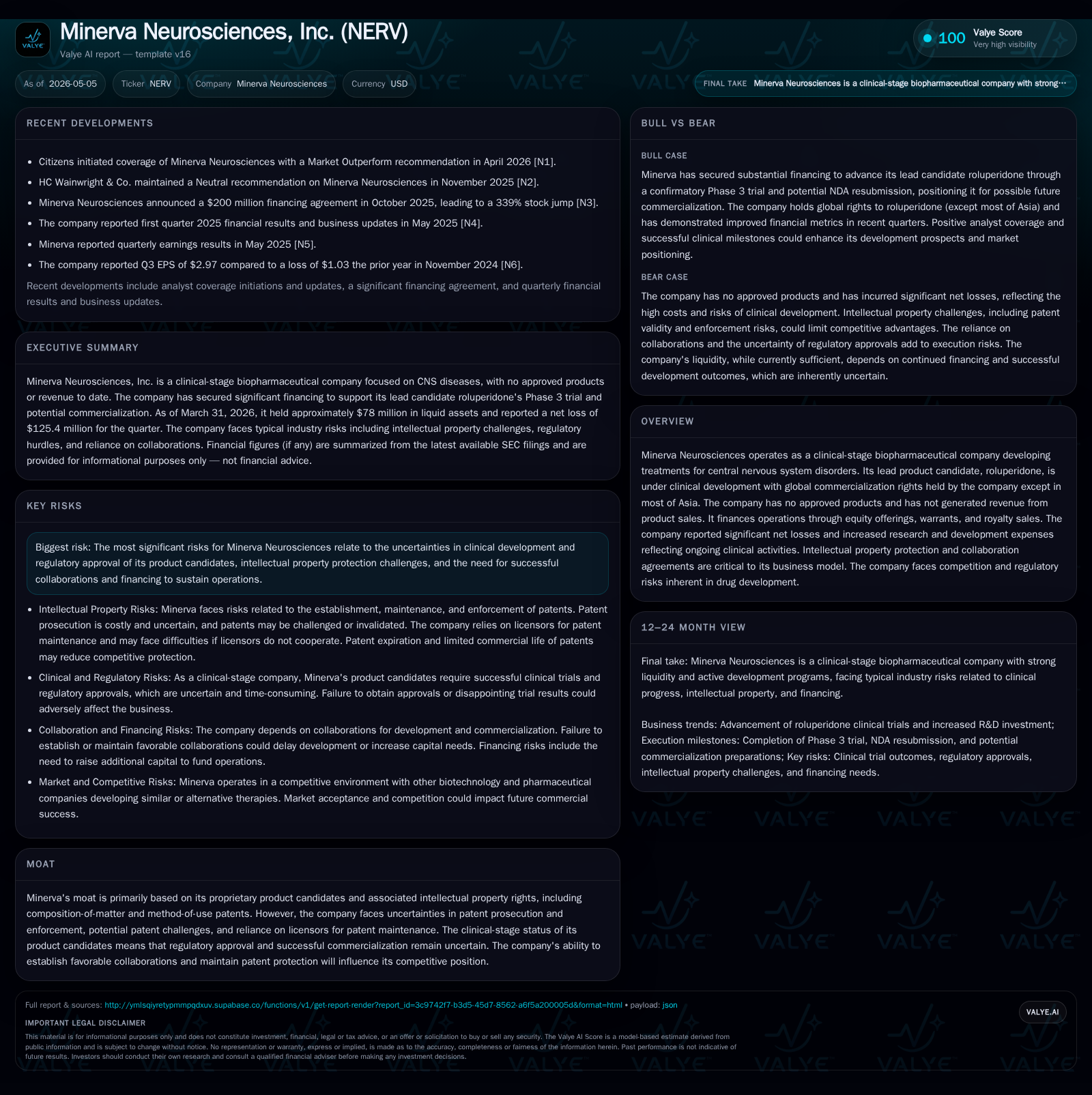
Minerva Neurosciences reported progress in advancing roluperidone through pivotal clinical trials targeting negative symptoms of schizophrenia, signaling a critical phase in its CNS-focused pipeline. Its opt-out of the Janssen co-development deal transformed seltorexant royalties into a recurring revenue stream, partially offsetting operating costs without further development expenses. As a clinical-stage biopharma company, Minerva depends on equity financing and milestone-based payments while navigating patent protection and regulatory challenges. The company's liquidity remains sufficient near term, though sustaining operations hinges on future capital raises aligned with clinical milestones and royalty inflows.
Latest Quarterly Operating Highlights
In its Q1 2026 filing dated May 5, 2026 [S2], Minerva Neurosciences detailed substantive operational progress centered on roluperidone, its lead CNS product candidate designed to target negative symptoms in schizophrenia. The company continues to advance this asset through pivotal Phase 3 clinical trials. Concurrently, Minerva reiterated that it exercised its contractual right to opt out of the Janssen co-development and license arrangement for seltorexant during 2020. This pivot transformed its relationship from development partner to royalty recipient.
Specifically, the company retains global commercial rights to roluperidone except for rights in much of Asia. For seltorexant — initially co-developed with Janssen as a treatment for insomnia disorder and adjunctive major depressive disorder — Minerva now collects mid-single-digit royalties worldwide on future sales in certain selected indications without incurring any ongoing development costs or obligations [S2]. This royalty stream acts as a partial offset to high R&D expenditures inherent in clinical-stage development.
This dual focus marks a nuanced operational profile: advancing a proprietary CNS pipeline through costly late-phase trials while leveraging royalty monetization agreements to partially stabilize cash flows. The company's recent press release accompanying the Q1 report also emphasized ongoing cost discipline alongside active engagement in potential strategic collaborations [S3].
Business Model and Product Portfolio Overview
Minerva Neurosciences functions as a clinical-stage biopharmaceutical entity heavily concentrated on central nervous system disorders treatment innovation [S1,S2]. Its revenue model currently lacks product sales income due to absence of approved therapeutics. Instead, Minerva’s economic foundation rests on equity financings (including convertible preferred stock issuance), milestone payments, potential royalties from prior agreements, and collaboration/license arrangements.
Roluperidone is the cornerstone asset—developed internally for negative symptoms of schizophrenia, an area with limited effective treatment options and substantial unmet medical need [S1]. High research and development expense lines reflect ongoing large-scale Phase 3 trials necessary before potential regulatory submission. Intellectual property protection notably encompasses composition-of-matter patents as well as use claims relevant to CNS indications [S1]. Protecting these patents remains central given intense competition within neuroscience drug development.
On the revenue side, recurring income stems largely from royalties on seltorexant sales following Minerva's decision to disengage from active co-development with Janssen [S1,S2]. The mid-single-digit percentage royalties for seltorexant represent a non-dilutive cash flow albeit subject to market uptake variability. Importantly, no further financial investments are required by Minerva toward seltorexant’s continued commercialization and trial phases handled by Janssen.
Competitive Environment and Intellectual Property Landscape
Within the crowded CNS therapeutic landscape, Minerva faces competition from multiple established pharma players developing novel molecules addressing schizophrenia’s negative symptoms—an inherently challenging clinical domain marked by complex pathophysiology and high unmet need [S1]. Establishing efficacy combined with safety profiles better than existing treatments is crucial for differentiation.
Minerva’s moat primarily derives from a strategic intellectual property portfolio built around its specialized CNS compounds including roluperidone. The company holds numerous U.S. and international patent applications covering compositions-of-matter along with method-of-use protections [S1]. However, a key vulnerability lies in its reliance on licensors who control patent prosecution activities; if licensors cease maintenance efforts or fail timely prosecution actions, Minerva must independently step in at considerable cost.
Patent enforcement risk further complicates competitive position because generic entrants or alternative approaches could challenge scope or validity leading to reduced exclusivity duration post-approval. Additionally, the timing of patent expiration influences commercial exclusivity windows critical for return on investment planning.
Growth Drivers: Clinical Development and Royalty Revenues
Roluperidone's advancement through pivotal Phase 3 trials constitutes Minerva’s primary structural growth driver [S2]. Successful completion of these trials followed by favorable regulatory verdicts would allow commercialization entry into an underserved schizophrenia subset focused on negative symptom management—a promising segment offering pricing power due to limited alternatives.
Tangible KPIs driving value realization encompass trial enrollment velocity, interim data readouts, regulatory submission dates (e.g., NDA/BLA filings), FDA feedback loops, and ultimately approval decisions.
Complementing pipeline value is the steady flow of royalty payments tied to seltorexant sales by Janssen [S2]. Since Minerva opted out of further development obligations yet retained royalty rights payable as long as specified conditions are met worldwide in defined indications, these streams provide recurring income that can partially fund operations.
Royalty receipts depend heavily on market adoption of seltorexant in insomnia disorder and adjunctive major depressive disorder settings—both competitive markets where Janssen's marketing effort will determine penetration rates.
Risks and Operational Constraints
Minerva operates under several prominent risks inherent in clinical-stage biotech ventures [S1]. First is clinical risk: late-stage trial failures or delays can materially impede timelines or render assets nonviable for approval.
Regulatory challenges introduce uncertainty regarding appropriateness of endpoints used in roluperidone studies or agency acceptance criteria that may evolve over time. Intellectual property risks compound uncertainties because lapses or legal disputes around patents could jeopardize market exclusivity.
Dependency on third-party collaborators such as Janssen for royalty compliance presents counterparty risk; if Janssen fails timely payments or breaches contract terms unexpectedly, Minerva faces contingent liabilities including reimbursement obligations to Royalty Pharma under prior agreements [S1].
Finally, sustained operation requires consistent access to financing given no product revenues exist yet developing CNS drugs demands high capital intensity amid lengthy approval processes.
Upcoming Milestones and What to Watch Next
Near-term catalysts include key data releases from ongoing Phase 3 roluperidone trials scheduled within upcoming quarters [S2]. Regulatory interactions regarding potential submission timing will also signal progression trajectory.
Updates regarding the performance of Janssen-driven seltorexant commercialization efforts affecting royalty volumes will be critical demand markers dictating cash inflows.
In addition, careful attention should be paid to any announcements about strategic partnerships or additional financing rounds which are likely given continuing R&D burn rates despite moderate cash reserves [S3,N1].
Earnings calls might offer incremental guidance or management commentary illuminating progress metrics or funding outlooks; however explicit forward-looking financial guidance remains limited typical of clinical-stage firms.
Current Financial Position
Latest financial snapshot
| Metric | Value | Period |
|---|---|---|
| Cash & equivalents | $33mm | |
| 2026-03-31 | ||
| Current assets | $79mm | |
| 2026-03-31 | ||
| Current liabilities | $4mm | |
| 2026-03-31 | ||
| Current ratio | 17.65x | |
| 2026-03-31 |
Source: SEC companyfacts cache [F1].
At March 31, 2026 quarter-end, Minerva reported cash and cash equivalents totaling approximately $32.7 million with current assets aggregating about $79.1 million versus current liabilities near $4.5 million—yielding a robust current ratio close to 17.65 indicating solid short-term liquidity coverage [F1,S2]. Total recorded debt was approximately $4.8 million based on best-effort available information [F1].
The company continues to incur net operating losses reflective of ongoing clinical trial investments without product revenues recorded yet [F1]. Accordingly, capital raised through equity offerings—including Series A convertible preferred stock private placements—and proceeds from royalty monetization remain crucial to maintain operational runway over the next twelve months and beyond given significant R&D cost commitments.
This financial standing provides a reasonable buffer but underscores dependence on clinical milestone progression and continuing capital market access for sustainable growth execution.
This analysis synthesizes facts drawn solely from latest SEC filings and company disclosures up to May 5, 2026 without speculative projection beyond documented evidence. It aims to illuminate Minerva Neurosciences' strategic positioning amid industry realities facing clinical-stage CNS biopharmaceutical firms.
Disclaimer: This is research-only, informational analysis and not investment advice. It may include AI-generated interpretation and general industry context. Always verify important details using primary sources.

Comments