
Arch Capital Group Advances Specialty Insurance Performance Despite Premium Decline
Arch Capital’s Q1 2026 results reveal resilience in underwriting profitability despite a drop in premiums, underscoring its strengths in specialty insurance and risk management.
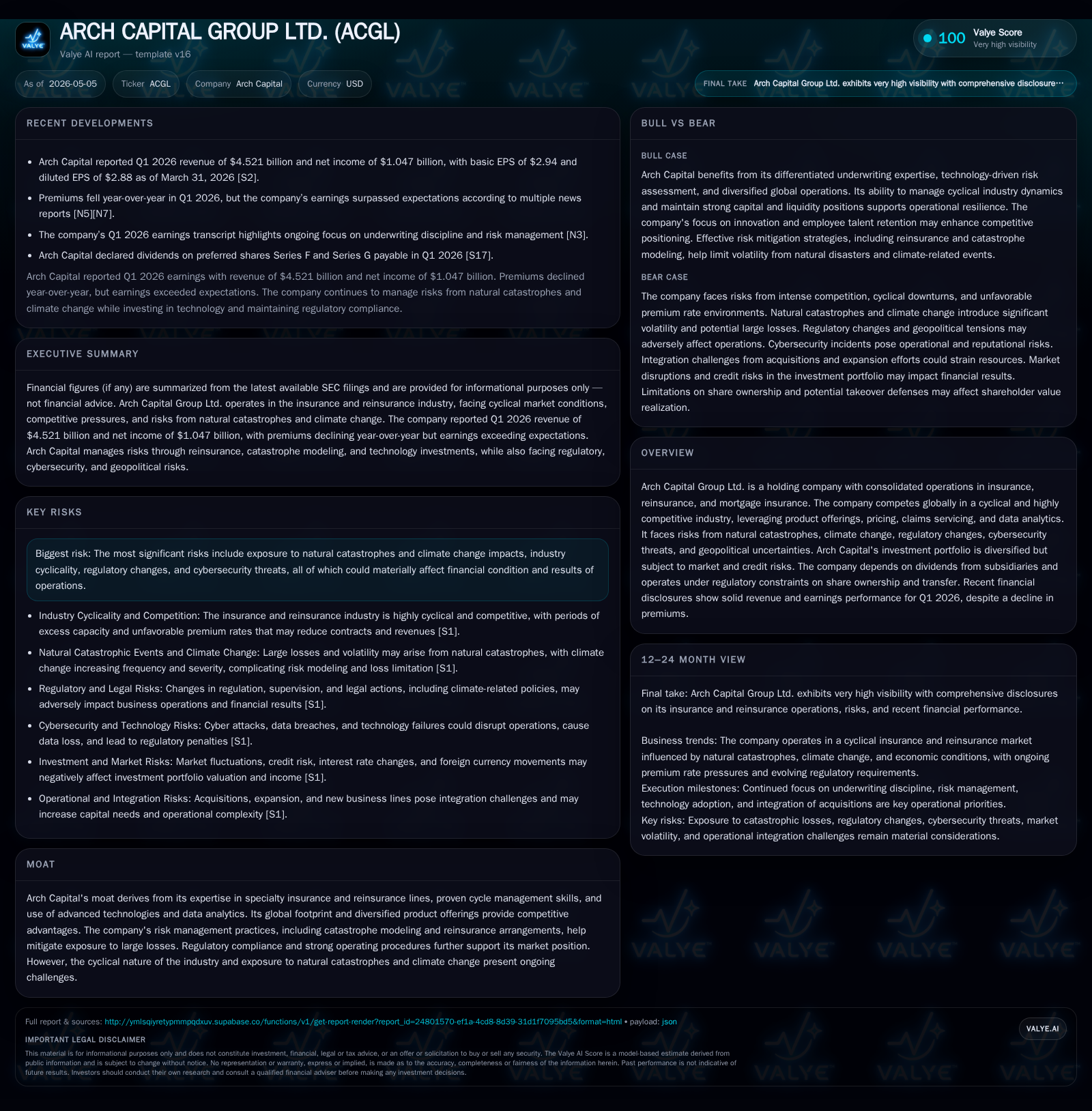
In its latest quarterly filing for Q1 2026, Arch Capital Group reported a decline in premiums written, reflecting ongoing cyclical challenges in the reinsurance market. Nevertheless, the company delivered solid earnings performance supported by disciplined underwriting and effective risk management. Arch Capital’s broad range of specialty insurance and reinsurance products, combined with advanced catastrophe modeling and data analytics capabilities, position it well competitively amid industry cyclicality. Key risks remain from natural catastrophes, regulatory pressures, and cyber threats, but the company’s strong capital position and operating model provide buffers as it navigates evolving market conditions.
Q1 2026 Operational Highlights and Market Context
Arch Capital Group Ltd.'s Q1 2026 Form 10-Q [S2] released May 5 highlights a nuanced operating environment marked by a decline in premiums written but stable overall earnings quality. Despite the premium contraction—reflecting a softening reinsurance cycle—the company managed to sustain underwriting profitability through disciplined pricing adjustments and risk selection. The April 28 press release detailed these dynamics [S3], underscoring Arch's ability to navigate challenging market fundamentals that have seen peers like Everest also report premium declines [N2]. Solid earnings outperformance relative to consensus [N5][N6] suggests emerging resilience in operational execution despite cyclicality inherent to the sector.
The premium softness aligns with industry-wide excess capacity pressures evidenced across specialty lines globally. However, Arch’s performance signals ongoing effective cycle management including selective underwriting remediation and leveraging data analytics to tighten loss ratios at scale.
Business Model and Core Product Segments
Arch Capital operates as a diverse holding company encompassing specialty insurance, reinsurance, and mortgage insurance segments [S1]. Its revenue derives primarily from premiums collected across these lines where customers—primarily institutional clients such as other insurers (in reinsurance) or mortgage originators (in mortgage insurance)—pay for risk transfer. Pricing mechanisms are governed by actuarial models informed by historical loss data combined with sophisticated catastrophe modeling.
Specialty insurance lines exhibit higher margins due to technical pricing expertise and less commoditized coverage offerings. Reinsurance operations carry more pronounced cyclicality but benefit from global diversification and retrocession arrangements that hedge large exposure concentrations [S1]. The mortgage insurance business adds further diversification with economic drivers tied to housing markets.
The firm's moat sustains on its advanced use of proprietary data analytics platforms that underpin underwriting decisions and claims servicing excellence. These technologies provide switching-cost effects for clients reliant on Arch’s predictive loss mitigation tools—a key differentiator versus generic commodity reinsurers.
Industry Dynamics and Competitive Positioning
The global insurance/reinsurance industry remains intensely competitive with cyclical swings impacting capacity deployment and pricing power. Natural catastrophe frequency influences market cycles substantially; after periods of heightened losses leading to price hardening phases, capital influx tends to pressure rates downward—exemplified by recent prime rate easing displayed in Arch’s premium trends.
Arch distinguishes itself from competitors like AIG or Everest through deeper specialization in niche segments coupled with robust catastrophe exposure management via retrocession layers and conservative risk appetite frameworks [S1][N2][N5]. Regulatory scrutiny intensified after its designation as an Internationally Active Insurance Group (IAIG) adds complexity but also affirms its systemic importance globally [S20]. This regulatory layering can act as both friction point and moat enabler if compliance drives operational discipline.
Primary Growth Vectors and Cyclicality Management
Despite premium softness near term, long-term growth drivers are structural. Arch pursues selective line expansions into emerging specialties less prone to commoditization—such as surety bonds where performance guarantees create sticky client relationships—and innovations within mortgage insurance exposing new risks aligned to evolving residential lending practices [S1][S2]. Expanding geographic footprints beyond historically concentrated zones bolsters resilience against region-specific catastrophes.
Investment in AI-driven loss propensity models enhances pricing accuracy facilitating margin improvements even amidst volatile claim frequencies [N3]. Performance indicators such as bookings growth in specialty lines or loss ratio stabilization will serve as leading signs of sustainable growth trajectories.
Risks and Constraints Shaping Future Performance
Material risks include amplified natural catastrophe losses intensified by climate change unpredictability impacting casualty severity patterns [S4][S8]. Regulatory fragmentation worldwide imposes compliance costs while posing constraints on capital mobility between jurisdictions [S20]. Cybersecurity remains an ongoing threat vector capable of disrupting claims processing or compromising sensitive customer data [S25].
Employee retention challenges threaten talent pipelines critical for maintaining underwriting excellence amid technological shifts [S24]. The cyclical nature of the sector inherently subjects Arch to periodic margin compression requiring constant agility.
Key Upcoming Catalysts and Monitoring Points
Future monitoring should focus on quarterly premium evolution to gauge pricing normalization pace alongside combined ratio metrics for underwriting profitability traction post-first quarter softness [S2][S3]. Progress on geographic expansion initiatives or new specialty product launches declared in earnings calls will indicate strategic execution effectiveness [N3]. Regulatory developments impacting IAIG status requirements or climate-related reporting obligations may alter capital allocation frameworks.
Watch also for enhancements in data analytics capabilities driving underwriting precision improvements—a critical intangible asset underpinning long-term competitive advantage.
Financial Overview Supporting Operational Insights
As of March 31, 2026, Arch Capital held $914 million in cash and equivalents providing liquidity buffer supporting capital-intensive underwriting cycles [F1]. This cash position enables flexibility to balance risk appetite versus investment return optimization even amid episodic claim spikes.
The company’s financial stability complements its operational strategy focused on disciplined risk selection calibrated by real-time analytics ensuring sustainable profitability through fluctuating cycles.
This analysis synthesizes Arch Capital Group Ltd.'s most recent SEC disclosures with industry context as of mid-2026. It emphasizes the company’s strategic strengths in specialty insurance lines leveraged through technology-enabled underwriting excellence while acknowledging cyclical pressures defining the broader reinsurance market environment. Key risks remain tied to natural catastrophe exposures intensified by climate change effects alongside regulatory complexity. Ongoing monitoring of premium trajectories, combined ratios, regulatory changes, and technology investments will be essential for assessing Arch’s path forward.
Disclaimer: This is a contemporaneous industry analysis intended solely for informational purposes without offering investment advice.
Disclaimer: This is research-only, informational analysis and not investment advice. It may include AI-generated interpretation and general industry context. Always verify important details using primary sources.

Comments