
Achieve Life Sciences Advances Cytisinicline Regulatory and Commercial Strategy
Recent filings reveal clinical trial completion, leadership renewal, and capital enhancements as Achieve prepares cytisinicline for commercial launch.
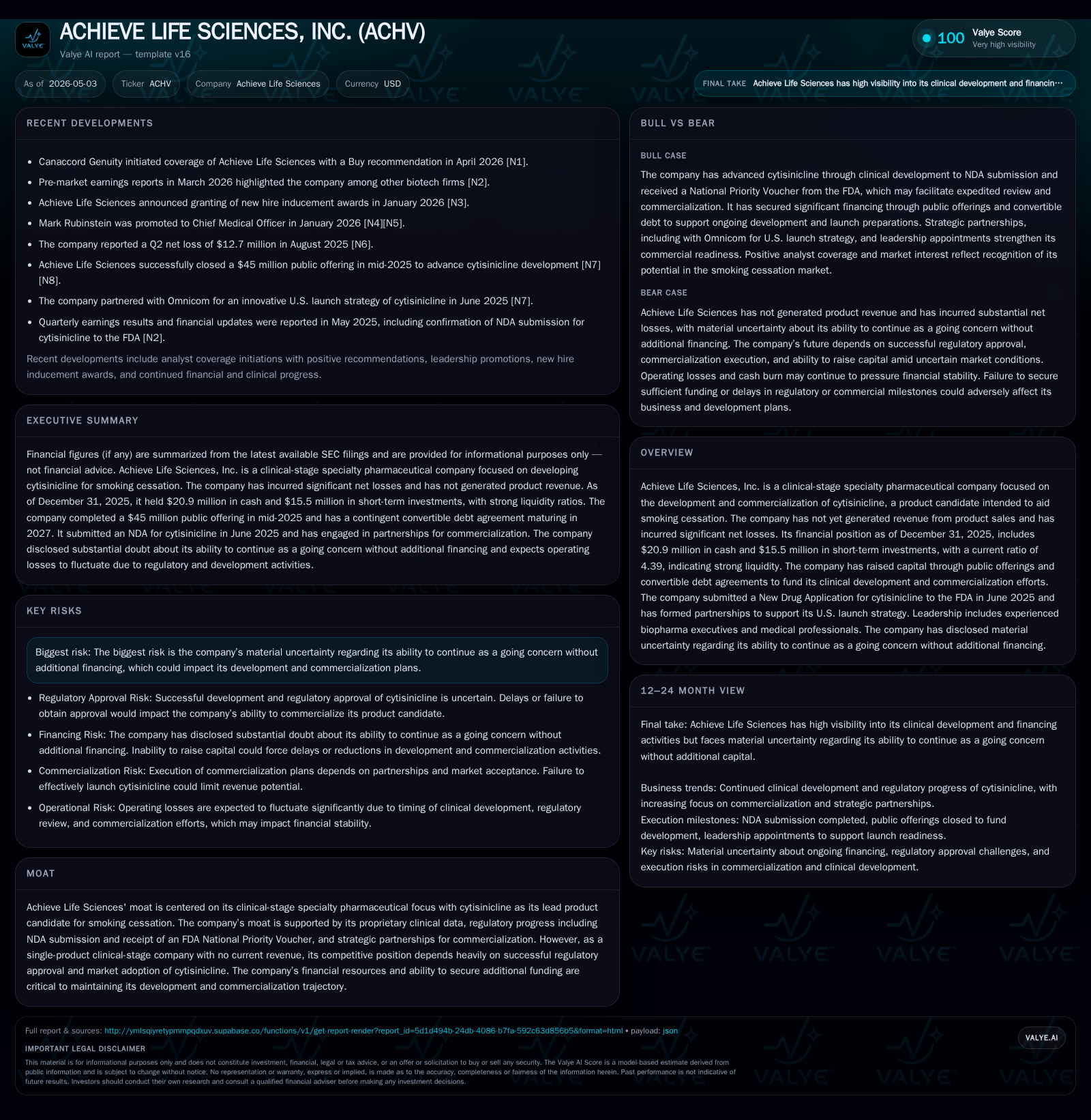
Achieve Life Sciences continues to solidify its development and upcoming commercialization of cytisinicline, a smoking cessation drug candidate. The completion of the pivotal ORCA-OL trial in late 2025 reduced R&D expenses but launched a surge in administrative costs linked to commercial readiness. A significant leadership change occurred with Dr. Andrew Goldberg assuming CEO duties in April 2026, signaling an intensified focus on market entry execution. While the company maintains a robust liquidity position with nearly $21 million in cash and a strong current ratio, financial sustainability remains dependent on timely regulatory approval and further financing. The smoking cessation therapy market is competitive and mature, posing both hurdles and opportunities for cytisinicline’s uptake.
Recent Operating Developments: Post-NDA Filing Progress and Leadership Changes
The most recent quarterly report filed November 6, 2025 ([S2]) marks a critical operational inflection point for Achieve Life Sciences as it completed the ORCA-OL open-label clinical trial for cytisinicline by September 2025. This milestone curtailed research and development expenses in the quarter relative to prior periods—R&D dropped from $7.6 million to $5.3 million in Q3 year-over-year—reflecting the end of resource-intensive enrollment activities.
Conversely, general and administrative costs surged significantly to $9.4 million from $4.9 million in the same period prior year, driven largely by costs linked to preparing for a commercial launch including staffing increases and marketing infrastructure buildup. This shift embodies the company’s transition from pure clinical development toward the commercialization phase after submitting its New Drug Application (NDA) for cytisinicline to the FDA in June 2025 ([S1]).
Further sharpening the commercial readiness lens was the appointment of Dr. Andrew Goldberg as CEO effective April 18, 2026 ([S3]). Dr. Goldberg's dual role as president and principal executive officer alongside his Board membership signals an executive-level pivot towards scaling operational capabilities relevant for launch execution. His separation agreement terms also indicate a strong retention focus amid anticipated transformational phases.
Business Model Overview: Cytisinicline as a Specialty Therapeutic Product
Achieve’s business model is singularly centered on achieving regulatory approval and subsequent commercialization of cytisinicline, a specialty pharmaceutical designed to aid smoking cessation ([S1],[F1]). Cytisinicline benefits from proprietary clinical data demonstrating efficacy sufficient for the company's June 2025 NDA submission underpinned by an FDA-granted National Priority Review Voucher—an instrument accelerating review timelines given public health importance ([S1]). However, the product's positioning as a single-asset pipeline constitutes a high operational leverage scenario typical for small specialty biopharma companies.
Commercialization economics will depend heavily on pricing agreements concluded with payers who historically resist premium pricing in smoking cessation segments due to availability of cheap generics such as nicotine replacement therapy (NRT) products or rival prescription drugs like varenicline (Chantix). The company’s margin profile remains forward-looking but subject to high fixed cost absorption due to investment imperatives around sales force deployment and market education.
Competitive and Industry Environment: Market Dynamics for Smoking Cessation Therapies
The smoking cessation treatment landscape is comparatively mature with entrenched incumbents—primarily Pfizer’s varenicline—and wide over-the-counter availability of generic NRT options ([S1],[N2]). This creates a complex environment characterized by patient stickiness to existing regimens driven by medical familiarity, payer formulary preferences favoring generics or proven brands, and variability in physician prescribing habits.
Switching costs embedded within behavioral treatment categories potentially slow adoption rates for novel entrants without compelling differentiation or demonstrable superior efficacy/safety profiles over commoditized therapies ([N2] analyst commentary). Furthermore, reimbursement challenges could impair pricing power absent clear value proposition narratives.
However, cytisinicline’s differentiation stems from its chemical nature as a plant-based alkaloid with established use outside the U.S., augmented by encouraging clinical safety data from the ORCA-OL trial targeting sustained abstinence potentials—a key demand driver given persistent gaps in outcomes across existing treatments.
Regulatory priority status granted by the FDA expedites review but does not mitigate competitive positioning risks; thus Achieve has pursued strategic partnerships aimed at expanding sales reach domestically once approved ([S1]).
Growth Drivers: Regulatory Momentum, Commercial Partnerships, and Market Adoption
Achieve’s growth trajectory is anchored on key pillars commencing with timely FDA approval under priority review that shortens decision latency post NDA submission ([S1],[S2]). Approval unlocks revenue prospects hinged on rapid market entry executed through partnerships whose rollouts are reflected indirectly by increased G&A expenditures noted during late 2025 indicating scaling efforts ([S2],[N2]).
Demand-side growth catalysts include prescriber adoption stimulated by educational campaigns converging around differentiated clinical safety/efficacy signals validated through recent trials; payer acceptance will follow contingent on cost-effectiveness evidence.
Investor communications emphasize monitoring metrics such as prescription volume ramp rates post-launch, formulary placements secured across pharmacy benefit managers (PBMs), as well as active management of supply chain robustness notably given reliance on external manufacturing partners ([N2],[S1]).
The nascent commercial infrastructure combined with regulatory momentum positions Achieve at an inflection stage where focused execution can translate into measurable topline acceleration.
Risks and Challenges: Financing Needs, Execution Risks, and Market Competition
A dominant risk remains Achieve’s dependence on securing additional financing notwithstanding current liquidity buffers as disclosed through year-end financials ([F1],[S2],[S3]). The filings explicitly disclose material uncertainties regarding going concern status driven by non-revenue status compounded by high operating burn rates aligned with advanced clinical/commercial activities.
Execution-wise, any delay or negative outcome in FDA review would be materially adverse given single asset dependency magnified within their business model framework ([S2]). Market competition intensifies challenges with entrenched therapies holding substantial mindshare; reimbursement resistance can erode achievable price points impairing targeted margins.
Additionally, regulatory compliance risks remain elevated due to stringent post-market requirements inherent to specialty pharmaceuticals alongside evolving healthcare policy environments affecting drug pricing transparency and reimbursement frameworks ([S15],[S18]).
Upcoming Milestones: FDA Review Progress, Launch Readiness, and Sales Targets
Following the June 2025 NDA submission using FDA’s priority review pathway endorsing faster review cycles, definitive regulator feedback is expected imminently or shortly post filing date timeframe ([S1],[N2]). This event constitutes a major binary catalyst influencing subsequent capital markets visibility and commercial partner engagement dynamics.
Under new CEO leadership since April 2026 ([S3]), focus areas include expanding sales force recruitment, finalizing distribution agreements, deploying marketing assets tailored towards physician outreach programs focused on differentiating cytisinicline versus incumbents—these represent measurable milestones that investors should track closely.
Initial sales volumes once on market will serve as foundational KPIs providing evidence whether adoption scales aligned with management projections amidst competitive headwinds ([N2]). Additional clinical readouts or real-world evidence initiatives may be leveraged subsequently to bolster product lifecycle value propositions.
Financial Profile Snapshot: Liquidity Status and Capital Structure
Achieve’s most recent balance sheet summary dated December 31, 2025 portrays a liquidity profile anchored by $20.93 million in cash & equivalents coupled with $39.89 million total current assets versus $9.08 million current liabilities yielding a sturdy current ratio of 4.39 indicating comfortable near-term solvency capacity supporting runway into late H2 2026 ([F1]).
However, recurring cash burn characterized by rising G&A linked to launch readiness underscores continued capital dependency requiring further financing rounds or strategic partnerships potentially dilutive or debt-bearing ([S2],[S3]).
This financial landscape aligns with typical profiles observed among specialty pharmaceutical entities transitioning from clinical development into early commercialization phases where funding access remains pivotal amidst binary risk appetite from capital markets.
Disclaimer: This analysis relies solely on publicly sourced SEC filings and related disclosures up to May 3rd, 2026. It does not constitute investment advice or recommendations but aims to provide an informed assessment grounded explicitly in verifiable operating data without speculative extrapolation.
Disclaimer: This is research-only, informational analysis and not investment advice. It may include AI-generated interpretation and general industry context. Always verify important details using primary sources.

Comments