
Navitas Semiconductor's Strategic Pivot to AI Data Centers Challenges Supply Chain and Execution
Shift from consumer markets to high-power GaN IC applications reshapes Navitas’ competitive and operational landscape.
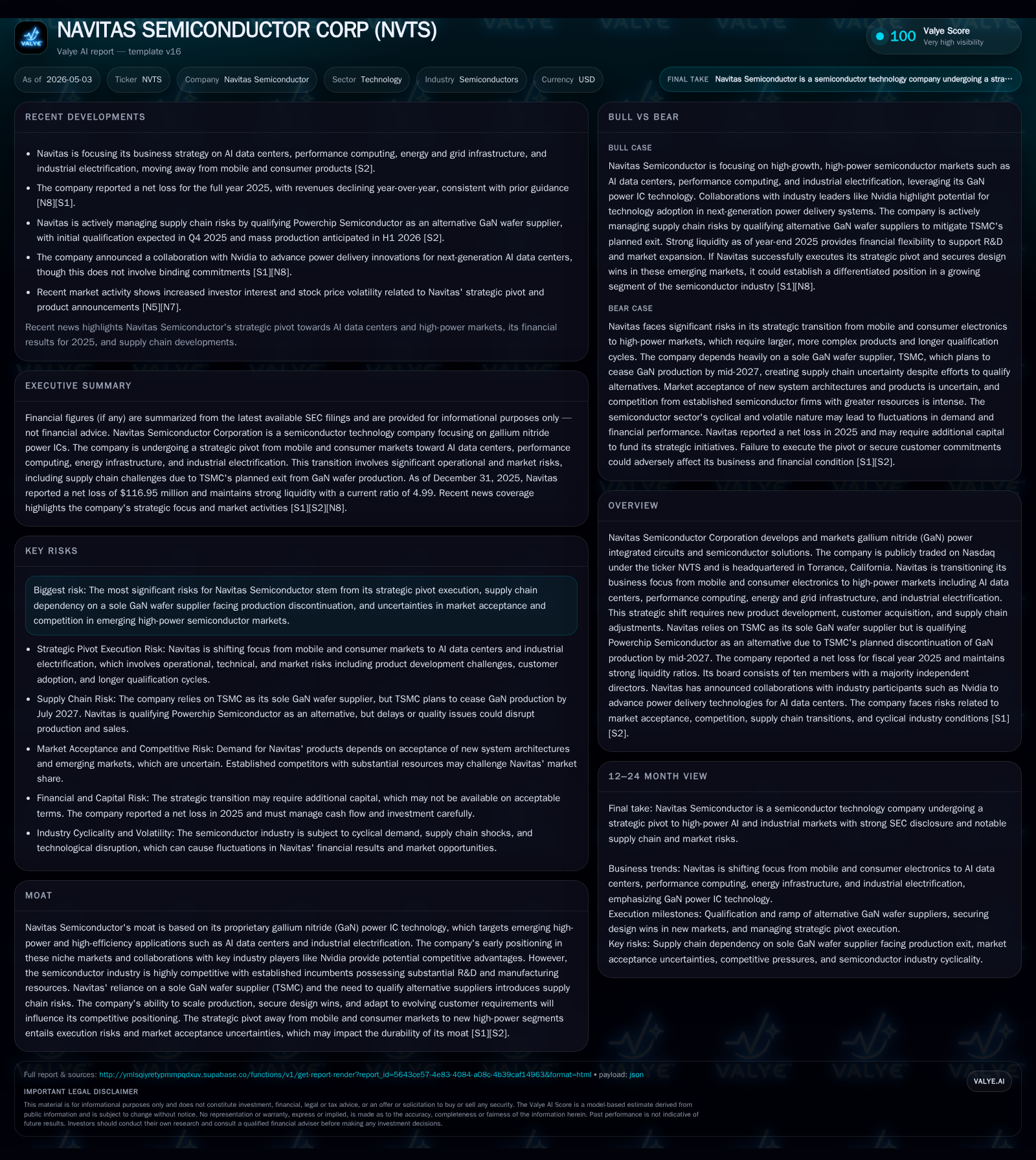
Navitas Semiconductor reported a strategic transition in its latest quarterly filing, pivoting focus from mobile and consumer electronics to high-power markets such as AI data centers, performance computing, and industrial electrification. This shift demands substantial R&D investment, new customer acquisition, and supply chain diversification, notably qualifying an alternative GaN wafer supplier due to TSMC’s planned production discontinuation. While proprietary GaN technology offers differentiation in emerging high-efficiency power segments, execution risks and supply dependencies remain critical challenges for sustainable growth.
Recent Operating Update: Strategic Shift Anchors Near-Term Narrative
Navitas Semiconductor's latest quarterly report (10-Q filed November 3, 2025) marks the company's formal strategic realignment towards supplying gallium nitride (GaN) power ICs primarily for AI data centers, performance computing, energy grids, and industrial electrification rather than its historical mobile and consumer electronics base [S2]. This shift introduces both an expanded total addressable market opportunity and operational complexities including development of larger die designs requiring higher performance thresholds.
Concurrently, Navitas disclosed its dependence on Taiwan Semiconductor Manufacturing Company (TSMC) as the sole GaN wafer supplier is under threat due to TSMC’s announced cessation of GaN manufacturing by mid-2027. To mitigate this critical supply-chain risk, Navitas is actively qualifying Powerchip Semiconductor as a secondary source—a pivotal move given long supplier qualification cycles common in high-reliability semiconductor markets [S1].
The company also recently expanded its Board of Directors with two new positions filled by Class III directors, including Gregory M. Fischer who joins compensation and executive steering committees. This governance augmentation coincides with Navitas’ significant strategic transition phase requiring robust oversight and expertise alignment [S3][S15].
Business Model: Selling Proprietary GaN Power ICs for High-Efficiency Applications
Navitas generates revenue by designing and marketing gallium nitride-based power integrated circuits aimed at improving energy efficiency and thermal performance compared to legacy silicon-based solutions. Customers pay for differentiated semiconductor components that enable faster switching speeds and higher voltage support essential in demanding applications like AI data center power modules or industrial motor drives.
Revenue mechanics are driven primarily by:
- Design wins with key customers enabling inclusion of Navitas’ GaN ICs into their end-product BOM
- Volume scaling aligned with increasing adoption of electric vehicle chargers, server racks, or industrial electrification solutions
- Pricing power derived from product performance advantages translating to system-level energy savings
Margins have inherent leverage potential as volume ramps reduce fixed R&D and manufacturing overhead allocation; however, upfront investments into newer product families targeting advanced process nodes are capital-intensive with longer qualification cycles impacting cash flow timing [S1].
Industry Structure and Competitive Position
Navitas operates within the broader semiconductor power device ecosystem dominated by large incumbents such as Infineon Technologies, Wolfspeed (Cree), Texas Instruments, and On Semiconductor who possess extensive fabrication capabilities and diversified product portfolios across silicon carbide (SiC), silicon MOSFETs, and emerging wide-bandgap semiconductors.
The key structural factor distinguishing Navitas is its exclusive focus on GaN technology which offers compelling efficiency improvements for specific medium-to-high-voltage domains but requires customers to undergo rigorous design qualification processes before switching away from established silicon offerings. Moreover, Navitas’ reliance on foundry partners rather than own fabs necessitates securing stable wafer supply which remains a vulnerability given TSMC’s announced exit.
Strategically, the company must convert early-stage proof of concepts into scalable design wins amidst fierce competition investing heavily in next-generation power semiconductor innovation. Its collaborations with industry leaders like Nvidia underscore relevance but do not obviate the sizable barrier incumbents present in customer relationships and channel access.
Growth Drivers
Several structural growth factors underpin Navitas' targeted markets:
- AI Data Centers: Explosive AI compute demand drives need for highly efficient power delivery units leveraging GaN’s superior characteristics over silicon; this extends battery life in mobile devices upscaled to rack-level server modules powered by robust GaN ICs [N2][N3].
- Industrial Electrification: Expanding use cases in electric vehicle charging stations, renewable energy inverters, smart grids where gallium nitride enables higher density converters with less heat dissipation.
- Grid Infrastructure Modernization: Utilities upgrading transmission efficiency benefit from GaN’s capabilities supporting higher voltages while reducing losses.
Each driver demands increasing die sizes fabricated on cutting-edge process nodes which raise R&D intensity but validate NAVITAS’s strategic pivot away from historically lower-margin consumer segments facing commoditization risks.
Risks / Watchpoints / Growth Constraints
What to Watch Next
Key developments likely to signal Navitas’ trajectory include:
- Progress announcements relating to Powerchip Semiconductor supplier qualification milestones before mid-2027 cutoff at TSMC.
- New product launches or customer partnership disclosures in AI data center or energy infrastructure verticals validating adoption traction.
- Financial updates clarifying capital deployment toward new R&D programs reflecting strategic priorities outlined in the pivot.
- Boardroom changes or executive hires enhancing operational execution capacity amid growth-phase demands.
Investor interest continues around the success of Navitas’ deep technology moat built on proprietary GaN IP amid sector-leading peers; quarterly updates will shed light on market penetration pace against stated long-term incentive plan goals pegged through 2028 [S24].
Financial Profile Snapshot (As of Fiscal Year End 2025) [F1]
Latest financial snapshot
| Metric | Value | Period |
|---|---|---|
| Cash & equivalents | $237mm | |
| 2025-12-31 | ||
| Current assets | $260mm | |
| 2025-12-31 | ||
| Current liabilities | $52mm | |
| 2025-12-31 | ||
| Current ratio | 4.99x | |
| 2025-12-31 |
Source: SEC companyfacts cache [F1].
This strong liquidity position supports ongoing investments required for the strategic business model transition though operating losses remain significant reflecting heavy upfront R&D expenditures (-$107.8 million operating income FY25) [F1].[F1]
This analysis synthesizes the latest SEC filings supplemented with company disclosures up to May 2026. It reflects a nuanced assessment grounded solely in verifiable sources without speculative forecasts or investment guidance.
Disclaimer: This is research-only, informational analysis and not investment advice. It may include AI-generated interpretation and general industry context. Always verify important details using primary sources.

Comments