
Synlogic's Shift to Strategic Transaction Focus After Nasdaq Delisting
Following delisting from Nasdaq, Synlogic has pivoted to governance-led strategic evaluation with minimal operational activity.
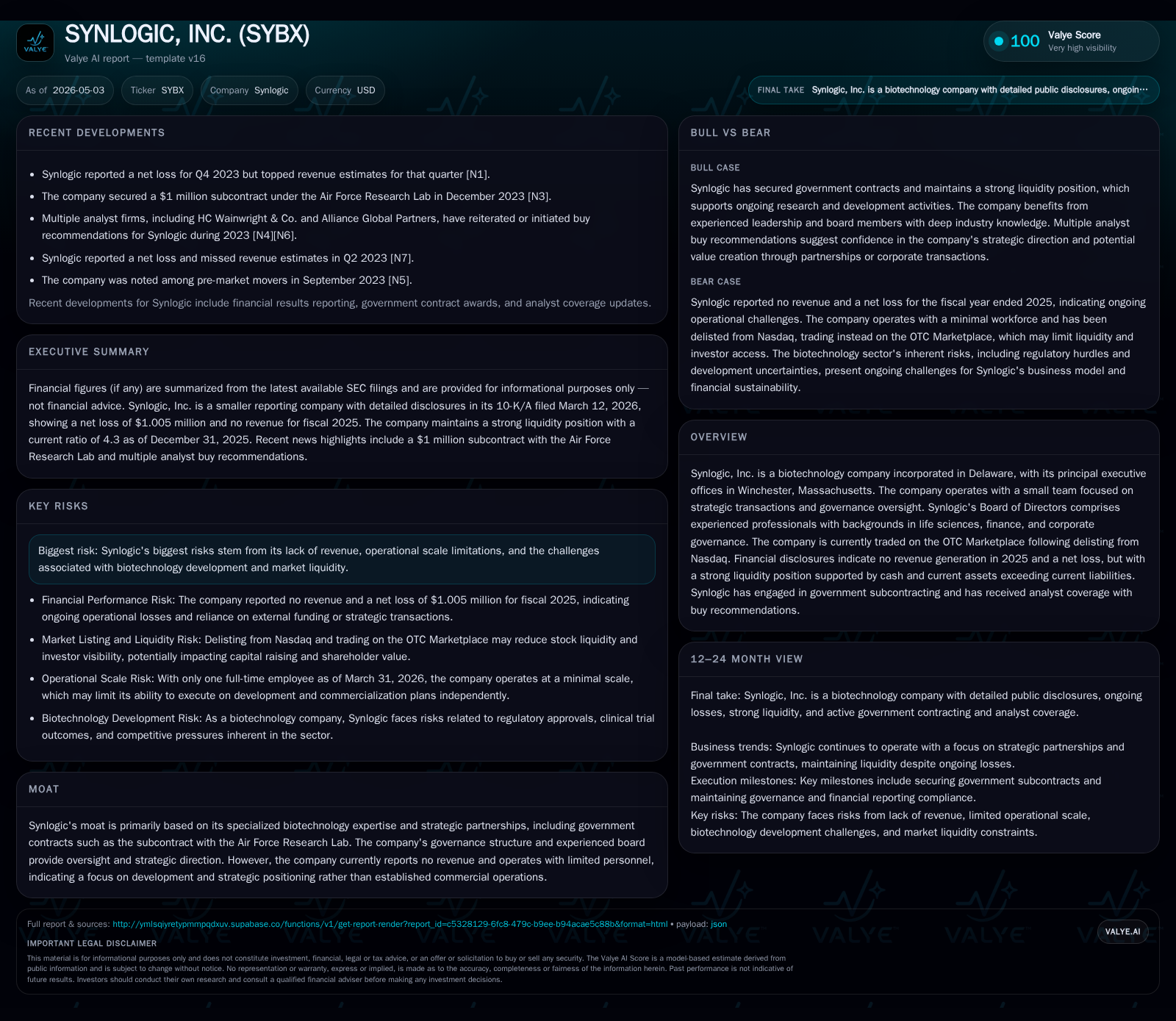
Synlogic, Inc., a biotechnology firm specializing in engineered microbial therapeutics, reported no revenue in 2025 and continues to operate with a single full-time employee focused on strategic transactions. The company was delisted from Nasdaq in early 2026 due to its limited operational scale and classified as a public shell by Nasdaq’s staff. Synlogic’s competitive edge lies in its proprietary biotech expertise and select government subcontracting, but it faces significant risks from lack of commercial products and liquidity pressures. Going forward, the company will pursue strategic alternatives and maintain OTC trading status while leveraging its cash reserves to evaluate potential corporate transactions.
Recent Operating Update: Transition Following Nasdaq Delisting
Synlogic's recent quarterly filing dated November 13, 2025 [S2] confirms continued absence of commercial revenue and minimal R&D expenditures—a stark contrast to earlier years when more substantive pipeline development was underway. Subsequently, Synlogic received a delisting notice from Nasdaq in late November 2025 citing classification as a public shell due to the lack of revenue-generating assets and significantly curtailed operations [S13]. Despite requesting a hearing to contest delisting, the company ultimately withdrew this appeal in January 2026 [S15], accepting suspension from Nasdaq effective January 21, 2026.
The company now trades on the OTC Markets platform [S4], continuing periodic SEC reporting but shifting operational focus. As of March 31, 2026, Synlogic operates with just one employee tasked primarily with assessing strategic transactions under board supervision [S1]. This personnel minimization signals a transformation from active product development to governance-oriented capital allocation.
Business Model: Evolving From Development to Strategic Evaluation
Historically, Synlogic positioned itself as a pioneering synthetic biology firm focused on engineering microbial therapeutics for unmet medical needs. Revenue historically arose principally from collaborative agreements and government contracts alongside potential future milestone payments contingent on product approvals.
However, as evidenced by zero revenue reported for FY 2025 [F1], the company no longer generates income from product sales or partnerships. Instead, its current business model centers on managing existing intellectual property assets and exploring corporate transactions that could monetize these assets or consume cash resources more efficiently [S1].
Revenue mechanics have wholly shifted: there are no paying customers or predictable inflows; rather, value creation depends on unlocking latent asset value through licensing deals, mergers, or outright sale. Margins and cash conversion dynamics are less relevant currently given negative operating income (-$4.0 million) but sharply reduced compared to prior years' heavy R&D spending [F1].
The company's competitive strength rests largely on its specialized expertise in synthetic biology platforms for therapeutic applications and relationships cultivated within defense research sectors (notably Air Force Research Lab subcontracting) [N/A SEC context]. These niche capabilities could interest partners seeking advanced microbial therapy technologies.
Industry Structure and Competitive Position
Synlogic operates within the highly technical synthetic biology subset of biotechnology—a complex field marked by substantial capital intensity, elongated clinical validation timelines, stringent regulatory pathways, and concentrated competition including major pharma-biotech players investing heavily in engineered living medicines.
The sector demands sustained R&D investment and robust commercial execution capabilities to translate early-stage innovations into approved therapies. Synlogic's considerable reduction of operational scale hampers its ability to compete as a standalone innovator at the clinical or commercialization stage.
Within this landscape, the company's small team limits ability to maintain technological leadership or forge diversified partnerships at scale. Nonetheless, Synlogic's expertise is non-trivial; synthetic biotherapeutics remain an emergent area with significant barriers to entry for new competitors absent foundational know-how.
Beyond direct product competition, governance oversight by an experienced board provides strategic transactional capability—potentially distinguishing Synlogic by enabling efficient evaluation of options amidst funding constraints.
Growth Drivers
Growth drivers for Synlogic are now primarily externalized rather than organically rooted in pipeline progress:
- Strategic Transactions: Pursuit of mergers, acquisitions, or licensing deals that either inject capital or transfer assets for monetization represents the principal avenue for unlocking shareholder value [S1].
- Government Contracting: Ongoing subcontracting engagements with defense agencies may provide modest income streams or validation paths indirectly enhancing asset attractiveness.
- Equity Financing: Maintaining sufficient cash reserves (~$14.7 million as of December 31, 2025) enables continued operational sustainability during option evaluation phases [F1].
- Intellectual Property Leverage: Effective packaging/licensing of proprietary synthetic biology platforms could generate partnership opportunities.
This shift means growth is contingent upon management’s ability to navigate complex deal structures amid challenging market conditions—not typical biotech clinical milestones or regulatory approvals.
Risks and Watchpoints
Several inherent risks temper near-term outlook:
- No Revenue Generation: Absence of paying customers constrains financial flexibility; further operational downsizing risks rendering asset base illiquid if market conditions deteriorate.
- Limited Operational Scale: A single full-time employee restricts capacity for technology advancement or business development beyond transactional due diligence phases.
- Market Liquidity and Listing Risks: Delisting from Nasdaq removes access to a higher-profile capital market; OTC marketplaces generally suffer lower liquidity and may impact stockholder engagement adversely.
- Competitive Pressures: Larger biotech/pharma companies with deep pockets may outcompete for partnership interest or acquisition opportunities involving similar technology sets.
- Dependence on Board Effectiveness: Success increasingly hinges on board’s capability to identify viable alternatives rapidly; any governance missteps could impair shareholder outcomes.
Investors should monitor evolving SEC disclosures regarding proposed deals or changes in operational strategy that could materially impact trajectory.
What To Watch Next
Key upcoming milestones driving investor attention include:
- Announcement of Strategic Alternatives: Updates detailing potential merger/sale negotiations or licensing agreements would signal progress toward value realization.
- OTC Market Trading Volumes and Pricing Trends: Market response post-Nasdaq delisting will reflect investor sentiment on viability.
- Board Actions: Any revisions in corporate governance policies or expansions in senior management could indicate shifts toward reactivation initiatives.
- Regulatory or Contractual Developments: New subcontract awards or government collaborations could temporarily improve financial profile.
Financial Profile Summary (Annual Data for Fiscal Year Ending December 31)
Historical performance (annual)
Capital returns and efficiency (annual)
In comparison with prior years showing high losses exceeding $40 million annually during active R&D phases (e.g., -$55 million operating income in FY23), FY25 shows material reduction in expenses aligned with the downscaling strategy [F1].
Disclaimer
This analysis is based solely on publicly available information including SEC filings up to April 30, 2026. It does not constitute investment advice or recommendations. Investors should conduct their own due diligence before making decisions regarding securities discussed herein.
Disclaimer: This is research-only, informational analysis and not investment advice. It may include AI-generated interpretation and general industry context. Always verify important details using primary sources.

Comments