
RE/MAX Holdings Faces Strategic Transition Following Merger Agreement with Real Brokerage
RE/MAX Holdings entered into a definitive merger agreement in April 2026, marking a pivotal moment amid ongoing industry challenges.
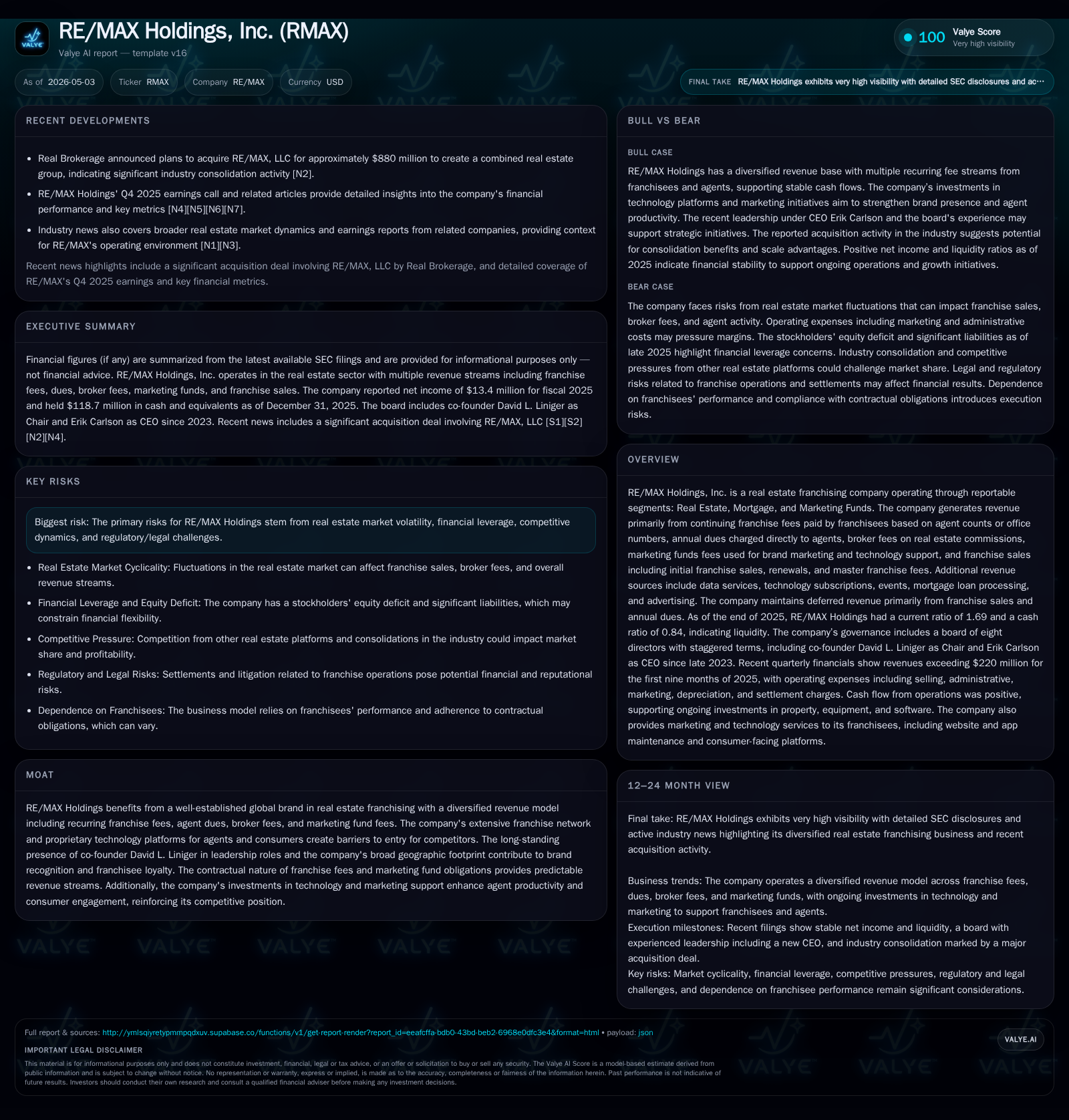
In late April 2026, RE/MAX Holdings announced a planned acquisition by Real Brokerage through a merger agreement requiring regulatory approvals, signaling a major strategic shift. The company’s business model centers on franchising real estate brokerages globally, generating diversified revenue from recurring fees linked to agent counts and sales activities. Despite industry headwinds, RE/MAX has maintained agent growth and margin improvements, supported by its strong brand and technology investments. Key growth drivers include expanding franchise agent counts and enhancing technology platforms, but risks persist from market volatility and regulatory hurdles. Monitoring the merger approval process and integration execution will be critical near-term milestones.
Recent Operating Update and Strategic Shift
On April 26, 2026, RE/MAX Holdings entered into an Arrangement Agreement and Plan of Merger with Real Brokerage Inc., initiating a transformative transaction subject to obtaining antitrust and other regulatory approvals[S3]. This filing highlights the company's strategic recalibration as it seeks new scale and operational synergies through the combination. Notably, RE/MAX declared it would forego the May 8, 2026 Q1 earnings call due to this pending transaction[S21]. The deal reflects heightened consolidation activity within the residential real estate services sector amid resetting industry dynamics[N3][N4].
The company's disclosures emphasize that these developments do not constitute any offering or solicitation of securities outside permissible jurisdictions[S3], underscoring regulatory complexity in completing the transaction.
Business Model
RE/MAX Holdings' core business is global franchising of real estate brokerages under the well-known RE/MAX brand complemented by U.S.-based mortgage brokerage franchising via Motto Mortgage[S1][S2]. Revenue streams are diversified but predominantly recur via:
- Continuing franchise fees: fixed monthly contractual fees owed by franchisees based on agent headcount or office numbers.
- Annual dues charged directly to individual agents.
- Broker fees applied as a percentage of real estate commissions from property transactions involving RE/MAX agents.
- Marketing fund fees collected to finance brand advertising and technological platform support.
- Franchise sales including initial franchise grants, renewals, master franchise arrangements.
Additional revenues come from data services, technology subscriptions for agents and consumers, mortgage loan processing income, event hosting, and advertising[S1].
Fee structures anchored on agent counts or office footprints provide predictable cash flows sheltered somewhat from transactional volatility. The contractual basis for continuing fees creates high retention incentives aligned with maintaining active agency franchises.
Industry Structure and Competitive Position
RE/MAX occupies a prominent position among real estate franchisors globally with broad market penetration via its independent franchise network. Its longstanding brand recognition benefits from over four decades of operation driven partly by co-founder David L. Liniger's leadership legacy[S1]. This heritage supports franchisee loyalty despite competitive pressure from emerging digital brokerage platforms challenging traditional models.
Its integrated mortgage services enhance cross-selling opportunities in U.S. markets but represent only part of total revenue[S2]. Proprietary consumer-facing websites and agent productivity technology underpin differentiation as they foster switching costs and improved lead generation.
However, industry structure remains fragmented with significant competition at local levels from boutique brokers and national consolidators alike. Scale advantages alongside advanced technology play increasing roles in defining winners versus laggards within franchising amid rising digital disruption.
Growth Drivers
Key growth drivers evidenced by recent filings include:
- Agent Count Growth: Agent footprint expanded by 1.4% to approximately 148,660 at end-2025 despite broader housing market challenges[S1]. A growing agent base feeds into recurring fee enhancements.
- Margin Expansion: Operational efficiencies helped improve adjusted EBITDA margins even while industry softness lingered[S1].
- Technology Investment: Continuous development of proprietary platforms aims to increase agent productivity and consumer engagement metrics supporting long-term retention[S1].
- Franchise Sales: Recurring renewals plus new franchise grants contribute upfront revenue inflows which also sustain deferred revenues on balance sheets[S2].
- Marketing Funds Optimization: Effective use of marketing fund fees supports brand visibility helping stabilize demand cycles across regions.
Collectively these factors suggest RE/MAX’s structural exposure is partially buffered against cyclical downturns yet remains tied quadratically to housing transaction volumes over time.
Risks and Constraints
Several risks loom large for RE/MAX:
- Real Estate Market Volatility: Given dependence on home sales activity for broker fees as well as agent recruitment/retention dynamics, downturns directly pressure top-line growth.[S1]
- Leverage Levels: With approximately $439 million total debt offset partly by $119 million cash equivalents (net debt around $320 million), financial leverage requires careful management especially through economic cycles[F1][S2].
- Regulatory Approval Uncertainty: The pending merger hinges on complex US/Canadian antitrust clearances which inject transaction risk.[S3]
- Competitive Pressures: Accelerating disruption from digital-native platforms forces continuous investment in technology while threatening franchise growth.
- Integration Challenges: Post-merger integration risks include cultural alignment issues and realizing projected synergies which could distract management focus.[N4][S17]
Risks combined constrain visibility beyond near-term milestones but are offset partially by operational resilience demonstrated during recent industry weakness.
What to Watch Next
Critical near-term catalysts center around the merger timeline:
- Regulatory review outcomes on antitrust fronts in US and Canada detailed in proxy statements/registration filings expected imminently after April 2026 announcement.[S12][S17]
- Shareholder approvals for completing the transaction among both RE/MAX Holdings’ and Real Brokerage’s investor bases[S12][N3].
- Execution of integration strategies post-closing that could unlock cost efficiencies or drive expanded distribution reach.
- Continued tracking of agent count trends as an indicator of fundamental demand strength despite cycle fluctuations.
- Monitoring margin expansion or contraction trends as competitive pressures remain fluid in the evolving market landscape.
Investors should prioritize updates related to formal SEC filings connected to the merger (proxy statements/prospectus) alongside quarterly operational updates once public communications resume post-merger completion phases.
Financial Profile Brief Context
Latest financial snapshot
| Metric | Value | Period |
|---|---|---|
| Cash & equivalents | $119mm | |
| 2025-12-31 | ||
| Total debt | $439mm | |
| 2025-12-31 | ||
| Net debt | $321mm | |
| 2025-12-31 | ||
| Current assets | $240mm | |
| 2025-12-31 | ||
| Current liabilities | $142mm | |
| 2025-12-31 | ||
| Current ratio | 1.69x | |
| 2025-12-31 |
Source: SEC companyfacts cache [F1].
As of December 31, 2025 end-of-year metrics portray a sound liquidity stance with $118.7 million cash & equivalents against $141.8 million current liabilities yielding a current ratio of approximately 1.69 supporting working capital adequacy[F1]. Total debt stands near $439.3 million with net debt about $320.6 million reflecting manageable leverage given EBITDA generation capacity documented historically[F1][S1]. Adjusted EBITDA reached $93.7 million in 2025 with operating income at $47 million underpinning profitability amid challenging external conditions[S1].
RE/MAX also holds deferred revenues principally arising from prepaid franchise sales fees creating staggered revenue recognition that cushions short-term earnings volatility[S2]. The capital structure combined with recurring cash flow nature underpins operative flexibility necessary during the M&A transition phase.
Disclaimer: This report is an analytical summary intended solely for informational purposes regarding RE/MAX Holdings’ recent SEC disclosures and strategic developments. It does not constitute investment advice or recommendations. Readers should refer directly to official filings for authoritative details.
Disclaimer: This is research-only, informational analysis and not investment advice. It may include AI-generated interpretation and general industry context. Always verify important details using primary sources.

Comments