
9F Inc. Reinvents Digital Wealth Management with Technology-Driven Efficiency Gains
9F Inc. reports robust H1 2025 revenue growth fueled by strategic product mix shifts and cost discipline amid regulatory adjustments.
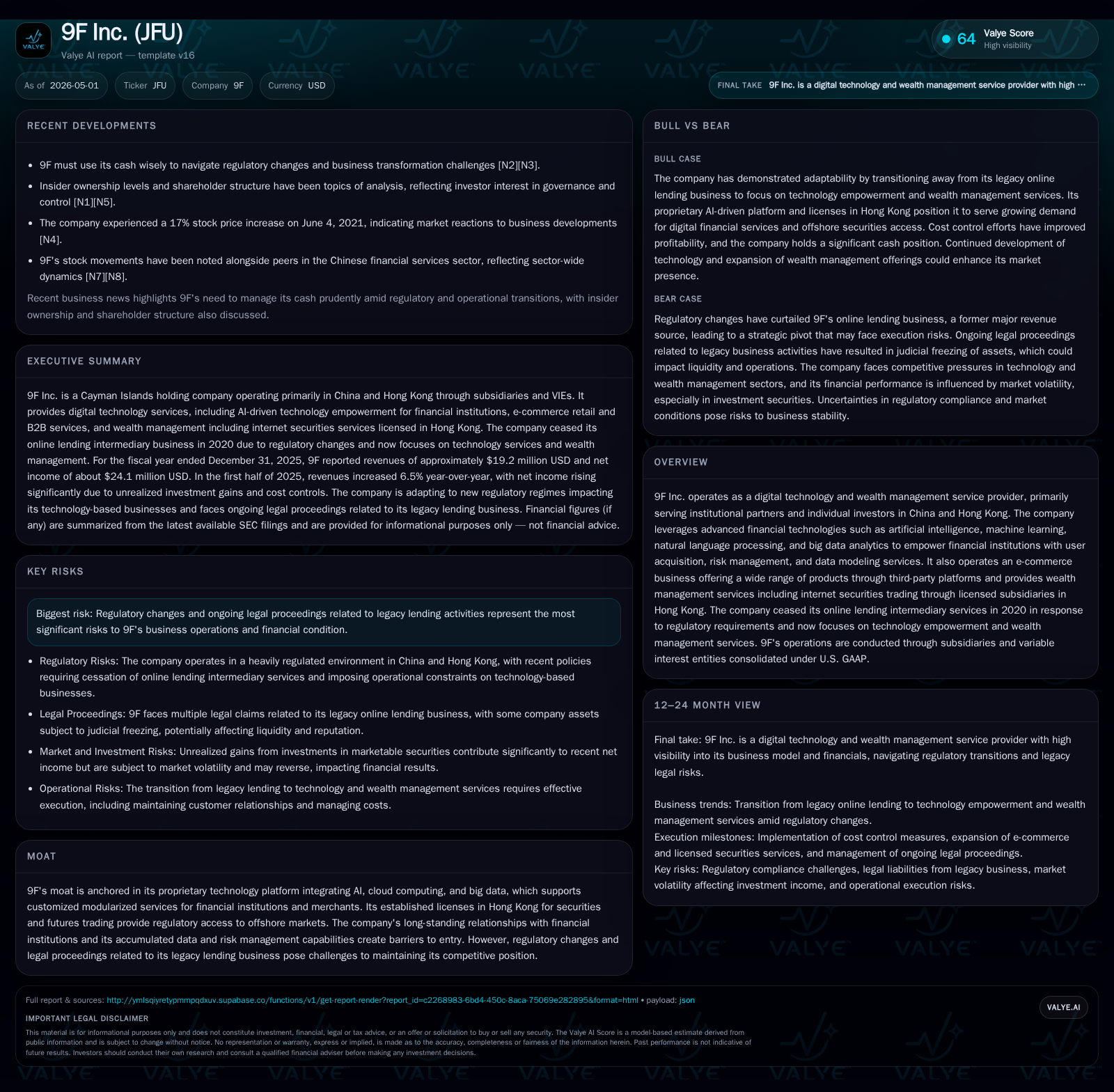
In the first half of 2025, 9F Inc. demonstrated meaningful operational progress with a 69.5% surge in sales income revenues driven by product offering optimization, despite declines in technical services and wealth management segments. This shift, along with stringent cost controls, contributed to a dramatic increase in adjusted net income. The company’s evolving business model now emphasizes AI-powered technology empowerment for financial institutions and licensed wealth management services in Hong Kong, capitalizing on proprietary data analytics and cloud-based modular platforms. While entrenched in China's fintech space with competitive moats derived from technology integration and regulatory licenses, lingering regulatory headwinds stemming from legacy lending activities pose ongoing risk. Key growth paths involve scaling digital wealth products and expanding offshore securities business under Hong Kong licenses, balanced against litigation and judicial asset freezes totalling approximately RMB231 million.
Operating Update: First Half 2025 Performance Highlights
9F Inc.'s first half of 2025 financial results revealed a pivotal transition emphasizing strategic product restructuring aimed at elevating margins and streamlining operations [S2]. Total net revenues increased modestly by 6.5% year-over-year to RMB152.1 million (US$21.2 million), underpinned primarily by a sharp 69.5% surge in sales income revenues from RMB44.8 million to RMB75.9 million (US$10.6 million). This improvement directly tracks the company's proactive adjustment of its product offering structure toward higher efficiency and profitability.
Conversely, the technical services segment contracted by approximately 22%, declining from RMB78.5 million to RMB61.0 million (US$8.5 million), reflecting waning demand attributable to the relative slowing of customer business activities amid broader sectoral challenges [S2]. Similarly, the wealth management unit's revenues fell by about 21.7%, dampened by reduced insurance service demand from clientele.
The company reported an extraordinary net income spike to RMB218.5 million (US$30.5 million) compared with RMB12.5 million in the first half of 2024, heavily influenced by unrealized mark-to-market gains on temporary investments in listed stocks and ETFs utilized for optimizing cash reserves [S2]. Recognizing these gains as non-operational and potentially volatile, the management highlights that core operational performance is better reflected through adjusted net income — which increased substantially to RMB105.1 million (US$14.7 million) from RMB6.4 million previously [S2].
Cost discipline was evident as total operating expenses fell nearly 42%, led by sharp drop-offs in origination/servicing expenses (-57%) alongside decreased marketing and administrative outlays [S2]. These efforts reinforce the transition toward leaner operations amidst regulatory pressures reshaping internet loan facilitation frameworks.
Evolving Business Model: Technology Empowerment and Wealth Management
Historically engaged in online lending intermediation until regulatory mandates curtailed such operations in 2020, 9F has since pivoted decisively towards offering advanced digital technology solutions empowering financial institutions alongside direct investor-facing wealth advisory services [S1][S2]. At its core is a proprietary platform integrating artificial intelligence (AI), machine learning (ML), natural language processing (NLP), big data analytics, and cloud computing that provides modularized services tailored for diverse institutional clients.
These technology services encompass user acquisition enhancements, risk assessment tools leveraging rich datasets accumulated over years of operation, data modeling capabilities for credit scoring, fraud detection algorithms, and client segmentation — all designed to increase financial institutions’ operational efficiency and customer insight precision [S1].
Simultaneously, through wholly owned subsidiaries licensed under Hong Kong's Securities & Futures Commission (SFC) with Types 1 (dealing in securities), 2 (dealing in futures contracts), 4 & 5 (advising on securities/futures), and 9 (asset management) licenses held by entities such as Metaverse Securities Limited and Meta Futures Limited, the company operates an internet securities trading platform targeting individual investors seeking global asset exposure [S1][S24]. This dual-pronged approach leverages jurisdictional arbitrage advantages afforded by Hong Kong’s regulated environment for offshore securities investment — an increasingly sought-after channel given China's capital controls.
The company also engages in e-commerce retailing via third-party platforms across multiple consumer categories including electronics (3C), skin care products, food items, household appliances, liquor, and beverages — reinforcing diversified revenue streams albeit at a smaller scale relative to its financial tech operations [S1].
Competitive Positioning Within China’s Fintech Ecosystem
9F's competitive moat is built on combining proprietary technology assets with strategic regulatory positioning and entrenched institutional relationships [S1]. Its AI-driven cloud platform offers clients customizable modules that integrate user behavior analytics with dynamic risk models — capabilities that demand high switching costs given the complexity of developing such systems internally.
Moreover, the company’s holding of multiple SFC licenses enables participation in offshore wealth management markets inaccessible to pure mainland players lacking corresponding credentials [S1]. This licensing advantage extends its addressable market beyond domestic boundaries into Hong Kong's more mature financial ecosystem.
Data accumulation from prior lending activities contributes meaningfully to refined credit scoring models deployed across various industries including banking, automotive finance, securities investment advisory, and insurance underwriting — creating synergy effects difficult for competitors starting afresh.
Nonetheless, lingering regulatory uncertainty looms owing to outstanding legal disputes tied to legacy online lending intermediary business that ceased new operations in late 2020 but remains subject to judicial scrutiny [S17][S18]. Asset freezing orders totaling approximately RMB231 million further strain liquidity availability vis-à-vis ongoing litigation risks.
Growth Drivers: Product Offering Optimization and Market Expansion
The recent notable uplift in sales income revenues evidences the tangible payoff from deliberate product mix recalibration focused on higher-margin offerings within the fintech service portfolio [S2]. This targeted repositioning aligns with broader industry shifts away from commoditized technical services toward value-add advisory technology — particularly solutions harnessing AI-enhanced decision-making insights.
Expansion prospects remain promising through scaling internet securities trading driven by increasing retail investor appetite for diversified offshore assets via Metaverse Securities Limited’s platform underpinned by SFC-regulated safeguards [S24]. Incremental growth can be propelled through comprehensive digital onboarding processes employing facial recognition technologies compliant with supervisory regimes fostering trust among users.
Additional upside resides in extending current licensing suites or adding new regulated activities enabling entry into complementary areas such as futures contracts trading or insurance brokerage services as evidenced by subsidiaries like Meta Futures Limited or Jiuxing Insurance Brokerage Co., Ltd., subject to transaction closures [S1][S9][S24].
Operational efficiency improvements through automation reduce overhead burdens while enhancing scalability potential — facilitating higher adjusted profit margins across expanding revenue bases.
Risks and Constraints: Regulatory Landscape and Litigation Impact
Regulatory headwinds remain significant constraints following China’s tightening oversight over internet loan facilitation businesses which compelled cessation of legacy online lending intermediary operations starting in 2020 [S25]. Residual exposure persists through numerous small claims lawsuits initiated by loan investors against Jiufu Puhui and affiliated VIEs relating to historical loan offerings [S17][S18].
The Supreme People’s Court provided favorable rulings clarifying the absence of private lending contract formation in some cases; however judicial asset freezes amounting roughly to RMB231 million underscore ongoing liquidity risks [S3][S17]. Such frozen assets are specifically earmarked for certain litigations thereby constraining working capital flexibility.
Unrealized investment gains affecting reported net income introduce volatility risks given susceptibility to equity market fluctuations or timing mismatches upon divestment decisions [S2]. Tax uncertainties arising from indirect transfer provisions targeting overseas holding companies may adversely impact non-PRC investors if tax authorities challenge corporate structures under substance-over-form principles [S1].
Navigating this complex regulatory environment necessitates robust compliance frameworks alongside active legal defenses which could elevate operating costs or delay capital recycling.
Near-Term Catalysts: Execution Milestones and Operational Efficiency
Key monitoring points revolve around sustaining top-line momentum particularly continued sales income growth driven by refined product positioning coupled with expanded user penetration on digital wealth platforms [S2][S1]. Adjusted net income margin expansion via ongoing cost containment remains critical for translating revenue gains into sustainable earnings improvements.
Resolution progress on legacy litigation matters presents a material catalyst — unfreezing restricted cash balances tied up due to judicial freezes could materially enhance liquidity conditions if settled favorably within expected timelines indicated by settlement conferences held recently [S3][S17].
Further license approvals or new licensing acquisitions within Hong Kong markets would widen addressable opportunities especially if complemented by technological upgrades facilitating richer investor experiences.
Additionally, regulatory guidance clarity concerning permissible fintech activities post latest National Financial Regulatory Administration mandates will influence strategic pivot decisions potentially unlocking efficiency gains or identifying new business fields compatible with tightening compliance standards [S2].
Financial Overview: Annual Review of Income, Cash Flow, and Capital Structure
Data anchored on fiscal year ended December 31, 2025 reveals sustained recovery coupled with structural repositioning benefits:
Historical performance (annual)
Capital returns and efficiency (annual)
Revenue growth reflects incremental gains from optimized product offerings while net income surged due largely to operational leverage plus non-operational investment returns factored into reported results [F1][S2]. Operating cash flow strength signals improving quality of earnings underpinning healthy free cash generation after minimal capital expenditure outlays indicative of asset-light operations focusing on software-based services.
Balance sheet remains healthy with cash & equivalents at approximately US$62 million at year-end allowing capacity for opportunistic investments or working capital support despite pending litigation contingencies revealed through restricted cash reporting above [F1][S3]. Debt levels are minimal relative to cash holdings resulting in a negative net debt position supportive of balance sheet flexibility [F1].
This analysis is based solely on information publicly disclosed by 9F Inc., including SEC filings up to April 30, 2026 ([S1], [S2], etc.) supplemented by structured companyfacts data ([F1]) available as of this report date without any speculative additions or investment recommendations.
Disclaimer: This is research-only, informational analysis and not investment advice. It may include AI-generated interpretation and general industry context. Always verify important details using primary sources.

Comments