
Altex Industries Struggles with Cash Flow Challenges Despite Oil and Gas Holdings
Latest quarterly results underscore ongoing negative operating cash flow absent capital reinvestment in producing assets.
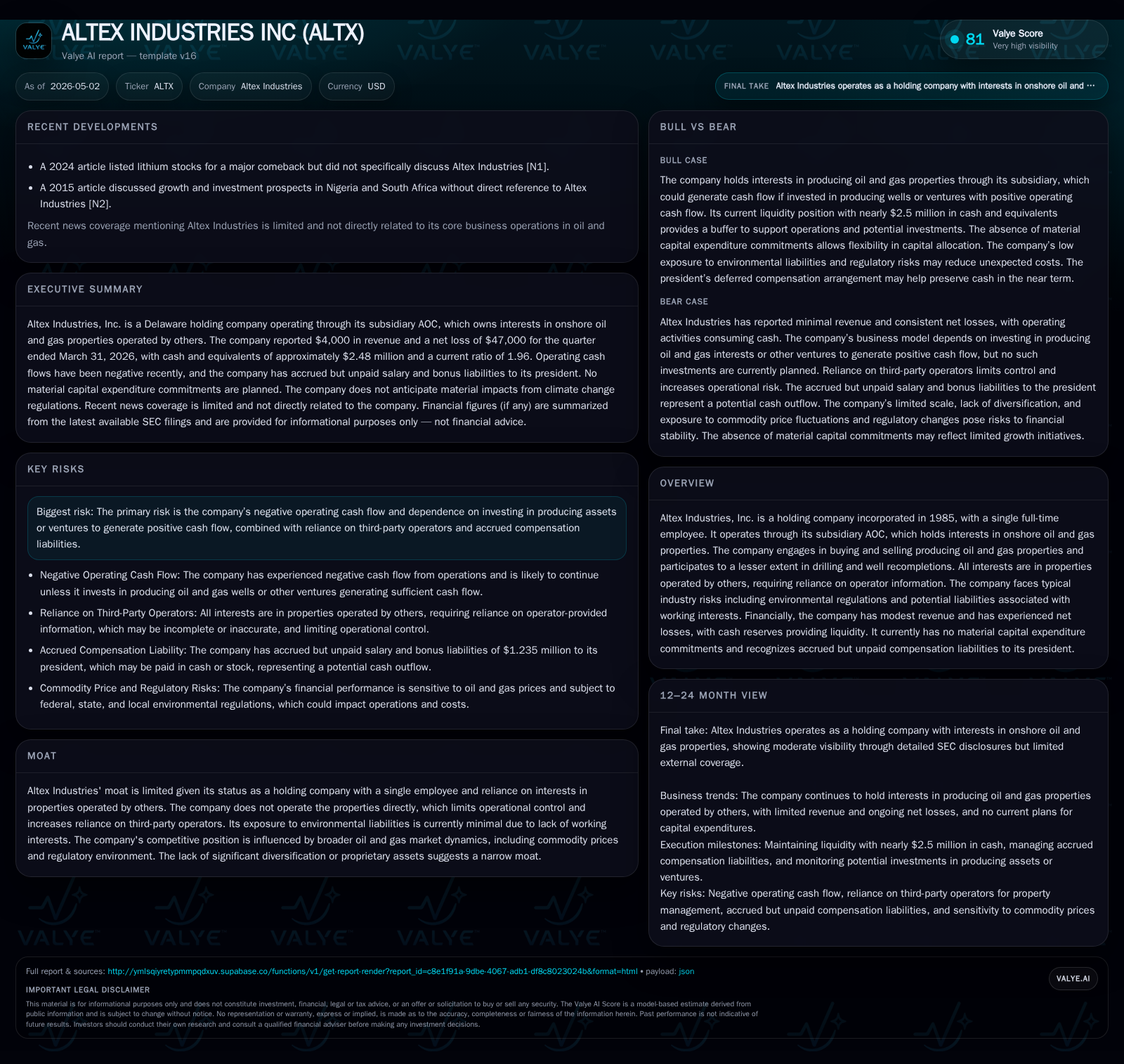
Altex Industries continues to face structural cash flow deficits as revealed in its 10-Q filed May 1, 2026, with no current plans for capital expenditure to acquire or develop producing oil and gas properties. Operating solely through interests held in non-operated onshore oil and gas assets managed by third parties, the company’s revenue is insufficient to cover expenses at current production levels. The reliance on operator-reported data and deferred executive compensation obligations add layers of operational and financial risk. Without new investments or ventures generating positive cash flow, Altex's liquidity position remains delicate despite a near $2.5 million cash reserve.
Latest Quarterly Operating Update: Cash Flow Pressures Persist
Additionally, accrued but unpaid compensation liabilities to the company’s president stand at approximately $1.235 million as of March 31, 2026 [S2], representing deferred salary and bonuses which could crystallize as a significant cash outflow. While Altex maintains about $2.48 million in cash and equivalents at quarter-end [F1], without deploying capital into revenue-generating assets, these reserves may erode under continued operational losses.
The operating results paint a picture of a holding structure generating limited operating income absent fresh investments or asset sales.
Business Model Overview: Holding Company Reliant on Non-Operator Interests
Founded in 1985 as a Delaware corporation, Altex operates predominantly through its wholly-owned subsidiary AOC which holds interests exclusively in onshore oil and gas properties operated by third parties [S1]. The company's role is confined to ownership stakes—there is no direct engagement in day-to-day field operations.
This non-operator status means Altex depends extensively on information provided by operators for production volumes, cost data, and compliance updates with AOC lacking direct oversight or control over operational decisions. The upstream industry jargon here differentiates between "working interests" (equity stakes incurring proportional costs) and "operatorship" (executive responsibility for field management). For Altex, the absence of operatorship limits agility to optimize operations or respond swiftly to changing market dynamics.
Additional risks arise from environmental regulations and potential joint liability even when ALTX’s working interests are small; however, AOC currently has no direct exposure as it holds no working interests entailing obligation for asset retirement obligations (ARO) or environmental remediation payments at this time [S1].
Competitive and Industry Context: Market Influences over Operational Control
Although multiple competitors exist within the upstream sector producing similar commodities, Altex's competitive positioning is shaped more by macroeconomic factors than direct operational advantages. Commodity price volatility driven by geopolitical events, OPEC supply decisions, global demand fluctuations, and regulatory changes fundamentally impact revenue streams tied to production volumes.
Moreover, prices for oilfield services such as drilling rigs, hydraulic fracturing crews, and well maintenance further influence potential margins but do so indirectly since ALTX neither controls these service providers nor manages associated costs directly. Supply chain bottlenecks in key service areas can elevate costs for operators carrying majority interest—thus impacting distributable income to minority participants like ALTX.
Regulatory oversight spans federal EPA rules to state-level drilling permits impacting environmental compliance costs; ALTX relies on operators' adherence but remains exposed through joint working interest obligations despite non-operatorship status.
Growth Drivers and Strategic Opportunities: Need for Productive Capital Deployment
Key growth levers identified revolve around reinvesting capital into acquiring additional working interests in producing oil and gas wells or participating in compatible ventures capable of generating positive operating cash flow [S2]. With no capital projects currently planned as per latest disclosures, growth is effectively curtailed pending strategic reallocations of existing cash reserves.
A successful growth pathway would involve identifying undervalued producing assets amenable to acquisition or financing exploratory drilling/recompletion projects through partnerships where ALTX can leverage its holdings without incurring full operational risk. Such moves would shift net operating losses toward breakeven or net positive inflows—changing core KPIs around operating cash flow generation.
Given commodity pricing uncertainty remains high post-pandemic recovery cycles combined with tightening ESG-themed investor scrutiny across energy sectors generally dampens prospects for expansive CAPEX without clear visible returns. Nonetheless, the intrinsic value proposition lies in effective capital cycling into producing assets rather than opportunistic asset trading which historically provided episodic gains but no sustainable revenue base.
Risks and Constraints: Liquidity Risks and Dependence on External Operators
Altex carries notable risks owing firstly to persistently negative net losses likely continuing absent fresh investments generating revenue beyond expenses [S2]. Deferred compensation liabilities exceeding $1 million payable at management's discretion represent an embedded quasi-liability that could accelerate liquidity pressures if payment timelines shorten unexpectedly.
Additionally, lack of diversification beyond a concentrated set of non-operated onshore properties exposes revenue streams to idiosyncratic regional regulatory changes or supply interruptions downstream from refineries/pipelines purchasing production output—all impacting distributable income indirectly but substantively.
Finally, absence of internal operational personnel beyond one full-time employee constrains capacity for proactive asset management or identifying alternative investment opportunities responsive to changing sector fundamentals.
Forward-Looking Considerations: Critical Milestones and Business Developments to Monitor
Investors and analysts should monitor Altex’s announcements regarding any intended capital deployments such as acquisitions or drilling/recompletion activities designed to generate positive operating cash flow. Since none were planned as of Q1 2026 [S2], any updates reversing this stance would be meaningful catalysts.
Tracking commodity prices—particularly WTI crude benchmarks—and interest rate movements remains critical given earnings sensitivity articulated by management regarding sustained net losses absent positive cash flows from productive investments.
Additionally important will be disclosures around negotiations with operators affecting reporting quality or agreements that modify working interest proportions could materially affect future revenues.
Finally, any policy shifts imposing greater environmental compliance costs on marginal producers—or unforeseen asset retirement obligations—could suddenly increase cost burdens disrupting forecasts presently considered stable from a regulatory standpoint.[S2][S1]
Financial Snapshot: Current Liquidity and Capital Structure
As reflected above based on latest quarterly filings and companyfacts snapshot records [F1][S2], Altex maintains nearly $2.5 million in liquid assets versus approximately $1.27 million of current liabilities yielding a healthy current ratio near two times coverage. This buffer provides a short-term safety margin against liquidity shocks.
This analysis incorporates facts exclusively grounded in Altex Industries’ latest SEC filings up to May 2026 ([S1], [S2]) and supporting financial snapshots ([F1]), synthesizing operating conditions within the upstream oil & gas holding context without extrapolating beyond disclosed data. It aims to provide an objective assessment of ALTX's standing amid persistent structural challenges inherent to its business model reliant on limited-operational-interest producing properties managed by external operators.
Disclaimer: This is research-only, informational analysis and not investment advice. It may include AI-generated interpretation and general industry context. Always verify important details using primary sources.

Comments