
Park Hotels & Resorts Unveils Strategic Momentum in Q1 2026 Amid Portfolio Renewal
The company advances its Core asset renovation program and manages leverage through disciplined Non-Core dispositions, reinforcing premium positioning.
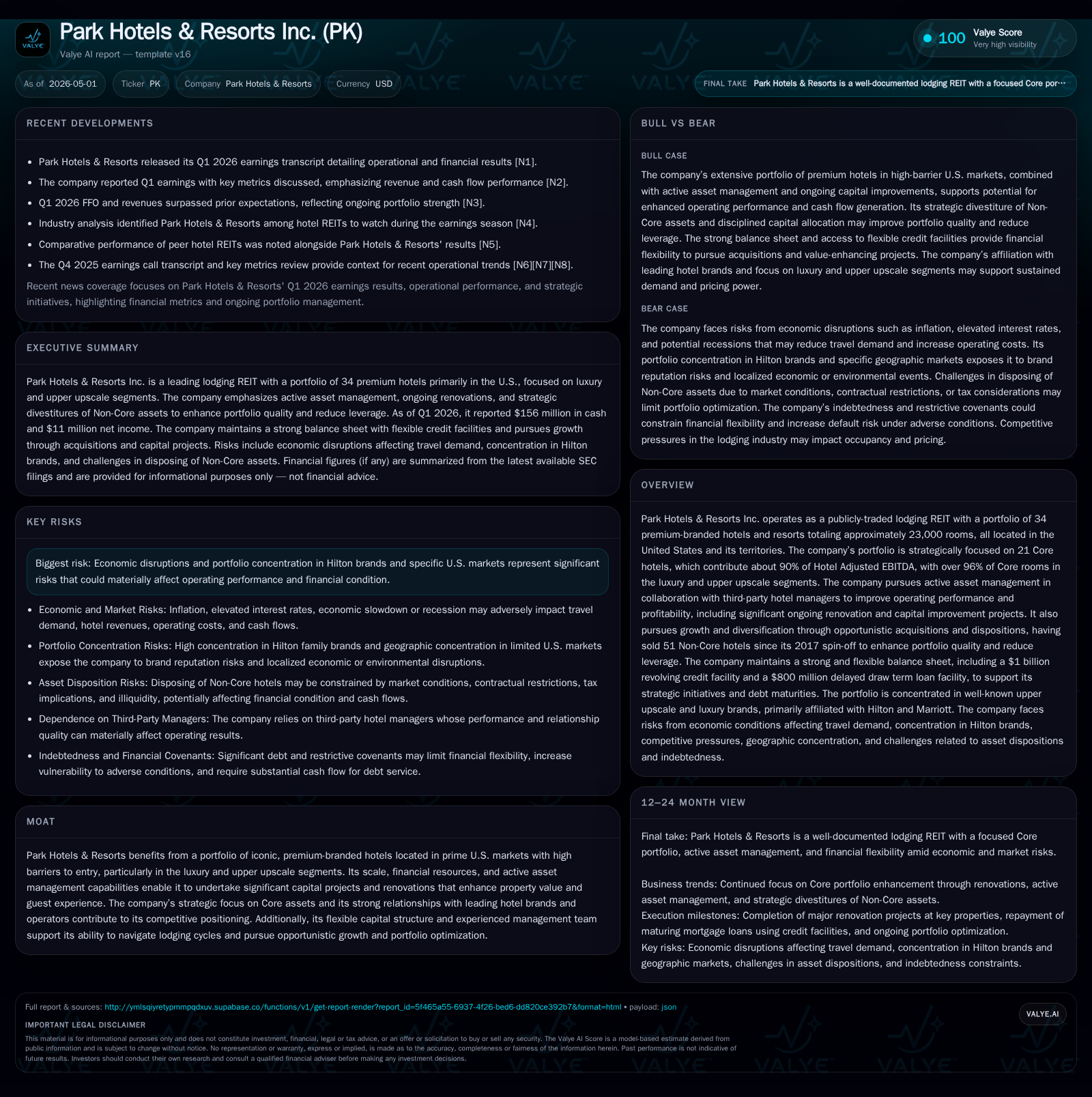
Park Hotels & Resorts reported operational progress in Q1 2026 marked by ongoing renovations at key luxury resorts and continued disposal of Non-Core assets. The Core portfolio, comprising primarily luxury and upper upscale hotels, drives approximately 90% of Hotel Adjusted EBITDA, supported by active asset management and partnerships with leading hotel operators. Strategic capital projects at flagship properties like Hilton Hawaiian Village and Royal Palm South Beach aim to enhance guest experience and revenue potential, while a strong balance sheet underpinned by $156 million in cash and $3.85 billion in total debt maintains financial flexibility amid industry cyclicality. Growth catalysts include meeting space expansions and adaptive reuse of underutilized areas, though risks persist from concentrated market exposure to Hilton brands and macroeconomic variability.
Q1 2026 Operational Highlights and Strategic Shifts
Park Hotels & Resorts delivered a Q1 2026 update unveiling tangible momentum in its Core asset renovation strategy alongside continued portfolio optimization efforts [S2][S3][N1][N2]. The company’s Core hotels sustained approximately 90% contribution to Hotel Adjusted EBITDA, reinforcing the strategic imperative of concentrating resources on premium lodging assets [S1]. Recent quarters have seen substantial completion phases: the Hilton Hawaiian Village Waikiki Beach Resort's second renovation phase concluded around March 2026 following an $85 million investment, while Royal Palm South Beach Miami commenced a comprehensive $100+ million refurbishment with reopening targeted mid-2026 [S1]. These capital projects reflect the company’s commitment to enhancing guest experience and driving rate recovery.
Corporate initiatives include active collaboration with third-party hotel managers to deliver operational improvements through targeted revenue enhancement platforms and modernizing amenities [S1]. Disposition efforts persist on Non-Core hotels to streamline operations and deleverage the balance sheet. No material acquisition transactions were announced in the quarter; however, management underscored ongoing opportunism balanced against market competition [S3]. Liquidity remains solid with $156 million cash on hand as of quarter-end supporting capital programs while maintaining financial flexibility during macro headwinds [F1][S2].
Business Model and Premium Asset Positioning
Park Hotels & Resorts operates as a lodging real estate investment trust (REIT) managing a portfolio of 34 premium-branded hotels encompassing approximately 23,000 rooms exclusively within U.S. markets characterized by high barriers to entry [S1][N5]. Its business model hinges on generating Rental Income primarily derived from hotel real estate leased or managed via third-party hotel operators. Revenue growth is driven by room-night volumes, average daily rates (ADR), and ancillary service income such as food & beverage and meeting spaces whose profitability is realized through Hotel Adjusted EBITDA shared between landlord (the REIT) and operator.
A strategic emphasis lies on the "Core" portfolio comprising 21 hotels contributing about 90% of operating earnings. Impressively, over 96% of these Core rooms fall into luxury or upper upscale segments—targeting affluent leisure travelers and corporate clients with higher RevPAR potential [S1]. Active asset management includes continuous capital expenditure cycles reinvesting into upgrades enhancing competitive positioning, guest satisfaction, and long-term brand equity. Key projects include phased renovations at Hilton Waikoloa Village and Hilton New Orleans Riverside that align product offering with evolving hospitality trends favoring experiential amenities and convening facilities.
Financially structured as an umbrella partnership REIT (UPREIT), Park can optimally deploy equity and debt financing while issuing limited partnership units strategically in capital markets or asset acquisitions. This structure facilitates tax efficiency for investors while enabling transactional agility.
Competitive Landscape of U.S. Luxury Lodging REITs
Within the universe of publicly traded lodging REITs focused on premium U.S. assets—such as Host Hotels & Resorts or Pebblebrook Hotel Trust—Park distinguishes itself through concentrated scale in luxury markets with a dominant presence in Hilton-managed properties [S1][N3][N4]. Brand affiliation with Hilton conveys substantial loyalty program leverage allowing pricing power advantages compared to independents or lower-tier chains.
Primarily situated in gateway cities and resort destinations where barriers like zoning restrictions limit new supply growth further fortify Park’s competitive moat [S1]. Moreover, long-term operator partnerships entail collaborative revenue-management strategies maximizing occupancy during cyclicality while controlling operating costs.
However, geographic concentration risk is notable: reliance on select U.S. markets intensifies exposure to local economic fluctuations or regulatory constraints influencing leisure/business travel demand patterns.
Capital Enhancement Initiatives Driving Value Creation
Capital investments underpin Park's strategy to sustain a differentiated product mix commanding premium rates. The recent completion of Hilton Hawaiian Village’s major renovation phases totaling $85 million exemplifies an infusion intended to modernize guestrooms while revitalizing public spaces critical for affluent travelers [S1][S2][N1]. Similarly, Royal Palm South Beach's ongoing $100+ million upgrade incorporates full guestrooms refresh plus incremental room additions aimed at boosting capacity in a high-demand coastal resort environment.
These renovation cycles are coupled with expansion of meeting venues across seven Core hotels featuring over 125,000 square feet dedicated space—addressing rising group travel demand—a lucrative segment given traditionally higher ADRs compared with transient stays [S1]. The company leverages balance sheet strength by funding selective returns-focused refurbishments rather than broad-brush capital expenditures reducing cost overruns risk.
Non-Core asset dispositions are another lever freeing capital for reinvestment into accretive property enhancements or debt reduction thereby enhancing overall portfolio quality [S1]. Financial returns from these projects hinge on increased ADR realization post-renovation accompanied by elevated occupancy driven by refreshed branding and enhanced customer experiences.
Growth Catalysts and Market Penetration Opportunities
Future growth drivers emerge primarily from three vectors: (1) unlocking additional revenue from convention space expansions anticipated at Core resort properties targeting business meetings rebounding post-pandemic; (2) adaptive reuse development converting vacant land parcels into retail or mixed-use income streams diversifying cash flow sources beyond traditional room revenues; (3) selectively pursuing accretive acquisitions that complement existing footprint while preserving portfolio luxury credentials [S1][N3].
Incremental product innovations serving evolving traveler preferences—for instance upgraded food & beverage outlets or tech-enabled concierge services—also offer unquantified upside potential through guest loyalty retention if executed consistently. However, M&A activity remains cautious given high competition amongst institutional buyers and tight pricing dynamics limiting near-term large-scale bolt-on deals despite management's expressed appetite for growth.
Risks Impacting Portfolio Concentration and Macroeconomic Sensitivities
Park’s concentrated exposure poses notable risks that require monitoring by stakeholders. Elevated economic sensitivity typifies lodging REITs given discretionary nature of travel expenditures: inflationary pressures could erode margins if increased labor or supply costs fail to transmit fully into room rates amid delicate consumer price elasticity interplays [S1][S2]. Furthermore, potential weakening in corporate travel budgets or recessionary forces could depress occupancy levels materially.
The portfolio's significant alignment with Hilton-operated hotels concentrates operational dependence upon third-party managers who face parallel industry challenges such as labor shortages impacting service quality or wage escalations compressing profitability [S1]. Additionally, elevated debt loads—around $3.85 billion total with net debt near $3.7 billion after cash offsets—introduce refinancing risk especially if interest rates remain volatile despite covenant structures designed to mitigate default probabilities [F1][S2]. Geographic concentration inherently increases vulnerability to region-specific downturns such as natural disasters or regulatory changes affecting tourism flows.
Upcoming Catalysts and Investor Watchpoints
Key milestones looming center around finalization dates of major renovations including Royal Palm South Beach’s planned June reopening which will be pivotal for validating incremental RevPAR uplifts attributed to capex spend [S2][N1]. Q2-Q3 performance metrics on ADR trajectories post-renovation will serve as crucial signals for assessing margin expansion viability alongside sustained EBITDA contribution trends across Core properties.
Monitoring unfolding disposition activities for Non-Core assets will be essential for evaluating continued deleveraging trajectory which influences capital allocation flexibility amid a dynamic lodging cycle environment. Reports from third-party hotel managers regarding occupancy levels during peak seasons will further elucidate demand durability especially across convention-centric venues benefiting from pent-up group travel demand rebound.
Latest Financial Snapshot
Latest financial snapshot
| Metric | Value | Period |
|---|---|---|
| Cash & equivalents | $156mm | |
| 2026-03-31 | ||
| Total debt | $3.9bn | |
| 2026-03-31 | ||
| Net debt | $3.7bn | |
| 2026-03-31 |
Source: SEC companyfacts cache [F1].
| Metric | Value (USD) | Period Ending |
|---|---|---|
| Cash & Equivalents | $156 million | |
| 2026-03-31 | ||
| Total Debt | $3.85 billion | |
| 2026-03-31 | ||
| Net Debt | $3.7 billion* | |
| 2026-03-31 | ||
| *Calculated as Total Debt less Cash & Equivalents [F1] |
The Company closed Q1 maintaining substantial liquidity cushions supporting ongoing capital investments alongside a sizable debt profile dominated by unsecured credit facilities subject to covenants designed for operating flexibility [S2][S14][F1]. This financial positioning underpins Park’s ability to endure cyclical headwinds while pursuing its renovation-led growth objective.
This analysis draws exclusively upon disclosed SEC filings, official earnings releases, and recognized news sources as cited; it does not constitute investment advice or recommendations but aims to provide a detailed operational perspective grounded in verifiable data.
Disclaimer: This is research-only, informational analysis and not investment advice. It may include AI-generated interpretation and general industry context. Always verify important details using primary sources.

Comments