
Alchemy Investments Pursues Cartiga Combination to Unlock Litigation Finance Potential
Recent filings highlight Alchemy’s advancing merger with litigation finance platform Cartiga amid execution and liquidity challenges.
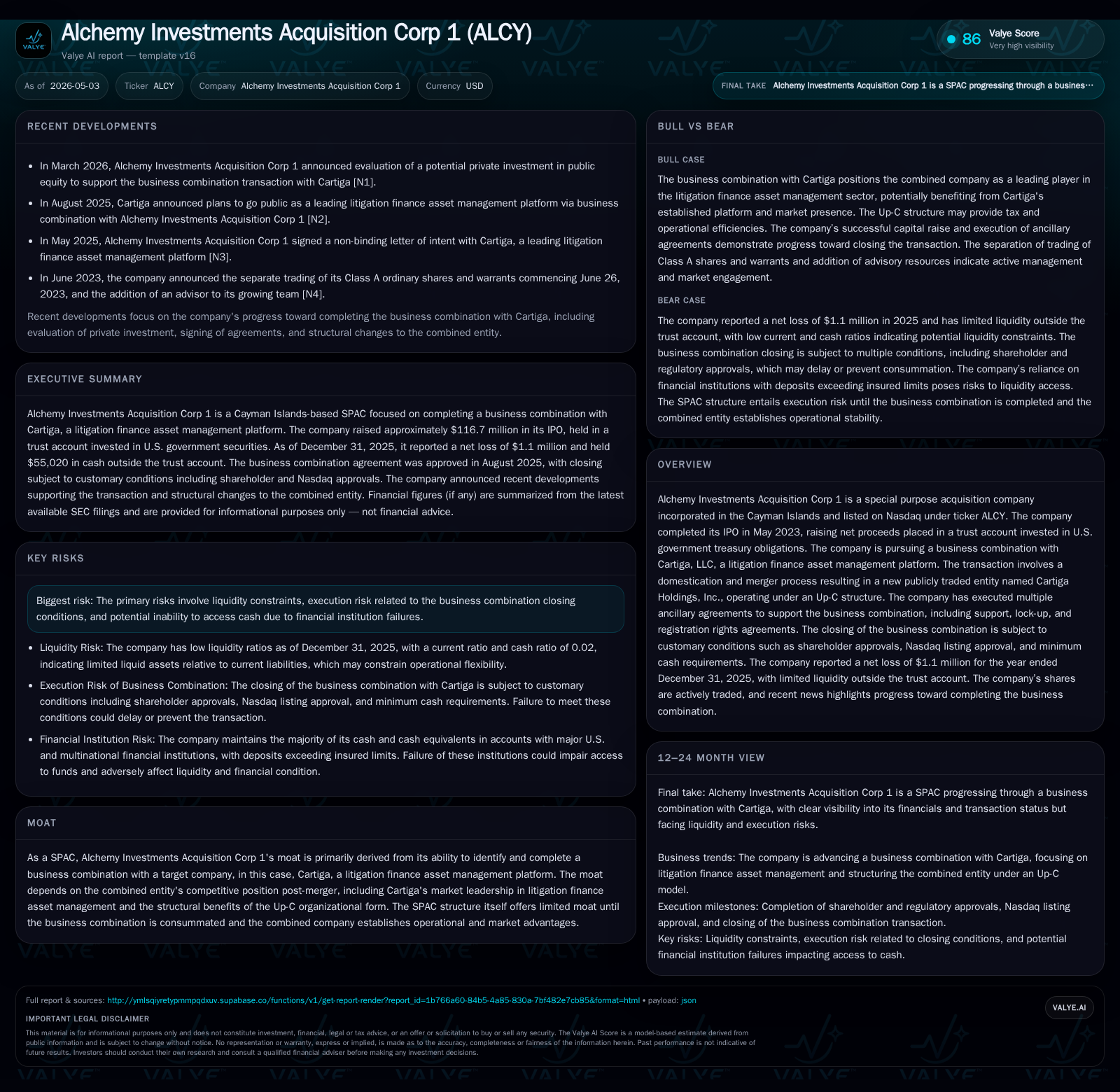
Alchemy Investments Acquisition Corp 1 is progressing toward completing its business combination with Cartiga, LLC, aiming to transition from a SPAC shell into a niche litigation finance asset manager. Recent SEC filings sharpen the timeline and underscore usual SPAC execution risks tied to shareholder approvals, Nasdaq listing, and minimum cash requirements. The combination will enable the new public entity, Cartiga Holdings, Inc., to leverage Cartiga’s specialized portfolio and an Up-C structure for tax efficiency and capital flexibility. However, liquidity constraints and market uncertainties present key watchpoints as the deal approaches closing.
Latest Operating Developments Sharpen Timeline and Execution Risks
Alchemy Investments Acquisition Corp 1’s latest quarterly report filed November 18, 2025 (Form 10-Q) along with subsequent event disclosures in early April 2026 (8-Ks) provide a clear snapshot of its near-term trajectory toward consummating its business combination with Cartiga, LLC [S2][S3]. The filings reaffirm that while significant progress has been made—such as executing multiple ancillary agreements including support, lock-up, registration rights, shareholders agreements; and engaging in PIPE transaction evaluations—the closing remains subject to several customary but binding conditions.
These include shareholder approval votes by both Alchemy's public holders and Cartiga's members; a Nasdaq initial listing approval post-domestication and merger process; satisfaction of minimum available closing cash thresholds (notably $40 million), which if unmet can trigger forfeitures of sponsor shares; absence of material adverse effects on either party; and expiration of applicable antitrust waiting periods [S17].
The recent investor presentation attached as Exhibit 99.1 to the April 7th 8-K filing reiterates these points while highlighting ongoing dialogue around potential PIPE financings intended to bolster deal economics [S6]. However, no definitive PIPE agreements have been announced yet, underscoring execution risk inherent in such financings. The company also flagged reliance on financial institutions for custody of cash balances that exceed insured limits—a vulnerability given market fluctuations could impair timely access to funds [S2]. These disclosures collectively frame a SPAC in late-stage deal execution mode but still exposed to typical closing uncertainties.
Business Model and Value Proposition: From SPAC Shell to Litigation Finance Platform
Alchemy Investments Acquisition Corp 1 originated as a Cayman Islands-incorporated special purpose acquisition company that raised its initial IPO proceeds in May 2023 by selling public units whose funds were escrowed into U.S. Treasury securities. Its core business model has been to pursue a transformative business combination rather than operating independently.
The targeted partner, Cartiga LLC, operates within litigation finance asset management—a sector focused on investing capital into diversified legal claims portfolios. These portfolios generate returns based on outcomes of legal proceedings rather than traditional corporate earnings streams. Cartiga's value proposition rests on proprietary deal sourcing capabilities for high-quality cases across multiple jurisdictions; rigorous risk modeling combining case merits with judicial trends; diversification strategies pooling several claims to manage idiosyncratic risk; and structuring fee arrangements typical in alternative asset management including management fees plus performance carried interest [S1].
Completing the merger will convert Alchemy from a cash-holding blank-check shell into an operational legal finance manager under the name Cartiga Holdings, Inc., adopting an Up-C organizational structure. This form combines tax efficiency—pass-through taxation benefits for original owners—with operational flexibility enhancing governance alignment between sponsors and public investors [S1]. The shift marks a strategic repositioning enabling revenue generation through asset management fees tied directly to litigation finance investments rather than purely financial engineering.
Industry Profile: Litigation Finance Asset Management Dynamics and Competitive Landscape
Litigation finance is an emergent asset class characterized by complex capital sourcing challenges due to its non-traditional nature—returns depend heavily on legal judgements’ timing and resolution unpredictability. Institutional adoption is growing but requires skilled managers capable of underwriting diverse claim types such as commercial disputes or intellectual property lawsuits.
Competition within this niche spans specialized hedge funds, private equity groups with litigation arms, boutique litigation finance firms like Cartiga, plus some family offices deploying flexible capital. Market growth is supported by increasing acceptance of litigation finance as an alternative risk-adjusted yield strategy amid low bond yields. Additionally regulatory frameworks impose nuanced due diligence requirements—managers must navigate jurisdictional rules regarding assignment of claims or usury laws affecting financing terms.
Cartiga’s competitive positioning draws on its diversified portfolio strategy minimizing single case volatility, sophisticated risk-pricing models incorporating historical judicial outcomes data sets, and relationships enabling access to early-stage cases before competitive bidding commences [S1]. These factors erect moderate moat barriers conditional on maintaining superior case origination pipelines and analytics capabilities compared with peers.
Growth Drivers: Market Adoption, Structural Advantages, and Capital Initiatives
Post-merger growth for the combined entity should be propelled by several identifiable drivers:
- Capital Deployment Scale: Completion of the domestication/merger transfers operational control enabling active deployment into new claim portfolios at scale beyond SPAC stage limitations.
- PIPE Financing: The ongoing evaluation of potential PIPE transactions could augment capital base materially allowing accelerated portfolio expansion [N1][S6]. Definitive agreement announcements would validate this growth lever.
- Tax-efficient Up-C Structure: By enabling original stakeholders tax benefits via pass-through treatment while retaining governance rights, the Up-C format incentivizes long-term value creation aligned with public shareholders [S1].
- Increasing Market Awareness: Broader institutional recognition of litigation finance as a compelling alternative strategy can drive incremental asset inflows into Cartiga's offerings.
- Portfolio Monetization Options: As portfolio maturities conclude with case settlements or judgments, proceeds recycling into fresh deals may sustain organic growth momentum.
Achievement of these drivers depends heavily on regulatory approvals clearing domestication steps (on path per filings), sufficiency of equity raised to meet minimum cash condition thresholds ($40M floor), share count dilution management via sponsor share forfeiture provisions if needed [S17], plus integration efficacy after transaction close.
Risks and Constraints: Deal Execution, Liquidity, and Regulatory Hurdles
The foremost constraint centers around completion uncertainty common with SPAC mergers but highlighted here by disclosed dependencies:
- Liquidity Vulnerabilities: With most cash concentrated in accounts exceeding FDIC insurance limits at financial institutions considered major counterparties, failure or restriction events could impair access delaying capital availability crucial for closing or immediate post-close funding needs [S2].
- Shareholder Redemption Pressure: Public shareholder redemptions diminish cash available on closing; falling below defined minimum triggers sponsor share forfeitures impacting valuation alignment [S17].
- Approval Dependencies: Required affirmative votes from both Alchemy’s stockholders and Cartiga members represent gating milestones not guaranteed despite support agreements [S12].
- Nasdaq Listing Approval: Post-domestication listing conditions must be met precisely or face delays inhibiting public trading commencement [S17].
- Market Volatility Impacting PIPE Financing: The absence of executed PIPE deals injects uncertainty whether adequate capital will be secured at acceptable terms affecting growth runway [S6].
- Regulatory Complexity: Navigating intricate laws regulating claim assignments across jurisdictions may constrain investment pace or necessitate costly compliance infrastructure.
Together these factors demand vigilant monitoring given they could impede straightforward deal closure or hamper initial operational scale-up threatening anticipated synergy realization.
Monitor Points: Closing Conditions, Financing Updates, and Market Reception
Investors should prioritize tracking several actionable upcoming milestones:
- Timely filing and dissemination of final proxy statement detailing merger terms, shareholder voting arrangements - critical precursor to vote scheduling [S15].
- Definitive PIPE financing agreements or syndication updates signaling strengthened capital position post-combination [N1][S6].
- Confirmation of Nasdaq listing clearance certificates or notices ensuring smooth transition from shell to operating public company [S17].
- Any amendments or waivers addressing minimum cash conditions revealing sponsor commitment levels.
- Early operational performance disclosures by combined entity—portfolio metrics such as assets under management trends or realized returns provide validation of business strategy execution.
Understanding these markers enables assessment whether structural deal risks are abating toward successful close or intensifying headwinds persist undermining planned transition.
Financial Overview: Current Liquidity Position and Capital Structure
Latest financial snapshot
| Metric | Value | Period |
|---|---|---|
| Cash & equivalents | $55020 | |
| 2025-12-31 | ||
| Total debt | $1710000 | |
| 2025-12-31 | ||
| Net debt | $1654980 | |
| 2025-12-31 | ||
| Current assets | $78905 | |
| 2025-12-31 | ||
| Current liabilities | $4mm | |
| 2025-12-31 | ||
| Current ratio | 0.02x | |
| 2025-12-31 |
Source: SEC companyfacts cache [F1].
As per latest comprehensive data dated December 31, 2025 from companyfacts repository complemented by recent filings:
| Metric | Value (USD) |
|---|---|
| Cash & Equivalents | 55,020 |
| Total Debt | 1,710,000 |
| Net Debt | 1,654,980 |
| Current Assets | 78,905 |
| Current Liabilities | 3,513,322 |
| Current Ratio | 0.02 |
This reflects a capital structure typical for a pre-business combination SPAC—with minimal working capital relative to obligations—and demonstrates that liquidity remains tightly constrained until deal proceeds are received in full. The heavy leverage position underscores reliance on successful merger consummation plus fresh equity inflows (potential PIPE) for creating operating stability beyond transactional costs or contingent liabilities identified within ancillary agreements.[F1]
Disclaimer: This analysis is based solely on publicly available information as of May 3 2026 including SEC filings and news services cited herein. It does not constitute investment advice or recommendations. Readers should perform their own due diligence considering updated disclosures when evaluating Alchemy Investments Acquisition Corp 1 or its proposed combination with Cartiga LLC.
Disclaimer: This is research-only, informational analysis and not investment advice. It may include AI-generated interpretation and general industry context. Always verify important details using primary sources.

Comments