
Smith Micro Software Reinvents Mobile Experience Amid Shifting Carrier Dynamics
Q1 2026 results highlight revenue resilience and operating losses amid strategic cost cuts and evolving wireless partnerships.
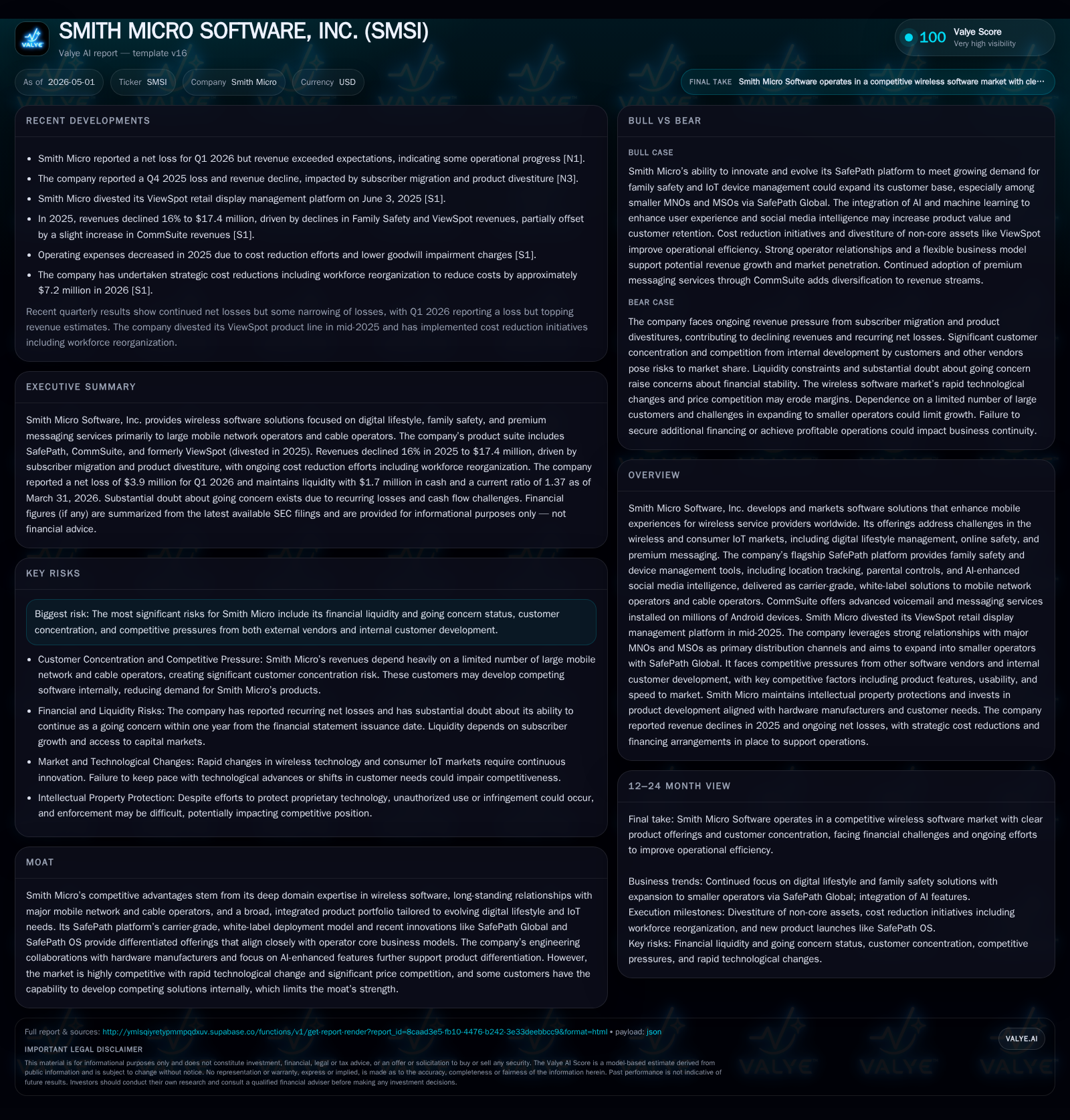
Smith Micro Software’s Q1 2026 filing shows slightly higher revenues than expected but persistent operating losses, reflecting challenges from subscriber migrations and legacy product declines. The company is focusing on its carrier-grade SafePath platform and CommSuite messaging suite, aiming to capitalize on digital lifestyle and IoT trends with added AI features. Despite competitive pressures and liquidity concerns detailed in the latest annual report, Smith Micro pursues growth via operator relationships and expansion into smaller network operators, supported by ongoing cost structure realignments. Key near-term milestones include monitoring subscriber metrics and further deployment of SafePath OS enhancements.
Latest Quarterly Operating Results: Revenue Shifts and Profitability Impact
Smith Micro Software’s Q1 2026 (ending March 31) results reveal a mixed but clarifying picture for the company’s near-term trajectory [S2][N1]. Total revenues slightly beat consensus expectations despite ongoing headwinds from subscriber migration dynamics notably impacting Family Safety product revenues tied to legacy Sprint accounts transitioning to T-Mobile network footprints. This decline further reflects a one-time event reducing revenue in an existing deployment. Concurrently, the divestiture of the ViewSpot retail display platform in mid-2025 removed a revenue source but allowed sharper focus on core software assets [S1][S5].
Despite revenue resilience, operating loss persists due to shrinking top-line volumes in key legacy segments offset only marginally by modest growth in CommSuite premium messaging revenues. The operating environment remains challenging with legacy contract winddowns and industry consolidation pressuring unit economics. Nonetheless, management has prioritized strategic cost reductions—announced savings approximating $7.2 million annually through workforce reorganizations—to realign the operating model toward profitability over the medium term [S3][S6][N1].
Business Model and Product Suite: The Carrier-Grade Edge in Digital Lifestyle and IoT
Smith Micro generates revenue primarily by licensing software solutions as white-label offerings to large mobile network operators (MNOs) and multiple system operators (MSOs). The core value proposition centers around the SafePath platform—a robust suite delivering family safety functions such as location tracking, parental controls, and AI-powered social media intelligence.
Deployed as a carrier-grade solution strongly embedded within operator ecosystems, SafePath offers significant switching barriers through tailored integration with operator billing and device management systems. Complementing SafePath is CommSuite®, which provides next-generation voicemail services including visual voicemail with Voice-to-Text transcription for both prepaid and postpaid subscribers on millions of Android handsets—monetizing legacy voice infrastructures while enhancing end-user experience [S15].
The May 2025 launch of SafePathOS introduces device-level protections pre-installed on smartphones aimed at families seeking out-of-the-box digital safety features—opening new routes for operators to differentiate kid-friendly or senior phones with embedded safety defaults. This vertical integration into device firmware exemplifies Smith Micro’s engineering collaborations with hardware manufacturers that reinforce differentiation in an increasingly commoditized app ecosystem [S15].
The divestment of ViewSpot—a retail display management tool designed for interactive in-store smartphone demos—reflects a disciplined refocus on software platforms aligned more tightly with wireless service providers’ core operational priorities [S1][S5].
Industry Context: Competitive Pressures and Operator Relationships
The mobile software landscape serving operators is intensely competitive. Key factors shaping this space include rapid technological evolution demanding agile innovation; pricing pressures intensifying due to commoditization risk; and threat from internal captive development by major carriers looking to reduce vendor reliance. Smith Micro’s moat rests on its deep domain expertise developed over decades, long-standing ties with tier-one MNOs/MSOs providing distribution access to hundreds of millions globally, and broad product integration that aligns closely with operator business models rather than generic consumer apps [S1].
However, its limited customer base means significant concentration risk where loss or contract renegotiation can materially impact revenues. Price competition remains fierce especially as carriers seek cost efficiencies during consolidation waves. Internal development efforts by large customers create substitution threats that temper pricing power despite differentiated features such as AI-enhanced analytics embedded within SafePath solutions [S1].
Growth Drivers: AI Enhancements, New Deployments, and Market Expansion
Smith Micro’s growth strategy centers on leveraging advanced AI capabilities integrated into its platforms to strengthen user engagement and retention. AI-driven social media intelligence enhances parental control insights delivered through SafePath enhancing stickiness beyond basic location tracking.
Expanding deployments of SafePathOS provide opportunities to reach new segments via pre-installed device protections expanding lifetime value per subscriber under contract. Additionally, the company aims to accelerate penetration into smaller MNOs/MSOs previously inaccessible or underserved through the introduction of SafePath Global—a flexible cloud-based version facilitating easier onboarding across diverse network scales.
The proliferation of consumer IoT devices drives demand for cohesive digital lifestyle management solutions bundled alongside traditional mobile offerings; this aligns well with Smith Micro’s positioning given its cross-device management capabilities.
Together these drivers suggest structural demand growth stemming from increasing necessity for operator-delivered safety features amidst rising concerns about child online safety, device security vulnerabilities inherent in IoT ecosystems, and continued monetization opportunities around premium messaging services fueled by ongoing voice infrastructure transitions [S1].
Risks and Constraints: Financial Liquidity, Customer Concentration, and Market Competition
Financially, Smith Micro confronts considerable liquidity constraints underscored by modest cash reserves ($1.74 million) vis-à-vis current liabilities ($4.36 million) yielding a current ratio of approximately 1.37 at quarter-end March 31, 2026—highlighting limited operational cushion without continued capital raises or accelerated cash flows [F1]. Although short-term notes contain no financial covenants mitigating immediate refinancing pressure, the company's going concern disclosures reflect substantial doubt about sustaining operations absent revenue ramp or additional financing [S4][S9].
Customer concentration emerges as a material risk given reliance on a handful of MNOs/MSOs; changes in carrier strategies (e.g., consolidation or internal platform adoption) represent existential threats well noted within regulatory risk discussions [S1]. Moreover technological shifts prompt continuous innovation expenditures; failing to keep pace risks commoditization accelerating price erosion that pressured gross margins historically.
Key Upcoming Milestones: Subscriber Metrics, Product Launches, and Cost Management
Investors should monitor Q2 updates relating to subscriber trends for Family Safety products especially any displacement effects from ongoing carrier migrations or market churn given their outsized influence on top-line trajectory. Equally pivotal is progress rollout status for SafePathOS enhancements evidencing reception among newer operator clients as well as verification that AI feature iterations maintain competitive standing.
Cost discipline execution represents another critical metric to track following announced workforce reorganizations intended to secure ~$7.2 million in annualized savings during 2026—progress will clarify sustainability of funding runway amid persistent net losses [S2][S3][N1]. Positive variance could materially de-risk liquidity pressures while improving returns leverage.
Financial Overview: Current Liquidity Position and Operational Spend Structure
Latest financial snapshot
| Metric | Value | Period |
|---|---|---|
| Cash & equivalents | $1742000 | |
| 2026-03-31 | ||
| Current assets | $6mm | |
| 2026-03-31 | ||
| Current liabilities | $4mm | |
| 2026-03-31 | ||
| Current ratio | 1.37x | |
| 2026-03-31 |
Source: SEC companyfacts cache [F1].
| Metric | Value (USD) | As of |
|---|---|---|
| Cash & Equivalents | 1,742,000 | |
| 2026-03-31 | ||
| Current Assets | 5,965,000 | |
| 2026-03-31 | ||
| Current Liabilities | 4,356,000 | |
| 2026-03-31 | ||
| Current Ratio | 1.37 | |
| 2026-03-31 |
Ongoing capital raises via registered offerings supplemented by convertible notes reflect efforts to bolster runway though repeated financings imply structural challenges securing abundant growth capital under favorable terms anytime soon.
This analysis synthesizes publicly filed regulatory disclosures alongside recent market commentary without extending investment advice or predictive forecasts. The information herein is intended purely for informed industry evaluation based on available operating metrics as of early May 2026.
Disclaimer: This is research-only, informational analysis and not investment advice. It may include AI-generated interpretation and general industry context. Always verify important details using primary sources.

Comments