
Nebius Group Secures Growth with $4 Billion Convertible Notes and Meta Contract Expansion
Nebius leverages substantial capital raises and a $27 billion Meta contract to solidify its AI cloud infrastructure platform amid scaling challenges.
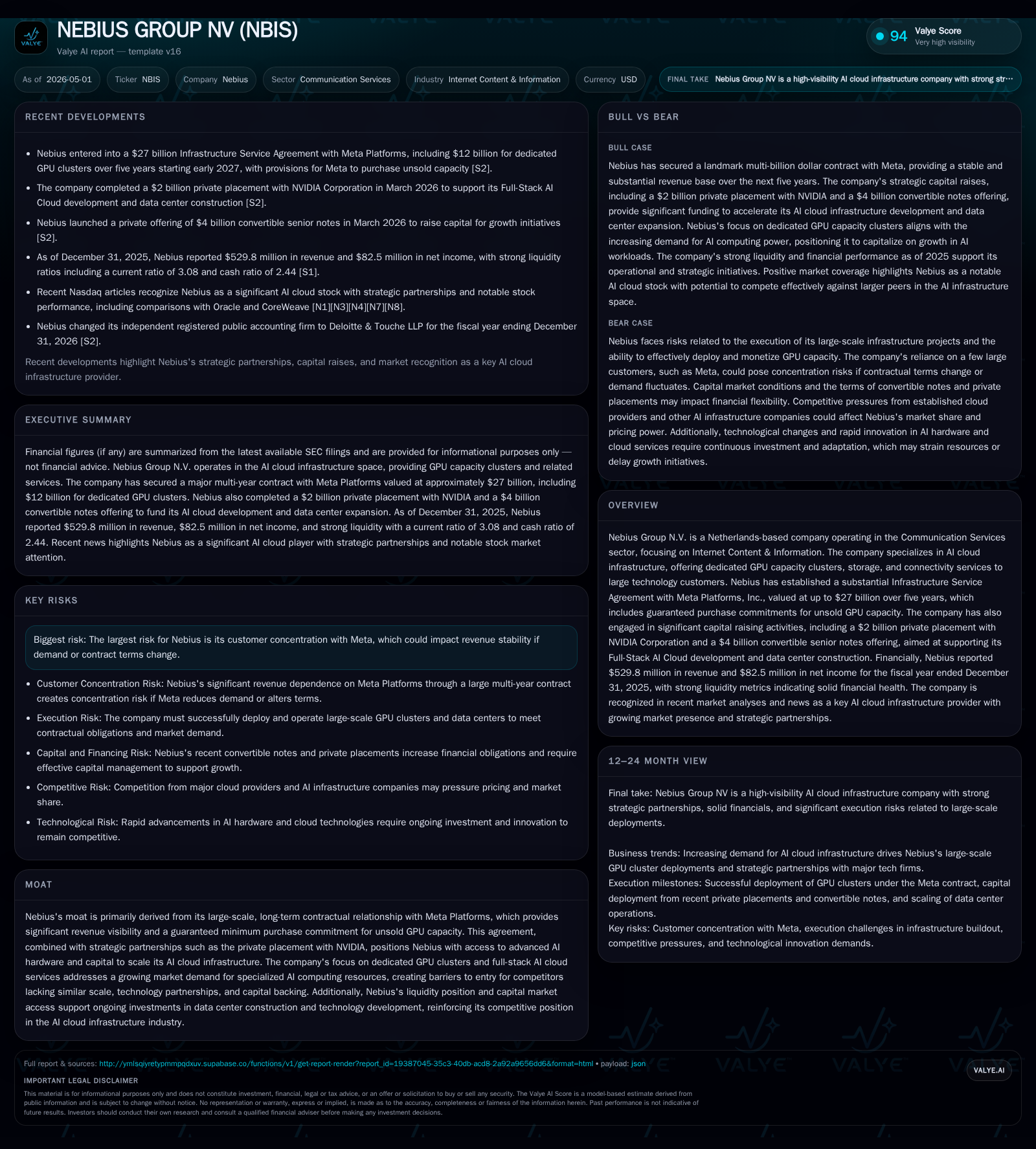
In early 2026, Nebius Group completed a $4 billion convertible senior notes offering and expanded its landmark multi-year infrastructure agreement with Meta Platforms, together providing long-term revenue visibility and capital for accelerated data center expansion. The company’s vertically integrated full-stack AI cloud platform—spanning in-house designed GPU clusters, software orchestration, and multi-tenant services—caters to growing AI workload demands. While Nebius’s strategic NVIDIA partnership and contract scale deliver competitive advantages, risks remain from concentrated customer exposure to Meta and ongoing internal control weaknesses. Investors should monitor capacity rollout progress, customer diversification efforts, and governance improvements in upcoming quarters.
Latest Operating Developments: Capital Raise and Contract Indentures
Nebius Group’s latest SEC filings in March 2026 reveal pivotal capital market transactions alongside substantial contract expansions that are reshaping its near-term operating profile. On March 17-20, 2026, the company completed an upsized private offering of $4 billion in convertible senior notes split into two tranches: $2 billion at a low coupon of 1.25% maturing in 2031 and another $2 billion at a higher coupon of 2.625% maturing in 2033 [S2][S3]. These note indentures detail terms that lock in inexpensive long-duration capital intended to fund Nebius's aggressive data center expansions and investments in its full-stack AI cloud infrastructure.
Simultaneously, Nebius solidified its strategic positioning with Meta through a newly inked Infrastructure Service Agreement effective early March 2026 with total contract value capped at approximately $27 billion spanning multiple five-year orders [S12][S14]. This arrangement includes dedicated GPU cluster deployments starting in early 2027 valued at $12 billion alongside storage and connectivity services. Critically, the agreement ensures Meta will purchase any unsold GPU capacity for up to five years post-deployment with a potential additional $15 billion commitment. This provision guarantees meaningful revenue floor protection even if third-party sales for excess capacity lag.
The timing of the capital raise dovetails directly with the contractual commitments requiring significant upfront hardware investments and operational scale-up over the next several years. Moreover, the note issuance reflects investor confidence given favorable coupon rates amidst broader market volatility.
Business Model: Full-Stack AI Cloud Infrastructure and Customer Engagement
Nebius operates a vertically integrated full-stack AI cloud platform that distinguishes itself by combining custom-designed silicon-level hardware deployment with an orchestration software stack tailored specifically for high-performance AI workloads across training and inference lifecycle stages [S1]. Its offerings span dedicated GPU compute clusters optimized for heterogeneous AI tasks supported by proprietary storage solutions and high-bandwidth connectivity services enabling robust multi-tenant environments.
This comprehensive integration allows clients – ranging from IT operations teams provisioning infrastructure to data scientists requiring scalable compute resources, as well as AI engineers deploying models without infrastructure complexity – to access seamless performance optimized for advanced machine learning applications. The company designs unique server racks embedding the latest generation NVIDIA GPUs early in their product cycles underpinned by synergy from its sizeable NVIDIA private placement of $2 billion completed earlier in March 2026, ensuring preferential access to critical AI chips [S13]. This alignment mitigates cyclical chip supply constraints common across the industry.
Nebius’s value proposition centers on maximizing computational throughput per watt while minimizing total cost of ownership (TCO) for customers by integrating hardware innovation with workload-aware scheduling software. These efficiencies position Nebius competitively versus hyperscalers or generalist cloud providers whose architectures are less specialized for dense AI tasks.
Competitive Landscape: Positioning in AI-Optimized Compute Services
Within the fiercely competitive AI infrastructure sector typified by players like CoreWeave and traditional cloud giants pivoting toward GPU clouds (AWS/GCP/Azure), Nebius’s moat is shaped largely by its long-term contractual lock-ins – particularly the Meta deal ensuring multi-billion-dollar commitments underpinned by guaranteed minimum purchases for idle capacity [N11][N12][S12]. This arrangement de-risks capacity under-utilization that plagues many competitors reliant solely on spot or short-term demand.
The company’s close partnership with NVIDIA adds exclusivity in procuring cutting-edge GPUs necessary for training large language models (LLMs) and other generative AI technologies. Competition depends heavily on access to such hardware due to global semiconductor supply chains shortages affecting overall pricing power.
Differentiation also lies in Nebius’s end-to-end approach: owning the design of data centers' physical layouts optimized for power efficiency coupled with bespoke cluster management tools that optimize latency-sensitive AI workflows – factors that reduce operational overheads for enterprise clients needing reliable performance at scale.
While competitors aggressively pursue broader clientele or specialize solely on certain segments (e.g., startup-friendly spot markets), Nebius balances scale-outsupported enterprise contracts alongside ventures into serving mid-tier software vendors and startups aiming to broaden its revenue base.
Growth Catalysts: AI Market Expansion and Strategic Partnerships
The surging adoption of generative AI models transitioning from experimental research phases into production-grade deployments is driving structural upgrades to cloud infrastructure globally [S1][N2][N8]. Nebius taps this structural wave via:
- Multi-year contracts with hyperscalers like Meta facilitating predictable capacity expansion budgets.
- A broadening customer mix targeting established enterprises requiring flexible AI capacity alongside nimble startups innovating new applications.
- Continuous innovation furthers integration between hardware-software stacks providing enhanced scalability parallelism crucial as model sizes grow exponentially.
These dynamics suggest volume growth driven by increasing compute hours purchased rather than mere price competition alone. Additionally, Nebius’s full-stack architecture positions it well to capture margins as clients seek turnkey platforms embracing emerging workloads such as real-time inference or federated learning where low-latency infrastructure is paramount.
Furthermore, strategic collaborations – evidenced by the NVIDIA warrant private placement entailing approximately $2 billion inflows – support not only capital intensity but potentially joint innovation pipelines granting Nebius early access to roadmap technologies critical in sustaining technical advantage [S13].
Risks and Challenges: Customer Concentration and Execution Risks
Despite its strengths, several risk vectors warrant scrutiny:
- Customer Concentration: Meta Platforms represents an outsized share of Nebius’s expected revenues given their $27 billion commitment over five years and contracts involving guaranteed minimum purchases on unsold capacity [S12]. Any shifts in Meta's demand patterns or strategic priorities could disproportionately impact Nebius’s top line.
- Internal Control Weaknesses: The company disclosed material weaknesses relating to fixed asset tracking and depreciation controls stemming from fast organizational growth post-2024 divestment restructuring [S1]. Persistent deficiencies could affect financial reporting reliability or delay regulatory compliance efforts.
- Execution Complexity: Rapid scaling required by contract tranches starting early 2027 necessitates flawless project management regarding data center buildouts, equipment installation, network integration, etc., any delays may induce penalty clauses or customer dissatisfaction.
- Equity Dilution: Convertible notes scheduled conversions represent dilution potential of roughly 66 million shares impacting shareholder value; disclosure signals intention to raise funds continuously which might pressure stock liquidity if not offset by commensurate earnings growth [S1].
- Macroeconomic Sensitivities: Given substantial capital expenditure plans during uncertain economic periods marked by interest rate fluctuations or geopolitical risks affecting supply chains could constrain execution or increase costs unexpectedly.
Upcoming Milestones and What Investors Should Monitor
Key near-term markers include:
- Progress reports on deployment phases aligned with Meta orders commencing early 2027 indicating tangible revenue ramp timings [S12][S14].
- Updates regarding expansion of non-Meta clientele demonstrating success in reducing concentration risk by diversifying sectors served per annual filing hints at growing enterprise footprint beyond tech hyperscalers [S1].
- Improvements or remediations undertaken related to internal control material weaknesses flagged in recent filings will be important governance signals [S1].
- Quarterly earnings guidance revisions reflecting scaling costs vs margin trajectories amid high initial capex absorption expected from expansive data center rollouts.
- Potential new strategic partnerships akin to NVIDIA collaboration expanding ecosystem access or preferential supply chain arrangements enhancing competitive moats.
Current Financial Profile: Liquidity, Debt, and Profitability Snapshot
Latest financial snapshot
| Metric | Value | Period |
|---|---|---|
| Cash & equivalents | $3.7bn | |
| 2025-12-31 | ||
| Total debt | $4.8bn | |
| 2025-12-31 | ||
| Net debt | $1159mm | |
| 2025-12-31 | ||
| Current assets | $4.7bn | |
| 2025-12-31 | ||
| Current liabilities | $1528mm | |
| 2025-12-31 | ||
| Current ratio | 3.08x | |
| 2025-12-31 |
Source: SEC companyfacts cache [F1].
Reflecting fiscal year ended December 31, 2025 metrics:
| Metric | Value (USD) | Period End |
|---|---|---|
| Revenue | 529.8 million | |
| 2025-12-31 | ||
| Operating Income | -611.7 million | |
| 2025-12-31 | ||
| Net Income | 82.5 million | |
| 2025-12-31 | ||
| Cash & Equivalents | 3.68 billion | |
| 2025-12-31 | ||
| Total Debt | 4.84 billion | |
| 2025-12-31 | ||
| Current Ratio | 3.08x | |
| 2025-12-31 |
Despite negative operating income reflecting heavy upfront investment costs associated with scaling its AI cloud infrastructure footprint, Nebius remains net profitable on a bottom-line basis helped by non-operating items including financing gains or equity stakes technicalities [F1].
Liquidity is robust with over $3.6 billion cash equivalents covering near-term liabilities comfortably as indicated by a strong current ratio above three times [F1], affording operational flexibility amid large capex needs. However, total indebtedness remains elevated at nearly $4.84 billion generating net debt slightly above $1.15 billion once cash offsets are considered—a leverage level consistent with capital-intensive infrastructure buildouts supported by recent convertible note issuance enhancing balance sheet strength further post-quarter end events [F1][S2].
Overall financial posture balances investment ambitions against cautious liquidity management critical for sustaining growth runway through volatile macroeconomic conditions accompanying accelerated AI cloud demand surges.
This analysis synthesizes information solely for informational purposes without recommending any investment action concerning NEBIUS GROUP NV (NBIS). All forward-looking statements referenced derive directly from disclosed SEC filings without speculative extrapolation.
Disclaimer: This is research-only, informational analysis and not investment advice. It may include AI-generated interpretation and general industry context. Always verify important details using primary sources.

Comments