
Haoxin Holdings Elevates Temperature-Controlled Logistics Amid Fleet Optimization and Capital Demands
Strong revenue growth driven by temperature-controlled services contrasts with rising costs and operational cash requirements.
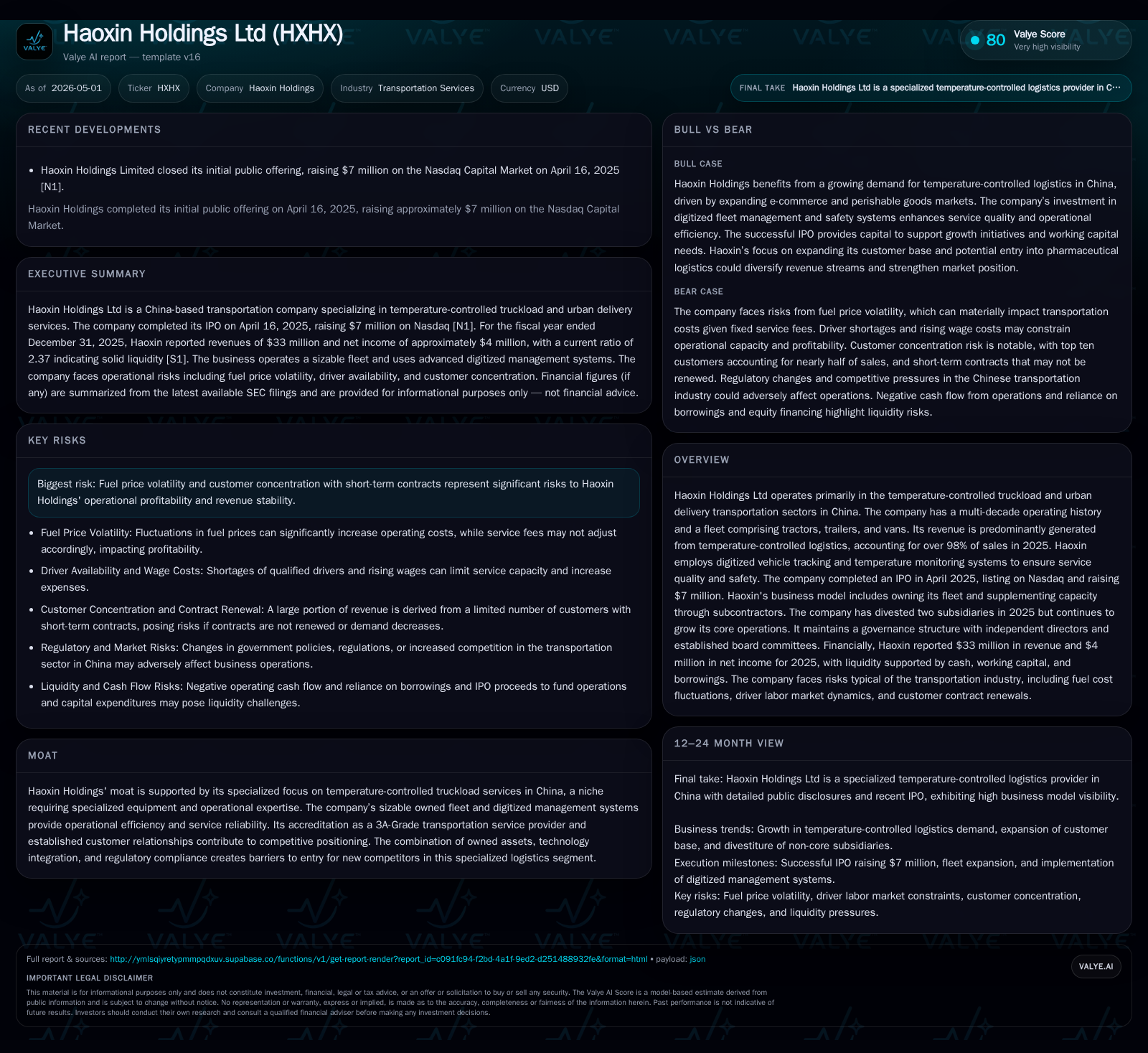
Haoxin Holdings Ltd, specializing in temperature-controlled truckload and urban delivery services in China, reported robust revenue growth through mid-2025, with temperature-controlled logistics accounting for over 98% of revenues. The company operates a sizable owned fleet enhanced by digital tracking systems and has divested subsidiaries to focus on core operations. However, rising transportation costs and substantial cash usage for capital expenditures and working capital pose liquidity considerations. Haoxin's competitive moat centers on specialized logistics capabilities and regulatory accreditation, yet fuel price volatility and customer concentration remain key risks.
Recent Operating Update
Haoxin Holdings Ltd disclosed strong interim results for the six months ended June 30, 2025 [S2]. Revenue nearly doubled to $17.8 million from $9.3 million year-over-year, fueled predominantly by its core temperature-controlled truckload services which accounted for over 98% of sales during the period. Operating income similarly doubled to $4.25 million despite a parallel rise in transportation costs by nearly 92%, reflecting efficient cost management within an intensifying scale of operations.
The company highlighted its ongoing reliance on substantial cash to cover operating expenses, fund capital expenditures, and meet debt servicing obligations [S2]. Financing has been secured through a mix of term loans, revolving credit facilities, direct equipment financing, operating leases, as well as proceeds from its April 2025 Nasdaq IPO which raised approximately $7 million net [S2],[S1]. Nevertheless, the business still posted a negative net cash flow from operations indicating capital intensity inherent in fleet expansion and operational scale-up.
Business Model
Haoxin Holdings operates primarily within the niche of temperature-controlled logistics—specializing in transporting factory-related goods including electronics, chemicals, fresh produce, food products, and commercial goods across China [S1]. Its integrated service offering encompasses long-haul temperature-controlled truckload transport complemented by urban delivery using medium-sized vans for last-mile intra-city shipments.
Revenue is largely mileage-based. The firm owns all vehicles utilized—70 tractors, 97 trailers, and 31 vans—with preference for finance leases when acquiring new fleet assets rather than outright purchases or rentals [S1]. This asset-heavy approach supports consistent service quality control but necessitates intensive capital investment.
The company leverages digitized management systems integrating real-time GPS vehicle tracking alongside continuous temperature monitoring throughout transport processes [S1]. Besides operational transparency for customers on cargo conditions, these systems contribute to risk reduction via safety alert mechanisms implemented across all vehicles.
Haoxin supplements owned capacity with subcontractors but maintains stringent standards to preserve uniform service reliability. Customer contracts typically span one year or less with renewal options but no guaranteed continuation—adding some volatility to revenue predictability [S1]. The primary pricing support arises from specialized cold-chain capabilities servicing regulated cold storage demands.
Recent strategic moves include divesting non-core subsidiaries (Longanda and Haiyue) within early 2025 without disrupting core operational growth [S1]. Future plans focus on consolidating transported product types along routes, developing cold warehouse infrastructure to reduce logistic costs per shipment block, acquiring pharmaceutical transport certifications to enter higher-margin segments, and advancing informatization initiatives to enhance dispatching efficiency [S1].
Industry Structure and Competitive Position
Haoxin occupies a specialized sector characterized by high barriers due to significant upfront fleet investment demands combined with stringent operational requirements around cold-chain integrity—a vital segment underpinning China's expanding food safety regulations and pharmaceutical distribution mandates.
The firm’s moat is reinforced by its accredited status as a 3A-Grade transportation service provider by the China Federation of Logistics and Purchasing—a distinction indicating compliance with rigorous quality standards that elevate competitive defensive position [S1],. The vertically integrated nature of ownership coupled with digital monitoring systems helps distinguish Haoxin from smaller subcontractor-reliant operators.
However, the market remains fragmented with many regional players competing on price for short-term contracts. Haoxin’s relatively concentrated top-10 customer base contributed about 44.9% of sales in 2025, underscoring potential exposure [S1]. Pricing power is partially sustained due to specialization but could face pressure if competitor capacity expansions or low-cost entrants increase.
Growth Drivers
- Expanding Cold-Chain Demand: China's growing regulatory environment pushing for stricter temperature control logistics elevates demand structurally for companies like Haoxin with dedicated fleets.
- Pharmaceutical Logistics Entry: Plans to acquire pharmaceutical transport qualifications represent a strategic avenue into higher-value segments requiring validated cold-chain expertise.
- Cold Storage Development: Building integrated cold warehouses could reduce per-unit logistics costs while enhancing service offerings around inventory management—potentially improving customer retention.
- Technology Integration: Strengthening informatization through dispatch system upgrades aims at improving operational efficiency and vehicle utilization rates reducing idle times.
- Market Penetration: Leveraging existing geographic coverage alongside stable customer relationships supports incremental business gains amid rising industrial output fostering logistics needs.
Risks / Constraints
- Fuel Price Volatility: Transportation expenses constitute a majority of costs; fluctuations can materially impact margins given limited locking mechanisms in short-term contracts,[S2].
- Customer Concentration & Contract Terms: Reliance on few large clients with mostly one-year or shorter agreements introduces vulnerability if renewals falter or contract terms weaken pricing power [S1].
- Capital Intensity: Fleet ownership drives heavy capex requirements causing negative operating cash flows; ability to sustainably finance this while scaling remains critical [S2],[F1].
- Internal Control Deficiencies: Material weaknesses identified in U.S. GAAP compliance controls have led to governance reforms but remain an area needing ongoing oversight improvement [S24],[S15].
- Foreign Exchange Risk: Most revenues/costs denominated in RMB against USD reporting currency expose Haoxin to currency translation risks though no hedging strategies are currently employed [S12].
- Regulatory Environment: While accreditation offers competitive advantage it also imposes compliance cost burdens restricting operational flexibility or increasing costs if regulations tighten further.
What To Watch Next
- Quarterly revenue progression showing sustained double-digit growth especially within the pharmaceutical transport segment rollout would indicate effective diversification.
- Improvements in operating cash flow metrics signaling better working capital management amid capex spending would be crucial.
- Updates on expansions in cold warehouse capacity or technology upgrades implementing integrated dispatch-temperature systems provide insight into strategic execution capabilities.
- Retention rates among top customers given short-term contracts will impact revenue stability; contract renewal announcements are key indicators.
- Progress reports on remediation of internal control weaknesses including staffing enhancements and audit committee activities reflect governance strengthening necessary for reliable financial reporting.
Financial Profile (Latest Snapshot)
Latest financial snapshot
| Metric | Value | Period |
|---|---|---|
| Cash & equivalents | $1404626 | |
| 2025-12-31 | ||
| Current assets | $46mm | |
| 2025-12-31 | ||
| Current liabilities | $19mm | |
| 2025-12-31 | ||
| Current ratio | 2.37x | |
| 2025-12-31 |
Source: SEC companyfacts cache [F1].
| Metric | Value | Period Ending |
|---|---|---|
| Revenue | $33,040,012 | |
| 2025-12-31 | ||
| Operating Income | $7,789,812 | |
| 2025-12-31 | ||
| Net Income | $3,967,882 | |
| 2025-12-31 | ||
| Cash & Equivalents | $1,404,626 | |
| 2025-12-31 | ||
| Total Debt | $477,708 | |
| 2024-12-31 | ||
| Current Ratio | 2.37 | |
| 2025-12-31 |
Despite healthy profitability at the latest fiscal year-end driven by expanding scale in specialized logistics services [F1], the balance sheet reveals low absolute cash buffers against moderate total debt (net debt approximately negative $927k) [F1], emphasizing dependence on constant financing access due to working capital intensive operations described earlier [S2],[S4]. This financing risk is somewhat mitigated by a current ratio greater than two indicating solid short-term liquidity coverage [F1].
Capital expenditure increased significantly in recent periods primarily reflecting fleet purchases essential for capacity ramp-up [S8]. Interest expense rose commensurately with increased borrowings demonstrating elevated leverage levels albeit manageable under current operating profit metrics [S2],[S9].
Overall liabilities predominantly comprise short-term bank borrowings aligning with liquidity strategy focused on revolving credits complemented by direct asset financing consistent with asset-heavy model requirements [S2],[S4].
This analysis is based solely on publicly available filings including the latest quarterly report (6-K dated December 30, 2025) supplemented by the annual report (20-F dated April 30, 2026). It does not constitute investment advice.
Disclaimer: This is research-only, informational analysis and not investment advice. It may include AI-generated interpretation and general industry context. Always verify important details using primary sources.

Comments