
Virtu Financial Shows Resilience with Robust Q1 Operating Performance and Expanding Market Access
Q1 2026 results affirm Virtu's technology-driven market making across global multi-asset classes amid volatile markets.
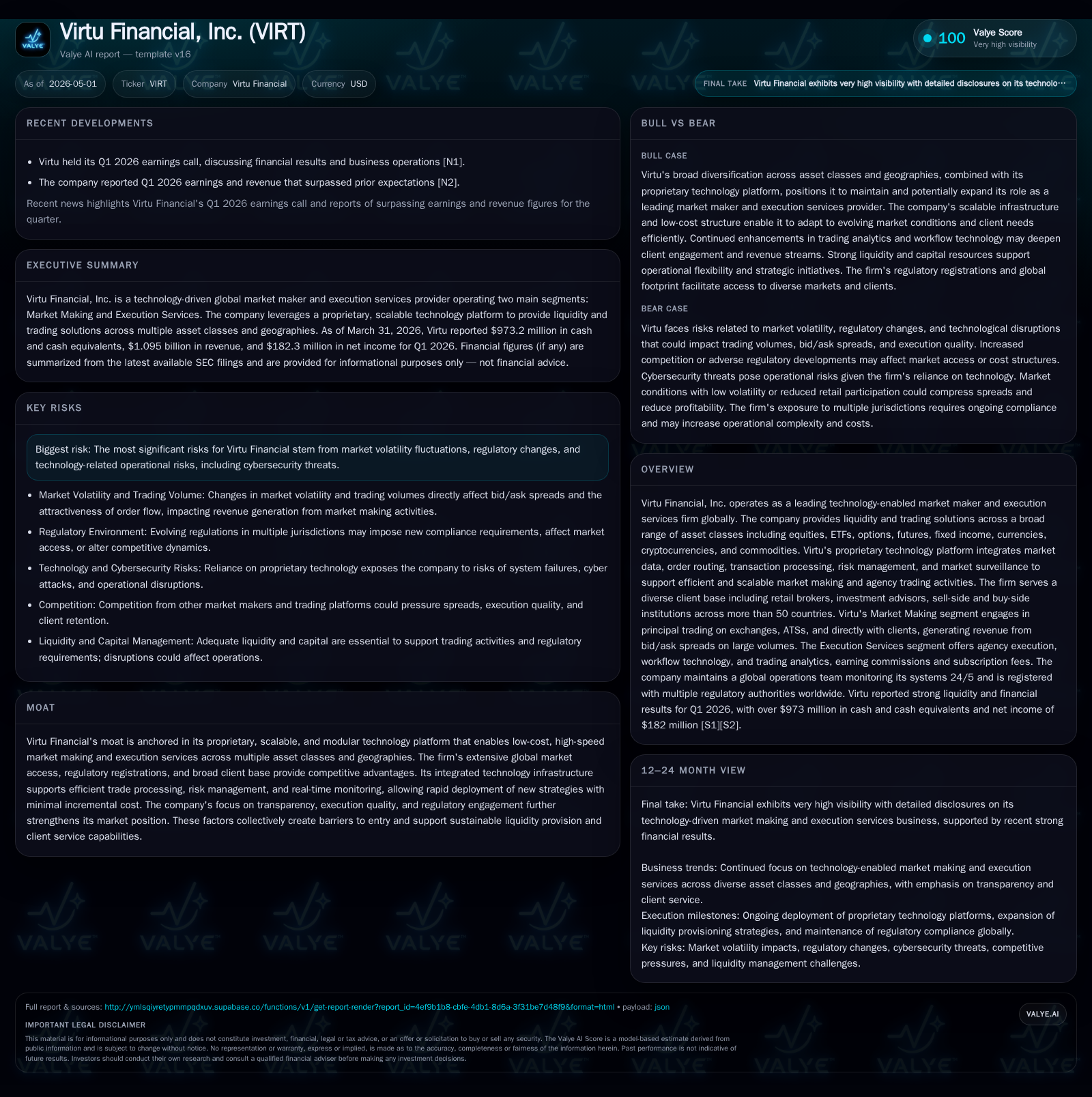
Virtu Financial reported strong operational resilience in Q1 2026, demonstrating growth in both market making and execution services despite challenging volatility. The company's proprietary technology platform continues to underpin scalable liquidity provision and efficient multi-asset trading across 50+ countries. While regulatory and market risks persist, Virtu’s expansive venue access, diverse product suite, and real-time risk management position it well for continued growth.
Q1 2026 Operating Highlights: Growth and Efficiency Metrics
Virtu Financial’s latest quarterly filing dated May 1, 2026 [S2] reveals a stable operating environment marked by resilient revenue generation through its Market Making and Execution Services segments. Despite ongoing market volatility that typically influences trading volumes and spreads, Virtu reported solid transaction activity consistent with prior quarters [S3]. The firm continues to leverage its global multi-asset presence to capture bid/ask spreads at scale.
Cost dynamics show disciplined expense management against a backdrop of investment in data connectivity, co-location facilities, and technology infrastructure — critical to sustaining low latency execution [S1]. There is an ongoing emphasis on optimizing employee incentive compensation aligned with profitability outcomes, as disclosed during the April earnings call [N1], supporting earnings quality.
Crypto assets remain a niche but growing contributor within the product mix, reflecting Virtu's commitment to emerging asset classes without disproportionate risk exposure [S2]. Overall, the company maintains operational flexibility which underpins its ability to scale activities efficiently across evolving market conditions.
Business Model: Proprietary Technology Driving Market Making and Execution Services
Virtu operates two main business segments: Market Making and Execution Services [S1]. The Market Making segment engages in principal trading across equities, ETFs, futures, options, fixed income, FX, cryptocurrencies, and commodities via electronic exchanges—extracting revenue primarily through bid/ask spreads on large-volume trades. This model relies heavily on proprietary technology modules including:
- Market data ingestion enabling real-time understanding of shifts across venues.
- Sophisticated order routing algorithms designed for low-latency trade execution.
- Integrated risk management systems monitoring exposures continuously.
- Automated trade reconciliation ensuring operational accuracy.
The Execution Services segment functions mainly agency-based, offering client-facing liquidity sourcing and trading solutions characterized by high transparency standards. This differentiation addresses regulatory emphasis on execution quality while meeting diverse client requirements spanning retail brokers to institutional investors globally.
Margins benefit from automation-driven scalability where incremental transaction volume incurs minimal cost escalation. The firm’s software-driven infrastructure reduces dependence on third-party licenses or manual processes while allowing rapid incorporation of new asset classes or regional markets without notable increases in overheads [S1].
Competitive Positioning Within Global Multi-Asset Trading Ecosystem
Virtu's moat is anchored in its advanced technology platform coupled with a widely established network of regulatory registrations spanning North America, Europe (FCA UK, CBI Ireland), Asia-Pacific (MAS Singapore, ASIC Australia), and Canada among others [S1]. This compliance footprint facilitates venue access across more than 50 countries—enabling Virtu to provide liquidity where competitors may face licensing or operational constraints.
The firm's extensive co-location presence near major exchange data centers combined with sophisticated market surveillance capabilities enhances order execution speed and integrity—key competitive advantages in an industry where microseconds impact profitability. Network effects emerge from bilateral relationships with numerous exchanges and alternative trading systems (ATSs), reinforcing Virtu’s position as a primary liquidity provider.
Transparency policies embedded in the Execution Services segment build client trust that can translate into sticky recurring revenue streams amid increasing regulatory scrutiny globally. Compared to peers reliant on either narrower asset focuses or more manual trading models, Virtu’s integrated tech stack ensures low incremental costs for scaling new strategies or assets — reinforcing sustainable cost leadership [S1].
Key Growth Drivers: Technology Scale, Asset Class Expansion, and Geographic Reach
Virtu’s growth trajectory leverages multiple interlocking levers:
- Technology Scale: Continued enhancements to proprietary algorithms and platform reliability enable rapid onboarding of new marketplaces without linear expense increases [S2].
- Asset Class Diversity: Expansion into underpenetrated categories such as cryptocurrencies builds optionality amid rising institutional adoption [S3].
- Geographic Reach: Regulatory approvals in diverse jurisdictions grant access to both mature Western markets and growth-oriented APAC regions.
- Real-Time Risk Management: Sophisticated controls allow the firm to selectively increase exposure while managing credit lines effectively under volatile conditions.
These drivers are quantitatively linked via metrics like daily executed volumes per asset class range; client count expansion; average spread capture; system uptime; and latency measures reported internally though not publicized comprehensively. Executing further integration of blockchain-based venues or decentralized finance channels could represent adjacent expansion avenues if compliance barriers evolve favorably.
Risks and Constraints: Market Volatility, Regulatory Compliance, and Operational Challenges
Core risks articulated clearly in the latest Form 10-Q [S2] indicate no material change from the prior year but remain pivotal:
- Market Volatility: Fluctuating volumes can compress bid/ask spreads or reduce total traded notional impacting revenues especially if sustained volatility abates.
- Regulatory Environment: Continuous engagement required as rules for electronic trading tighten globally; compliance failures risk sanctions or license revocations.
- Cybersecurity & Operational Risks: Complex tech infrastructure is vulnerable to breaches or disruptions that can impair trading capabilities or reputation.
- Leverage & Funding Risk: Net debt approximating $1.08 billion (total debt $2.05 billion less cash $973 million at quarter-end) [F1] necessitates prudent collateral management given reliance on margin financing frameworks.
Competitive pressures may intensify with new non-bank liquidity providers entering electronically enabled markets but Virtu’s integrated setup offers a defensive moat underpinned by rapid strategy deployment possibility without significant fixed cost additions [S1]. Capital allocation decisions must navigate between share repurchases—as evidenced historically—and maintaining strong regulatory capital buffers.
What to Watch Next: Upcoming Milestones and Demand Indicators
Key forward-looking indicators include:
- Periodic quarterly guidance updates capturing changes in average trade volumes/market making spreads post recent earnings call [N1].
- Monitoring incentive compensation accruals reflecting alignment with overall profitability goals highlighted in MD&A sections [S1]—serving as an indirect health gauge of business momentum.
- Technology platform upgrades aimed at reducing latency further or securing access on emerging venues such as crypto exchanges noted in filings [S3].
- Regulatory dialogues worldwide that could affect permissible scope or capital requirements potentially signaling growth headwinds or opportunities.
Management commentary during earnings suggests strategic patience emphasizing calibrated investment rather than aggressive capacity expansion until clearer macro signals emerge [N2]. Sustaining client retention via transparent execution also remains a continuous focus area given evolving investor expectations around market integrity.
Latest Financial Snapshot: Capital Structure and Liquidity Overview
Latest financial snapshot
| Metric | Value | Period |
|---|---|---|
| Cash & equivalents | $973mm | |
| 2026-03-31 | ||
| Total debt | $2.1bn | |
| 2026-03-31 | ||
| Net debt | $1078mm | |
| 2026-03-31 |
Source: SEC companyfacts cache [F1].
| Metric | Value (USD) | Date |
|---|---|---|
| Cash & Equivalents | $973,225,000 | |
| 2026-03-31 | ||
| Total Debt | $2,051,601,000 | |
| 2026-03-31 | ||
| Net Debt | $1,078,376,000 | |
| 2026-03-31 |
Despite elevated gross leverage reflective of market making operations requiring collateralized funding lines for inventory positions across venues, Virtu maintains substantial cash reserves supporting margin calls and general liquidity demands [F1]. The capital structure includes senior secured loans bearing fixed interest rates mitigating refinancing risk through late decade maturities documented in prior quarters [S8]. Share repurchase programs have been actively employed albeit balanced prudently against regulatory capital considerations described internally [S22]. Overall financial positioning complements the operating model's reliance on real-time risk management to preserve healthy returns even as cyclical trading conditions fluctuate.
Disclaimer: This analysis does not constitute investment advice or recommendations. It is an informational review based solely on publicly available filings as of the specified dates.
Disclaimer: This is research-only, informational analysis and not investment advice. It may include AI-generated interpretation and general industry context. Always verify important details using primary sources.

Comments