
MicroVision Advances Sensor Portfolio with Luminar Acquisition and Sets Stage for Intelligent Mobility Growth
Recent investor presentation highlights MicroVision’s transition to commercialization and market expansion following its $33 million acquisition of Luminar lidar assets.
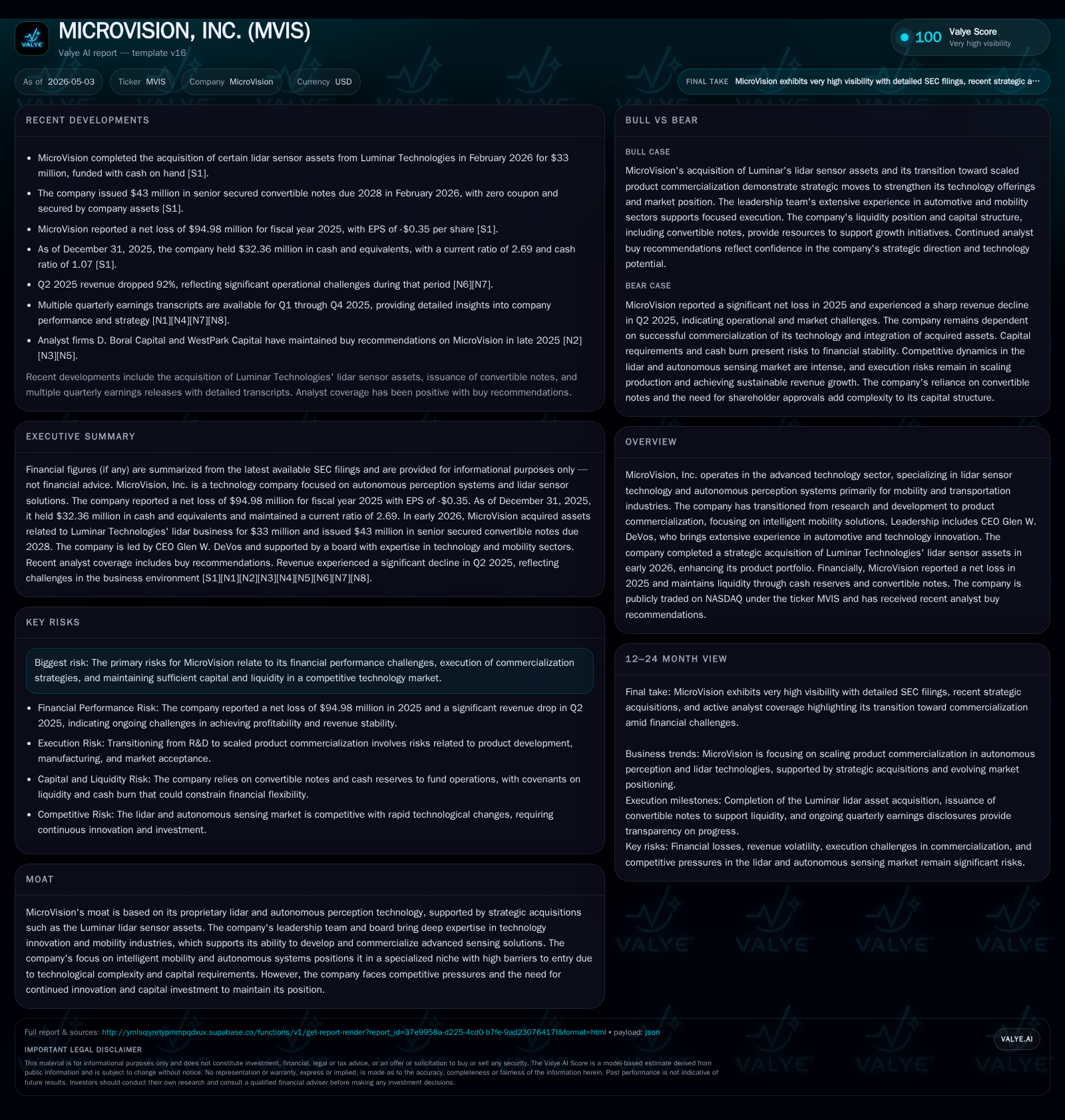
On April 7, 2026, MicroVision published a new investor presentation outlining strategic priorities after acquiring certain lidar sensor assets from Luminar Technologies earlier in the year. This move marks a clear pivot from R&D to active commercialization focused on intelligent mobility and autonomous perception markets. While the company continues to face net losses and execution risks, its strengthened technology portfolio and balance sheet provide a foundation for growth in a competitive yet capital-intensive sector.
Investor Presentation Update: Strategic Clarity After Luminar Acquisition
On April 7, 2026, MicroVision filed an 8-K disclosing an updated investor presentation available on its IR website [S3]. This presentation represents a critical step in communicating the company’s evolution beyond research into active commercialization. Management emphasized leveraging recently acquired lidar sensor assets from Luminar Technologies—including intellectual property and inventory related to the Iris and Halo sensors—as cornerstones for product offerings targeting autonomous mobility applications. The presentation is intended to be used throughout 2026 in engagements with investors and analysts, underscoring MicroVision's intent to increase market visibility around its commercial trajectory.
This event filing anchors MicroVision’s near-term operating picture around tangible progress in executing its strategic pivot. It signals a transition from technology development toward deployment-ready solutions amid aggressive sector competition.
Business Model and Product Quality: From Proprietary Lidar Technology to Integrated Mobility Solutions
MicroVision derives its revenue primarily from licensing and sales of advanced lidar sensors combined with autonomous perception software systems tailored mainly for the intelligent mobility sector [S1]. The company focuses on highly technical sensing hardware adaptable for automotive OEMs, transportation fleets, and related smart vehicle applications.
The company's competitive strength stems from proprietary laser scanning technology enabling high-resolution environmental mapping crucial for safe autonomous navigation. Integration capabilities incorporating sensing hardware with perception algorithms offer differentiated performance necessary for customer adoption amid rigorous reliability demands typical in automotive-grade systems.
Customer segmentation is sharply targeted at automakers and mobility service providers increasingly dependent on sophisticated sensor suites as ADAS (Advanced Driver Assistance Systems) evolve toward full autonomy. The quality attributes of MicroVision’s offerings—such as range accuracy, low power consumption, system compactness, and software adaptability—are pivotal decision drivers impacting adoption rates.
Competitive Positioning and Industry Dynamics in Autonomous Perception
The recent acquisition of Luminar’s lidar sensor assets notably reinforces MicroVision’s IP portfolio relative to peers in a fiercely competitive industry characterized by rapid innovation cycles and capital intensity. By integrating Iris and Halo sensor technologies into their platform suite, MicroVision addresses critical gaps in range capability and signal processing efficiency that are essential differentiators in lidar deployments.
Barriers to entry remain high due to complex photonics engineering requirements, substantial R&D outlays needed to address automotive standards compliance (functional safety certifications such as ISO 26262), and manufacturing scale challenges inherent in precision optical components. Regulatory uncertainties around autonomous vehicle deployment timelines add additional risk layers while potentially gating volume uptake.
Peer rivalry includes well-established lidar companies like Velodyne Lidar and newer competitors embedded within automotive supply chains. MicroVision's strategic asset purchase positions it more favorably within this cluster though commercialization execution will test its operational discipline amid supply chain constraints.
Growth Catalysts: Commercialization, Market Expansion, and Innovation Pipeline
MicroVision's pathway to growth hinges on accelerating commercialization via product launches leveraging Luminar-derived sensor technology combined with proprietary platform evolution described in the April investor deck [S3]. Expansion into broader transportation segments beyond passenger cars—such as last-mile delivery vehicles or industrial automation—also represents incremental avenues.
Partnerships or licensing agreements with OEMs or Tier-1 suppliers could multiply revenue streams once scalability is demonstrated. Additionally, ongoing investment in software integration enhances system intelligence vital for complex environment interpretation underpinning autonomous decision-making.
Mid-term demand growth aligns structurally with broader autonomous vehicle adoption trends projected by industry analysts over the next decade. Success depends on converting pipeline projects into volume production orders as regulatory frameworks evolve.
Risks and Constraints: Financial Pressures and Execution Challenges
Despite technological strides, MicroVision faces significant risks rooted primarily in its financial performance profile characterized by continuing net losses exceeding $94 million as of 2025 year-end [F1], necessitating careful cash management given recent acquisition expenses.
The transition from R&D-focused operations toward scalable manufacturing entails operational risks including yield improvements, supply chain stabilization for critical photonics components, quality assurance scaling, and timely certification compliance [S1].
Competitive intensity demands sustained investment into innovation cycles with no guaranteed market share gains. While the current ratio stands at a healthy 2.69 reflecting reasonable short-term liquidity [F1], capital expenditure needs post-acquisition may pressure financial flexibility if revenue ramp-up accelerates slower than anticipated.
Market pricing pressures alongside potential delays in customer adoption could constrain margin expansion prospects while external macroeconomic factors impacting semiconductor availability create volatility risks.
Key Milestones to Watch: Investor Guidance and Operational Indicators
Investors should monitor sequential disclosures from MicroVision regarding revenue progression attributable to newly acquired sensor products as well as announcements related to production scaling efforts highlighted in the investor presentation [S3].
Partnership developments or OEM certification achievements serve as critical demand validation points. Further communication around backlog formation or first commercial deliveries will provide early indicators of execution momentum.
Quarterly updates may clarify margin trajectory implications associated with factory ramp-up efficiencies or procurement cost improvements. Any amendments to guidance or strategy pivots would carry material signals about the evolving business environment.
Latest Financial Snapshot: Balance Sheet Strength Amid Losses
Latest financial snapshot
| Metric | Value | Period |
|---|---|---|
| Cash & equivalents | $32mm | |
| 2025-12-31 | ||
| Total debt | $20mm | |
| 2025-12-31 | ||
| Net debt | $-13mm | |
| 2025-12-31 | ||
| Current assets | $81mm | |
| 2025-12-31 | ||
| Current liabilities | $30mm | |
| 2025-12-31 | ||
| Current ratio | 2.69x | |
| 2025-12-31 |
Source: SEC companyfacts cache [F1].
As of December 31, 2025, MicroVision reported cash and equivalents totaling approximately $32.4 million supporting liquidity [F1]. Total debt stood at $19.5 million resulting in net cash positioning measured by net debt of about negative $12.8 million — indicating no immediate leverage stress [F1]. Concurrent current assets versus liabilities reflected a current ratio of 2.69, consistent with reasonable short-term liquidity [F1].
These financial metrics evidence capacity to fund near-term operational needs including the $33 million cash acquisition payment for Luminar assets completed early this year without recourse to dilutive equity financing [S4]. However, the sizeable net loss footprint highlights underlying sustainability challenges pending meaningful revenue inflows from commercialization activities.
Overall, MicroVision presents a fortified technology platform backed by recent asset acquisitions supporting its shift toward industrializing advanced lidar solutions within autonomous mobility markets. Yet navigating execution complexity amidst financial constraints remains central to realizing anticipated growth.
Disclaimer: This analysis is based solely on publicly available information up to May 2026 as provided by SEC filings and company disclosures; it does not constitute investment advice or recommendations.
Disclaimer: This is research-only, informational analysis and not investment advice. It may include AI-generated interpretation and general industry context. Always verify important details using primary sources.

Comments