
Kezar Life Sciences' Transformation: From Clinical Trials to Strategic Acquisition
Kezar advances its autoimmune therapy pipeline and initiates a transformative acquisition process embodying both opportunity and risk.
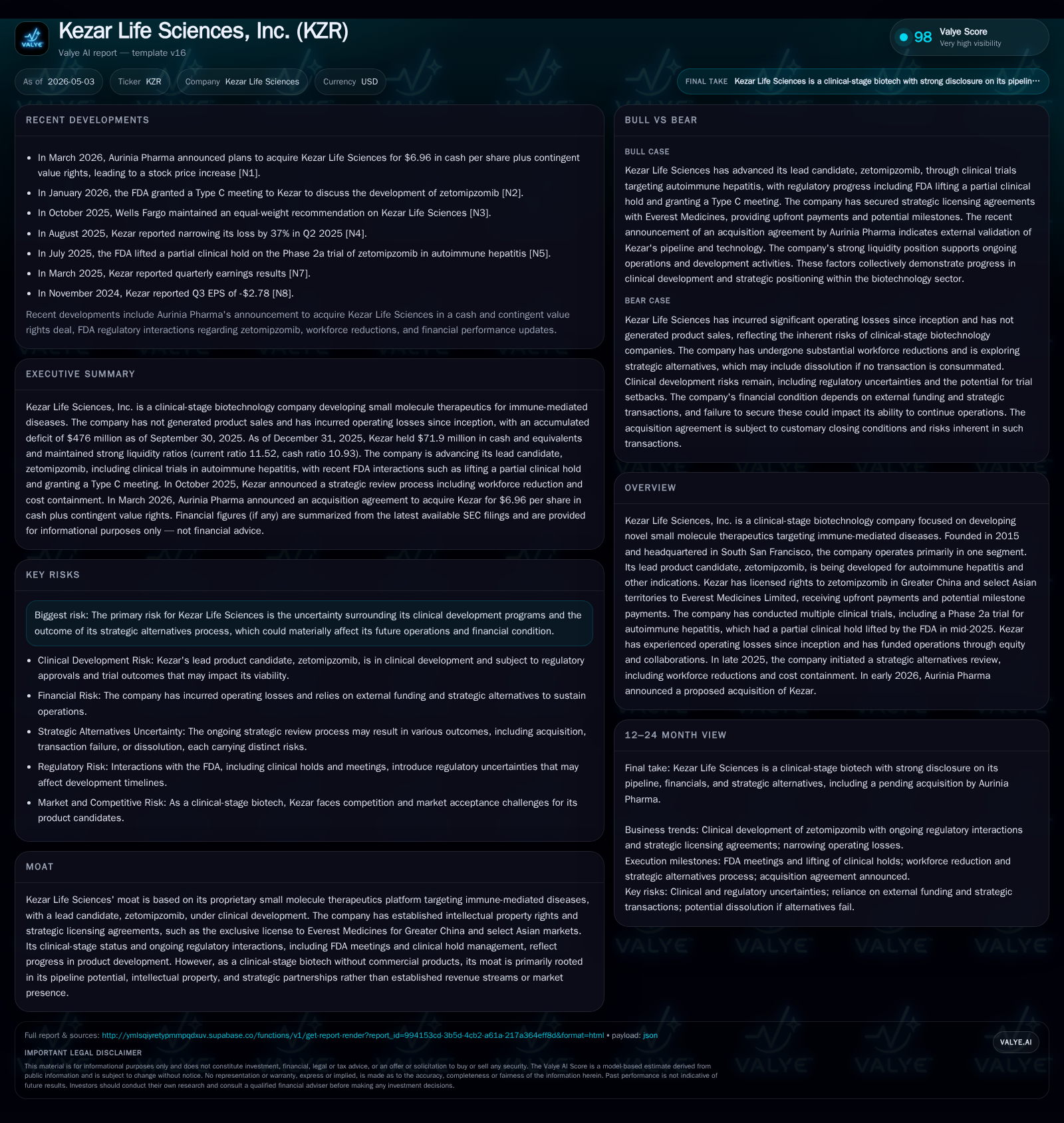
Kezar Life Sciences, a clinical-stage biotechnology firm focused on immune-mediated therapies, is undergoing a significant strategic transformation marked by Aurinia Pharmaceuticals' announced tender offer. Recent filings reveal operational restructuring including lease termination and workforce reductions, alongside progress in lifting the FDA's partial clinical hold on its lead candidate zetomipzomib. While the company navigates regulatory and clinical uncertainties inherent in early-stage biotech development, licensing arrangements and trial advancements provide growth avenues. Financially, Kezar maintains robust liquidity, underpinning its ongoing operations during the strategic alternatives evaluation.
Recent Operating Developments and Strategic Transaction Update
Kezar Life Sciences’ most consequential recent development is Aurinia Pharmaceuticals’ tender offer announced in early 2026 to acquire the company at $6.96 cash per share plus contingent value rights (CVRs) tied to future milestones [S3][N1]. This event caps a prolonged strategic alternatives exploration initiated in late 2025. Cost rationalization measures have already unfolded: Kezar significantly reduced its workforce by approximately 70% (announced November 2025) and executed a lease termination agreement on April 1, 2026 for its principal office space comprising nearly 49,000 rentable square feet [S2][S3][S4].
These moves reflect an attempt to preserve capital while navigating clinical uncertainties of their lead programs. Earlier in mid-2025, the FDA lifted a partial clinical hold on zetomipzomib trials—one of Kezar's pivotal therapeutic candidates targeting autoimmune hepatitis—paving the way for continued Phase 2a studies which had important implications for regulatory progress [S2][S4].
Kezar’s Business Model and Pipeline Focus
Operating solely within small molecule therapeutics aimed at immune-mediated diseases, Kezar invests heavily in research and development without generating commercial product revenue to date. The company’s core product candidate is zetomipzomib (also referenced as KZR-261), a selective immunoproteasome inhibitor currently in clinical trials primarily for autoimmune hepatitis—with potential expansion into other immune indications under exploration [S1].
Strategically separated from commercialization responsibilities presently due to clinical-stage status, Kezar monetizes its intellectual property through licensing deals such as with Everest Medicines Limited who holds Greater China and select Asian territory rights for zetomipzomib. These agreements provide upfront payments plus potential milestone-related revenues tied to developmental progress or sales escalations in licensed regions—a critical non-dilutive funding source supporting cash flows alongside equity fundraising efforts since inception [S1][F1].
The company's R&D expense profile reveals prioritization of biomarker-driven disease targets where specificity may grant pricing leverage upon approval. However, without marketed products yet contributing revenues, unit economics depend heavily on milestone licensing fees accompanied by sustained external financing or partnership inflows.
Competitive Positioning and Industry Dynamics in Immune-Mediated Disease Therapeutics
The autoimmune therapeutics domain is characterized by intense competition spanning innovative small molecules and entrenched biologics franchises. While biologics dominate many current indications due to proven efficacy profiles, small molecule approaches like those pursued by Kezar promise oral administration benefits and different mechanism-of-action profiles potentially favorable for patient compliance and safety.
Kezar’s moat principally derives from its proprietary chemistry platform enabling selective immunoproteasome inhibition—a novel target area—with associated intellectual property protection secured across jurisdictions. Partnerships such as the exclusive Everest Medicines license function dually as risk mitigation tools by unlocking regional expertise while providing developmental capital infusion.
Industry challenges exist around complex trial designs inherent in immune diseases due to heterogeneous patient populations and regulatory stringency. Pricing pressures also loom given evolving payer landscapes demanding clear demonstration of cost-effectiveness alongside innovation advantages [S1].
Growth Drivers Amid Clinical Progress and Licensing Initiatives
Critical growth vectors focus on advancing zetomipzomib through late-stage clinical validation with readouts expected from ongoing Phase 2a trials following FDA clearance to proceed post-hold lift. Similarly, second-wave candidates like KZR-261 expand pipeline breadth potentially unlocking additional indication segments within immune-mediated pathologies.
Licensing deals deliver tangible near-term revenue opportunities through upfronts and triggering milestone payments notably from Everest Medicines linked to clinical development benchmarks or eventual product launches in Asia—the company retains profit-sharing or royalty receipt optionality consistent with standard biotech partnership frameworks [S2][S4][S1].
Operationally, recent restructuring—including headcount reduction and lease exit—fosters leaner cost structures enhancing capital efficiency during transition phases post-strategic alternative announcement [S2][S4]. These combined factors establish measurable KPIs ranging from clinical study milestones and enrollment metrics to licensing fee receipt timings.
Risks and Constraints: Clinical, Strategic, and Market Uncertainties
By nature of its clinical-stage biotech status without approved therapies marketed yet, Kezar faces substantial risks surrounding the sufficiency of clinical trial outcomes especially for zetomipzomib's eventual regulatory approval. Potential exists for further regulatory setbacks including renewed FDA holds or requests for extended data collection.
The acquisition trajectory injects additional uncertainty: merger completion depends on stockholder acceptance of Aurinia’s tender offer alongside satisfaction of customary closing conditions. Contingent value rights introduce variability around final consideration realizable contingent on future specific milestones potentially affected by development success or market factors.
Financially, continued operating losses exceeding $59 million annually underline persistent funding needs that must be carefully balanced with burn rate management amid volatile biotech sector dynamics. Failure to consummate transaction or obtain auxiliary financing could constrain operational execution going forward [S2][N1][F1].
Near-Term Catalysts and Key Execution Milestones
Stakeholders should monitor closure timing of Aurinia’s tender offer which will finalize ownership changes imminently impacting strategic direction. Concurrently, updates from zetomipzomib’s clinical study progression are anticipated following regulatory clearance post-partial hold lifting—these data releases will critically shape therapeutic validation narrative.
Milestone payment events related to Everests Medicines’ regionally licensed territories constitute discrete financial inflection points that may materialize if progress timelines are met per contractual arrangements.
Operational discipline in effecting planned workforce adjustments into realized savings will also be indicative of management’s capability navigating transition stages effectively throughout mid-to-late 2026 horizons [S3][N1].
Financial Profile: Liquidity, Capital Structure, and Burn Rate
Latest financial snapshot
| Metric | Value | Period |
|---|---|---|
| Cash & equivalents | $71.9mm | |
| 2025-12-31 | ||
| Current assets | $75.7mm | |
| 2025-12-31 | ||
| Current liabilities | $6.6mm | |
| 2025-12-31 | ||
| Current ratio | 11.52x | |
| 2025-12-31 |
Source: SEC companyfacts cache [F1].
As of December 31, 2025, Kezar reported cash & equivalents totaling approximately $71.9 million combined with current assets around $75.7 million against current liabilities near $6.6 million yielding a robust current ratio exceeding 11x—a signifier of strong short-term solvency positioning amid industry volatility [F1].
Debt levels totaled about $10 million last reported at end-September 2024 reflecting relatively low leverage given scale of operations. Operating losses during fiscal year approximated $59 million consistent with intensive R&D commitments typical of biotech focused on early-phase pipelines without commercial revenues [F1][S2].
Workforce reductions initiated late 2025 are expected to reduce burn going forward while severance costs recognized represent one-time charges expected to ease subsequently enhancing cash conservation capabilities throughout strategic evaluation periods [S4][S2].
This analysis integrates the latest Kezar disclosures revealing a company poised at an inflection point defined by progressive therapeutic trial development coupled with strategic acquisition maneuvers reshaping its future trajectory amid inherent biotech sector risks.
This analysis is based exclusively on publicly available information as of early May 2026 without offering investment advice or price forecasts.
Disclaimer: This is research-only, informational analysis and not investment advice. It may include AI-generated interpretation and general industry context. Always verify important details using primary sources.

Comments