
Roku Accelerates Platform Monetization with Strategic Q1 Gains
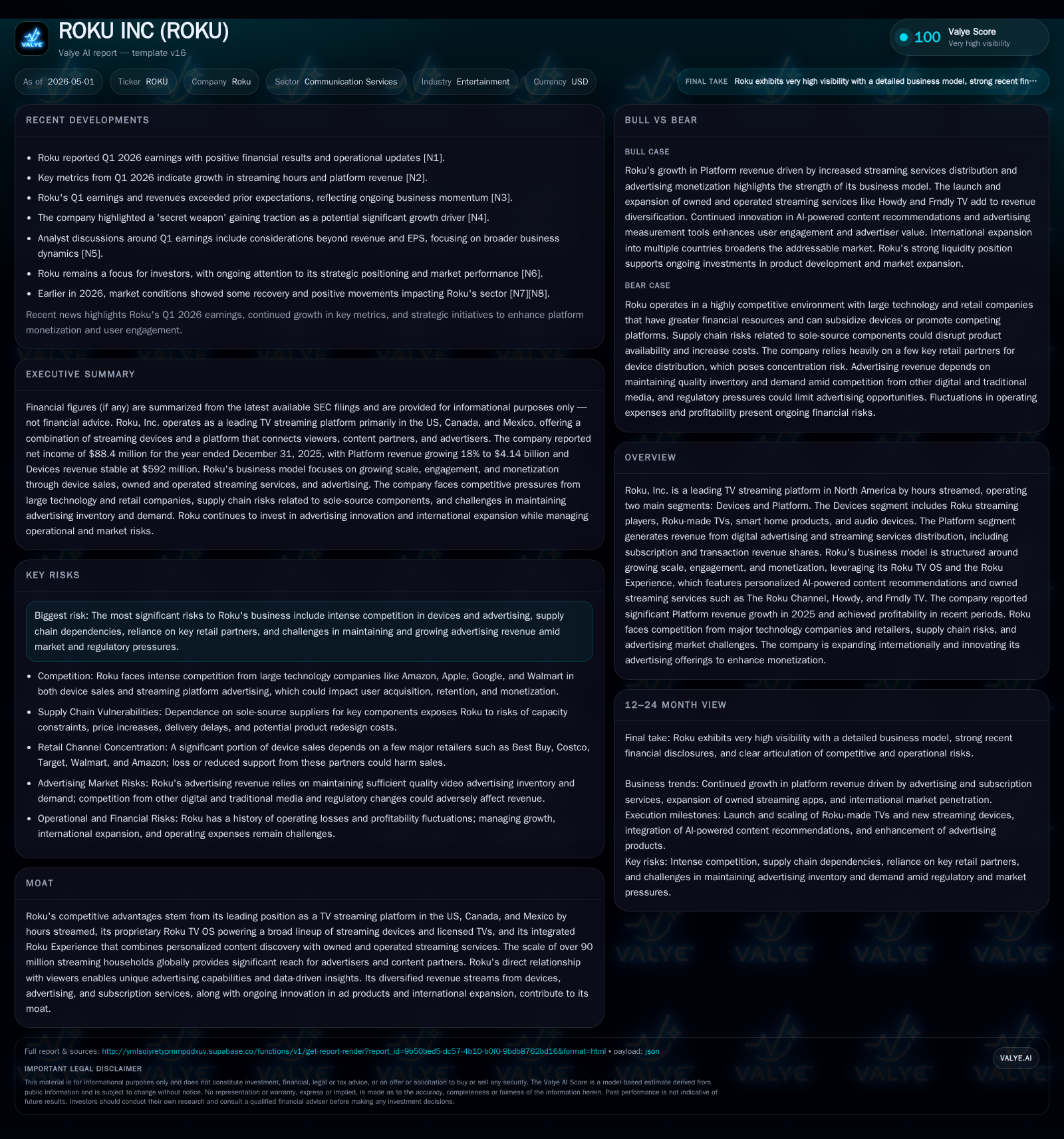
Roku’s Q1 2026 results underscore a decisive shift toward profitability and platform revenue growth amid intensifying competition and supply chain complexities.
In its latest quarterly filing covering Q1 2026, Roku reported continued expansion of its Platform segment revenues alongside achieving profitability in key operating metrics. The company’s integrated business model, anchored by its proprietary Roku TV OS and Roku Experience, drives growth through increasing streaming households, engagement, and monetization via advertising and subscriptions. Facing significant competitive pressures from tech giants and OEMs leveraging subsidized devices and exclusive content, Roku differentiates through scale, direct viewer relationships, and robust ad-tech capabilities. Growth catalysts include international expansion of The Roku Channel, deeper integrations for programmatic advertising, and new Roku-billed subscription features. Key risks remain around device supply constraints, advertising market dynamics, and competitive positioning. Roku’s strong liquidity position supports ongoing investments to navigate these challenges while scaling platform monetization.
Latest Quarterly Operating Developments and Strategic Implications
Roku's Q1 2026 quarterly disclosure reveals vital developments shaping its near-term trajectory [S2]. The company achieved notable Platform segment revenue growth powered by increased advertising demand and higher subscription billing through its platform [S28]. Importantly, Roku reported returning to profitability on an adjusted basis for the period—a milestone following periods of strategic investment in scale [N1]. Device segment sales reflected continued pressure on volume as competitive dynamics intensified but remained a critical vehicle to grow streaming households [S2]. Management emphasized that efforts to innovate the Roku Home Screen experience with AI-driven content recommendations and enhanced AVOD (advertising video on demand) units are directly contributing to elevated engagement metrics measured by Streaming Hours on Roku devices [N1]. This shift from predominantly hardware-driven growth toward platform monetization signals a maturation phase where incremental household additions yield disproportionate contributions to gross profit via digital advertising.
Roku’s Integrated Business Model and Product Ecosystem
Roku operates two interlinked segments: Devices and Platform [S1][S6]. The Devices segment includes streaming players competing across price points alongside their proprietary line of Roku-made TVs launched since 2023; this portfolio is designed to accelerate household penetration at attractive entry-level pricing supported by the cost-efficient Roku TV OS architecture [S6]. Alongside hardware sales come smart home products and audio lines to reinforce the cohesive Roku user ecosystem.
The Platform segment captures revenues from digital advertising—both direct sold and programmatic—as well as revenue-sharing agreements for premium subscriptions within third-party apps and owned/operated services such as The Roku Channel [S1][S6]. Revenue mechanics hinge on volume (streaming households), average streaming hours per household (user engagement), mix (ad load types plus subscription uptake), and pricing (CPM for ads). The clever leverage in this model comes from owning the TV OS experience; this enables unique personalization via artificial intelligence enhancements embedded in their user interface which boost consumer stickiness while improving ad relevance for marketers [S28].
This integrated device-to-platform model creates feedback loops: devices increase household count; enhanced engagement expands streaming hours; more streaming hours attract advertisers willing to pay premium CPMs; platform billing expansions unlock recurring subscription economics. Together these phases—grow scale (devices), grow engagement (platform UX), grow monetization (ads & subscriptions)—align with management's stated three-phase strategy for durable value creation [S6][N1].
Competitive Dynamics in the TV Streaming Industry
Roku occupies a central position in an increasingly contested domain dominated by tech giants such as Amazon (Fire TV), Google (Chromecast/Android TV), Apple (Apple TV), alongside powerful retailers like Walmart/Vizio who combine hardware subsidies with proprietary operating systems [S4][S5][S15]. These competitors benefit from deep pockets allowing aggressive device pricing or subsidization strategies that challenge Roku's price-value equation [S10][S19]. Additionally, exclusive content rights controlled by major SVOD providers or gaming consoles offering free OTT apps escalate rivalry for Streaming Hours—viewership being the prime currency powering platform revenues.
Retail channel dynamics further complicate matters as major e-commerce platforms act both as distributors and competitors selling their branded equipment or controlling online product prominence potentially disadvantaging Roku placements [S11][S19]. Cable operators bundling OTT devices into broadband offerings add layers of network effects that may slow independent device adoption.
Against this backdrop, Roku's moat derives not just from aggregated scale—90M+ streaming households across North America—but also from its direct first-party relationships with consumers that enable superior data-driven advertising targeting combined with continuously updated software innovation that rivals largely license rather than own outright [S16][S19]. These assets underpin a differentiated ad platform resisting commoditization trends crippling peer ad placements.
Key Growth Drivers: Scale, Engagement, and Monetization Initiatives
Several measurable growth levers underpin Roku’s path forward:
- International Expansion: New licensed Roku TV models launched in Brazil, Mexico, Canada, Colombia, Chile, Peru, and the UK reflect an aggressive push beyond North America where The Roku Channel’s audience steadily grows; this geographic diversification sets the stage for meaningful incremental streaming hours outside core markets [S1][S23].
- Home Screen Innovation: AI-powered content discovery improves user retention metrics feeding higher session durations per household. Recent Q1 remarks highlight new monetizable ad formats embedded natively within interface zones grabbing attention without disruption [N1][N8].
- Advertising Demand Scaling: Expanding programmatic integrations offer advertisers automation efficiencies while enriching inventory quality on-platform; long-term CPM stability remains a key focus amid broader macroeconomic noise impacting ad spend budget pacing [N8][S28].
- Roku-Billed Subscriptions: Growth here hinges on converting users away from off-platform third-party billing routes towards closed-loop subscriber management yielding higher margins; new branded app button placements on remotes enhance discoverability [S6][N1].
- Device Lineup Refreshes: Scheduled updates to Roku-made TVs coupled with smart home product introductions facilitate consumer ecosystem lock-in supporting engagement increases indirectly contributing back to Platform KPIs.
Each driver links firmly to observables such as rising Streaming Hours globally (direct engagement proxy), monthly active accounts billed via Roku (recurring revenue proxy), average CPM trends (pricing power indicator), and adoption rates of new device releases.
Risks and Challenges: Competition, Supply Chain, and Market Pressure
Roku faces several material risks outlined explicitly in the latest quarterly risk discussion:
- Intensifying Competition: Larger rivals wield subsidization strategies threatening volume growth; others push exclusive content or standards incompatible with Roku TV OS potentially fragmenting user attention; reliance on retail distribution further exposes visibility vulnerabilities [S2][S19][S28].
- Supply Chain Dependencies: Sole sourcing of key semiconductor components places constraints on manufacturing flexibility amid global chip shortages or tariff risks; inventory forecasting errors can inflate logistics costs or cause stockouts affecting holiday season sales peaks [S25][S26].
- Advertising Market Volatility: Shifts in advertiser budgets tied to macroeconomics or regulatory changes around privacy could reduce available quality video ad inventory or lower CPMs; programmatic integration execution missteps may hurt fill rates or campaign effectiveness risking advertiser retention [S2][S11].
- Content Partner Dynamics: Loss or non-renewal of popular apps or content providers curtails audience variety hurting overall engagement levels integral to sustaining monetization yields [S2][S11].
- Brand & Customer Loyalty Maintenance: Quality variance among licensed OEM partners’ TVs or software glitches could degrade user experience weakening brand equity hindering acquisition/retention efforts [S19]
Collectively these factors impose ongoing execution complexity requiring nimble supply chain management paired tightly with technology innovation investment ensuring sustained differentiation.
Monitoring Milestones and Catalysts for Future Performance
Key indicators will shed light on whether Roku can sustain its momentum:
- Sequential trends in Platform revenue versus Device revenue balance highlighting progressive shift toward higher margin sources post-Q1 profitability announcement [N1][S2]
- Streaming Hours acceleration across expanded international footprint reflecting successful new market penetration measures [N6]
- Gross margin trajectory specifically within Platform segment demonstrating scalable unit economics as subscription billing share grows relative to advertising volatility [N7]
- Adoption velocity of newly introduced AI-driven home screen features indicating consumer receptiveness
- Execution of emerging ad formats' rollout driving upward CPMs or incremental advertiser spend validating renewed monetization innovations [N8]
- Additional device launches including next-gen smart TVs or connected audio products broadening ecosystem connectivity enhancing switching costs
This constellation of measurable milestones forms a real-time dashboard informing operational health along Roku’s strategic vision.
Current Financial Snapshot and Liquidity Position
Latest financial snapshot
| Metric | Value | Period |
|---|---|---|
| Cash & equivalents | $1650mm | |
| 2026-03-31 | ||
| Current assets | $3.4bn | |
| 2026-03-31 | ||
| Current liabilities | $1158mm | |
| 2026-03-31 | ||
| Current ratio | 2.91x | |
| 2026-03-31 |
Source: SEC companyfacts cache [F1].
Roku retains a robust financial foundation anchoring its strategic initiatives at quarter-end March 31st 2026 [F1]:
| Metric | Value | As of |
|---|---|---|
| Cash & equivalents | $1.65 billion | |
| 2026-03-31 | ||
| Total debt | $25 million | |
| 2026-03-31 | ||
| Current assets | $3.37 billion | |
| 2026-03-31 | ||
| Current liabilities | $1.16 billion | |
| 2026-03-31 | ||
| Current ratio | 2.91 | |
| 2026-03-31 |
The healthy cash position combined with minimal debt facilitates continuous investments into R&D for platform enhancements alongside capacity buildouts supporting international expansion efforts. A sturdy current ratio near three affirms short-term liquidity cushioning against external shocks including supply chain disturbances or advertising market fluctuations.
Disclaimer
This analysis is based exclusively on publicly filed documents including SEC filings dated up to May 1st, 2026 ([S2], [S3], [S1]) supplemented by verified news transcripts ([N1]) without any forward-looking investment recommendations. All financial figures are drawn strictly from sourced disclosures ([F1], ). Readers should consider the information within the broader context of evolving market conditions before forming conclusions.
Disclaimer: This is research-only, informational analysis and not investment advice. It may include AI-generated interpretation and general industry context. Always verify important details using primary sources.

Comments