
Newell Brands Narrows Q1 Loss Amid Soft Core Sales and Strategic Restructuring
Q1 2026 results show improved operating income and a narrower net loss while restructuring and supply chain risks persist.
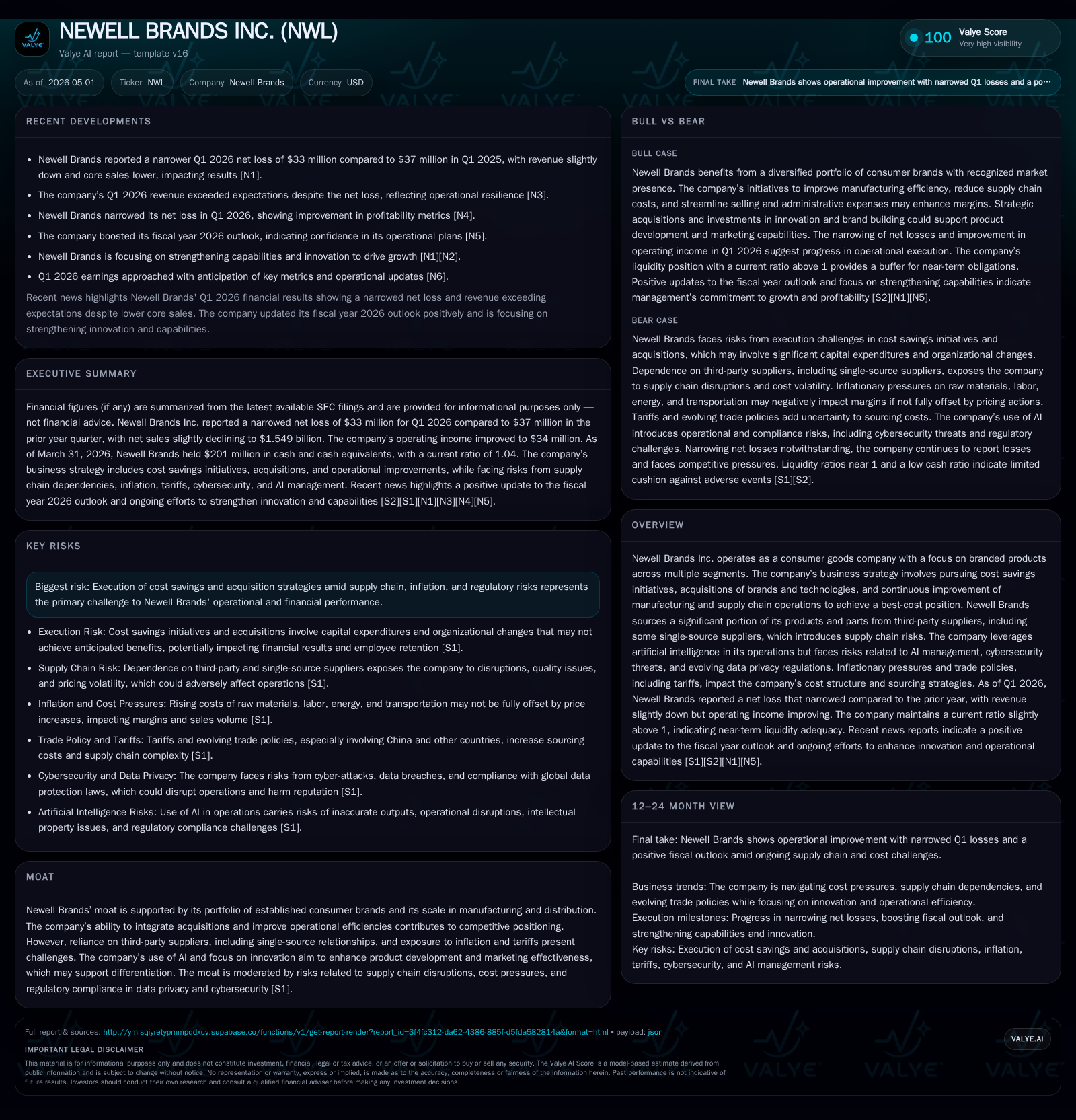
In its latest quarterly filing, Newell Brands reported a narrower net loss of $33 million in Q1 2026 compared to $37 million in the prior year, despite softer core sales and ongoing macroeconomic headwinds. The company continues to focus on cost savings through a global productivity plan, including workforce reductions and retail footprint optimization, while managing supply chain complexities from third-party dependencies and inflationary pressures. Its diversified consumer product portfolio across Home & Commercial Solutions, Learning & Development, and Outdoor & Recreation segments underpins its competitive positioning, although risks around supply chain disruptions, regulatory compliance, and leverage remain material. Monitoring execution on restructuring, product innovation leveraging AI, and margin improvement will be critical for Newell’s path forward.
Latest Operating Update
Newell Brands' first quarter of 2026 reflected cautious optimism as it reported a net loss of $33 million, narrowing from $37 million during the same period last year despite facing lower core sales volumes. Operating income rose modestly to $34 million supported primarily by disciplined cost management and benefits from restructuring programs initiated in late 2025 [S2][S18]. Revenue remained stable relative to the prior year quarter at approximately $1.55 billion but was impacted by softer consumer demand patterns during inflationary headwinds.
Cost of goods sold decreased slightly proportionate to volume changes, while selling, general, and administrative expenses were essentially flat year-over-year reflecting overhead control efforts. The company incurred $7 million in restructuring costs this quarter as part of its ongoing Global Productivity Plan designed to streamline operations and reduce complexity [S15][S24].
Notably, Newell has entered two cross-currency swap agreements totaling $145 million to hedge foreign currency exposures in Hong Kong dollar- and New Zealand dollar-functional operating subsidiaries [S2].
Business Model Overview
Newell Brands operates as a diversified consumer goods company encompassing three primary segments: Home & Commercial Solutions (H&CS), Learning & Development (L&D), and Outdoor & Recreation (O&R). Its portfolio includes established brands such as Rubbermaid, Sharpie, Yankee Candle, Graco, Coleman, FoodSaver, Calphalon, Paper Mate, and NUK among others [S2][S1]. These brands span categories like home organization products, kitchen appliances, baby care products, outdoor leisure equipment, writing instruments, and fragrance diffusion.
Revenue generation derives from selling branded consumables and durable household products through broad retail channels including mass merchandisers, specialty stores, e-commerce platforms, wholesale distributors, and direct-to-consumer operations via retail stores mainly tied to Yankee Candle [S1][S2]. Pricing power depends on brand strength but is moderated by competitive pressures especially in commoditized subcategories.
The company's production model relies substantially on third-party suppliers globally for parts and finished goods with several vendors providing single-source supply critical components. This exposes Newell to inherent supply chain risk which management actively mitigates through vendor diversification initiatives but remains a key vulnerability [S1]. Supply chain cost inflation—particularly resin raw materials and transportation—continues to pressure margins alongside tariff-related expenses despite recent U.S. Supreme Court rulings invalidating specific International Emergency Economic Powers Act (IEEPA) tariffs. Newell manages these challenges via selective pricing actions, manufacturing relocations where viable, productivity improvements using automation technologies including artificial intelligence tools applied in forecasting and marketing optimization [S17][S1].
The company pursues an active acquisition strategy aiming to bolster its brand portfolio with complementary assets or technological capabilities while focusing internally on continuous improvement goals such as lean manufacturing processes and overhead reduction programs under its Global Productivity Plan targeting both top-line enhancement opportunities and structural cost savings [S1][S15].
Industry Structure & Competitive Position
Newell faces competition across each segment from large multinational conglomerates as well as specialized niche players. In home solutions categories like kitchenware or storage containers brands like Tupperware or Rubbermaid's competitors include Spectrum Brands or Jarden Consumer Solutions peers historically. In baby care products under L&D segment the competitive landscape includes Pampers (Procter & Gamble) or Chicco (Artsana). Outdoor recreation brands vie against Coleman’s traditional rivals like Therm-a-Rest or MSR.
The market environment is characterized by moderate growth influenced by fluctuating consumer discretionary spending linked closely to economic cycles. Product innovation combined with strong brand equity creates differentiation levers but price sensitivity remains acute among value-conscious shoppers limiting aggressive pricing power.
Newell’s moat leverages its iconic brand portfolio combined with extensive distribution scale that facilitates shelf space access across multiple channels worldwide. Operational scale allows investment in both advertising/promotions alongside technology integration that smaller competitors find difficult to replicate.
However, reliance on third-party suppliers for critical inputs sustained over past years constrains agility potentially affecting responsiveness compared with vertically integrated peers.
Growth Drivers
Several visible vectors underpin Newell’s growth prospects:
- Product Innovation & Brand Reinvention: Leveraging R&D capabilities augmented by AI analytics aims at launching differentiated offerings enhancing consumer engagement especially in core categories within Home & Commercial Solutions.
- Expansion of E-Commerce & Direct-to-Consumer Channels: Increasing penetration through digital platforms supports higher margin sales with better customer data insights.
- Acquisition Strategy: Targeted M&A focusing on complementary brands or technologies boosts revenue base diversification while enabling scale synergies.
- Operational Efficiency Initiatives: The Global Productivity Plan focused on workforce rightsizing (~900 positions reduced over professional/clerical roles), process simplification, overhead streamlining aims at structural cost savings enhancing margin profile over time.
- Supply Chain Optimization: Mitigation of geopolitical disruptions via strategic supplier diversification plus hedging programs for commodity price exposure.
- Retail Footprint Rationalization: Store closures including ~20 Yankee Candle locations reflect changing consumer shopping preferences favoring omnichannel experiences rather than traditional brick-and-mortar expansion.
Risks & Growth Constraints
Key risks tempering Newell’s outlook include:
Supply Chain Dependency: Single-source vendors contribute vulnerability should geopolitical conflicts or logistical bottlenecks intensify.
Inflationary Pressures & Tariffs: Persistent cost inflation impacts gross margins; pricing pass-through capacity is restricted due to competitive dynamics.
Regulatory & Litigation Exposure: Ongoing product liability claims notably tied to Baby segment advertising practices introduce uncertain contingent liabilities without reserved estimates currently recorded.
Leverage Profile: The company maintains a current ratio of 1.04x as of March 31, 2026, reflecting near parity of current assets to current liabilities [F1]. Interest rates on total debt averaged 6.9% for the three months ended March 31, 2026 [S2]. Trajectory of core sales volumes will signal whether recent softness is transient or indicative of deeper demand shifts. Additionally:
Updates on supply chain resilience efforts such as new vendor onboarding or manufacturing footprint moves.
Integration success of any recent acquisitions announced post last annual update or throughout course of 2026.
Margin trends reflecting raw material cost pass-through effectiveness alongside fixed-cost absorption amid evolving sales mix.
Liquidity metrics ahead of revolver maturity including potential refinancing announcements or covenant amendments disclosures.
Resolution progress on pending litigation in Baby segment impacting contingent liabilities outlooks.[N11][N13]
Incremental adoption reports regarding AI-driven product development initiatives aiding go-to-market agility.
Financial Profile Snapshot (Q1 2026)
Latest financial snapshot
| Metric | Value | Period |
|---|---|---|
| Cash & equivalents | $201mm | |
| 2026-03-31 | ||
| Current assets | $2.9bn | |
| 2026-03-31 | ||
| Current liabilities | $2.8bn | |
| 2026-03-31 | ||
| Current ratio | 1.04x | |
| 2026-03-31 |
Source: SEC companyfacts cache [F1].
Combined senior notes + revolver + other short/long-term debt slice per filings [F1][S4][S9]
Net working capital remains tight given near parity current assets/liabilities ratio reflecting inventory buildup (+$212 million inventory increase YoY) offsetting accounts receivable declines most likely due to retailer stocking patterns. Interest expense increased commensurate with higher average debt balances demonstrating rate sensitivity risk going forward [S18].
This analysis is based strictly on disclosed data up to the first quarter of fiscal year 2026 without predictive judgments beyond clearly stated company disclosures or widely known sector dynamics. It does not constitute investment advice or recommendations regarding purchase or sale of securities.
Disclaimer: This is research-only, informational analysis and not investment advice. It may include AI-generated interpretation and general industry context. Always verify important details using primary sources.

Comments