
Cambium Networks Faces Liquidity Crunch and Nasdaq Delisting in Latest Quarter
Recent liquidity challenges and Nasdaq delisting sharply constrain Cambium Networks' operational flexibility and growth outlook.
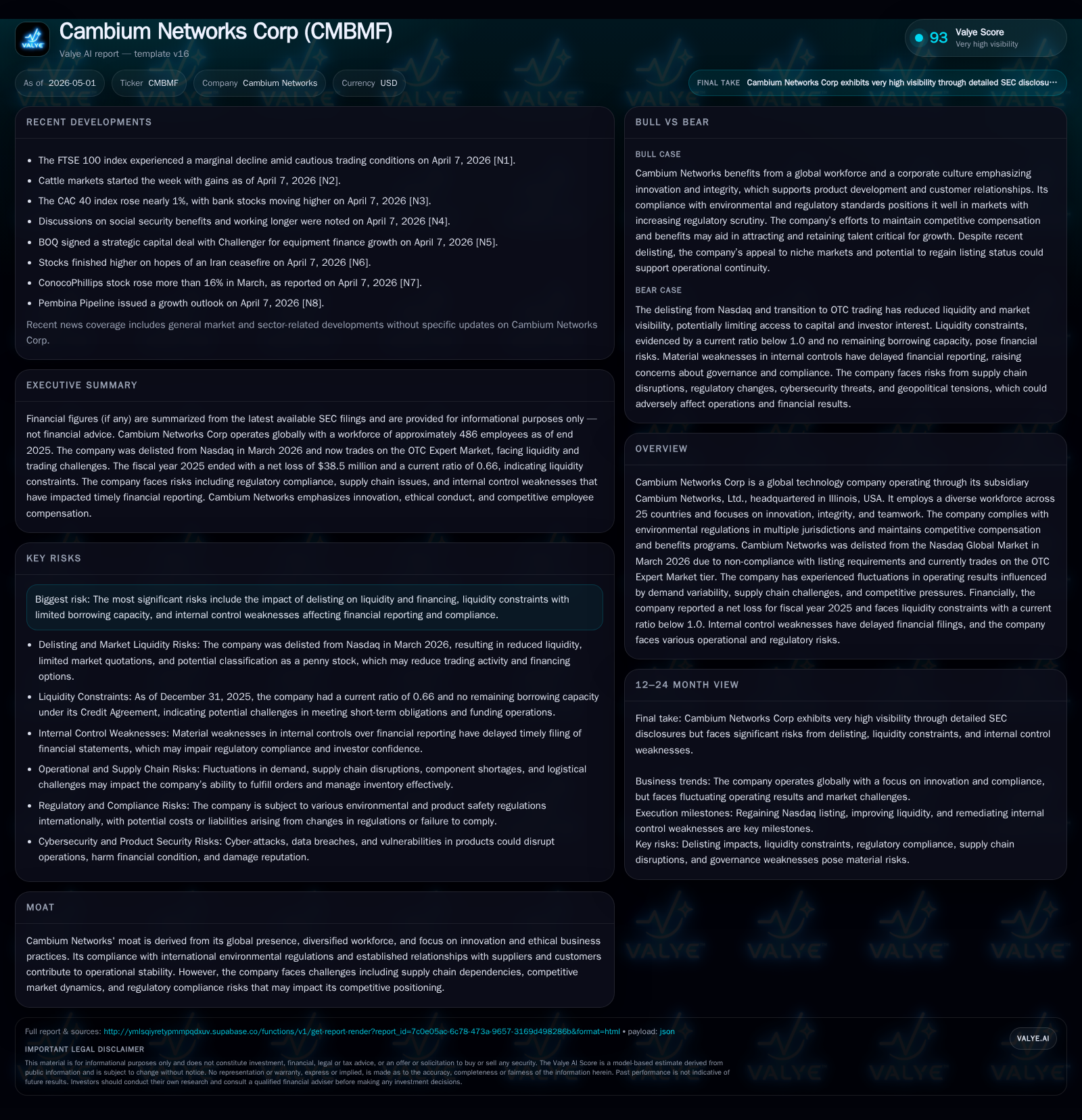
Cambium Networks Corporation announced in its latest quarterly filing that it has been delisted from Nasdaq due to non-compliance with listing requirements, driving shares to trade on the OTC Expert Market. The company continues to struggle with liquidity constraints, reflected in a current ratio of 0.66 and ongoing credit agreement covenant breaches, raising substantial doubt about its ability to continue as a going concern. Cambium's core business centers on wireless network infrastructure solutions, serving a global customer base through distributors, but faces intense competition, supply chain pressures, and regulatory compliance risks. Its growth depends on innovation and geographic expansion, yet constrained cash flow and internal control challenges heighten operational risks. Upcoming milestones to monitor include regulatory filings, refinancing efforts, and new contract wins.
Latest Quarterly Update: Delisting Impact and Operational Constraints
Cambium Networks Corporation’s latest SEC disclosures paint an urgent picture of strategic stress triggered by its Nasdaq delisting on March 25, 2026. The company's ordinary shares ceased trading on the Nasdaq Global Market after failing to comply with key listing requirements—primarily related to timely financial reporting and minimum bid price rules—and now trade on the OTC Expert Market tier [S3]. This shift immediately constricts investor access to liquidity and capital sources since OTC markets typically have lower visibility and reduced analyst coverage.
As of December 31, 2025, Cambium showed current assets of $90.7 million against current liabilities of $137.4 million—a current ratio of approximately 0.66—indicating a significant shortfall in working capital [F1]. The company is also in default under its credit agreement due to breaches of financial covenants including timely SEC reporting obligations [S4,S5,S6]. The secured lender holds rights to accelerate debt repayment as early as November 2026 and potentially foreclose on most company assets if defaults are not cured.
Management acknowledges "substantial doubt" regarding the company’s ability to continue as a going concern absent new liquidity sources or successful negotiations with lenders [S6]. Actions underway include cost deferrals and alignment of expenditures with revenue levels; however, these remedies may impair innovation capacity or responsiveness to market opportunities.
Cambium's Business Model: Network Infrastructure Innovation amid Market Shifts
Cambium operates in the wireless broadband infrastructure segment, designing fixed wireless access (FWA), Wi-Fi solutions, point-to-point and point-to-multipoint networking equipment for service providers and enterprises worldwide [S1]. Its technology portfolio encompasses products that support sub-7 GHz unlicensed bands alongside emerging Citizens Broadband Radio Service (CBRS) licensed spectrum deployments.
Revenue generation flows from sales of hardware devices and accompanying software licenses primarily through a network of global distributors that also function as value-added resellers [S1,S10]. Customers pay for integrated networking solutions designed to improve broadband connectivity in underserved areas or challenging environments. The company emphasizes innovation targeted at upgrading bandwidth capacity while delivering low latency — attributes increasingly vital in enterprise wireless deployments.
A workforce spread over 25 countries—including 341 employees outside the US—underpins engineering development, sales operations, logistics management, and post-sale customer support; this geographic diversity supports local market adaptability along with compliance adherence across varied international environmental mandates (e.g., RoHS & WEEE compliance) [S1,S14].
Competitive Landscape and Industry Headwinds in Wireless Networking
Cambium confronts robust competition from both specialized startups and large incumbent telecom equipment vendors. Competitors like Ubiquiti Networks dominate unlicensed spectrum solutions; meanwhile, firms such as Ericsson and Nokia compete aggressively within licensed spectrum segments like CBRS [S23]. Patent litigation risk is persistent within the industry due to overlapping intellectual property claims—particularly in Wi-Fi technologies—which exposes Cambium to costly legal defense demands and potential royalty payments.
Additionally, supply chain volatility continues affecting component availability for wireless devices globally. Cambium relies on third-party manufacturers and logistics partners located primarily in the US, Netherlands, and Vietnam for global distribution hubs. Shipping delays or parts scarcity directly translate into inventory imbalances, reduced fulfillment reliability for channel partners, escalating costs, and squeezed gross margins [S25,S26].
Growth Opportunities through Product Development and Geographic Expansion
Cambium’s path to growth leans heavily on advancing its product pipeline aimed at higher throughput wireless technologies leveraging millimeter-wave (mmWave) frequencies as well as enhancing the cost-efficiency of its fixed wireless access solutions [N1,S1]. Innovations addressing edge computing connectivity requirements or IoT enablement present additional expansion vectors.
Strategic focus also includes deepening international reach beyond North America where approximately half its revenues are generated. Increasing adoption across Asia-Pacific, South America, Europe, Middle East & Africa regions taps into rising demand for affordable broadband connectivity spurred by digital transformation initiatives in emerging markets [S10,S20]. Success hinges on securing stable distributor partnerships able to navigate local regulatory landscapes.
Potential margin improvements could arise from scaling manufacturing efficiencies or passing through rising component costs via pricing strategies supported by differentiated technology capabilities.
Risks: Liquidity Pressures, Regulatory Compliance, and Supply Chain Fragility
Internal control deficiencies identified historically have delayed financial reporting cycles considerably undermining transparency with investors and creditors; these weaknesses must be remediated promptly to meet SEC filing obligations—a prerequisite to any potential relisting or financing arrangements [S6].
Regulatory complexities compound risk exposure due to stringent environmental mandates (RoHS/WEEE directives) requiring costly compliance-driven product redesigns if exemptions change. Moreover, intellectual property infringement claims—particularly by patent holding entities—pose material litigation uncertainties impacting cost structures and market access.
Monitoring quarterly filing timeliness will reveal progress remediating internal controls critical for investor confidence.
Commercially significant will be announcements regarding new contracts reflecting demand stabilization or rebound following recent market softness as well as product launch activities highlighting innovation trajectory aligned with evolving customer needs [N1]. Additionally worth tracking are updates related to potential strategic partnerships or capital deals enabling balance sheet strengthening.
Any indication of restored Nasdaq listing eligibility would signal improved financial discipline but remains contingent on sustained operational turnaround.
Financial Snapshot: Liquidity, Leverage, and Profitability Overview
Latest financial snapshot
| Metric | Value | Period |
|---|---|---|
| Current assets | $91mm | |
| 2025-12-31 | ||
| Current liabilities | $137mm | |
| 2025-12-31 | ||
| Current ratio | 0.66x | |
| 2025-12-31 |
Source: SEC companyfacts cache [F1].
| Metric | Amount (USD) | Period Ending |
|---|---|---|
| Current Assets | $90,707,000 | |
| 2025-12-31 | ||
| Current Liabilities | $137,353,000 | |
| 2025-12-31 | ||
| Total Debt | $68,437,000 | |
| 2024-06-30 | ||
| Operating Income | ($27,963,000) | |
| 2025-12-31 | ||
| Net Income | ($38,538,000) | |
| 2025-12-31 |
This analysis strictly adheres to disclosed facts derived from Cambium Networks Corporation’s latest SEC filings through April-May 2026 without speculative additions. It aims solely to elucidate recent developments influencing corporate strategy within the context of industry competitive forces.
Disclaimer: This is research-only, informational analysis and not investment advice. It may include AI-generated interpretation and general industry context. Always verify important details using primary sources.

Comments