
TPG Inc. Delivers Q1 Earnings Above Estimates Leveraging Diversified Investment Platform
Strong first-quarter results underscore TPG’s resilient multi-asset investment model amidst regulatory complexities and growth initiatives.
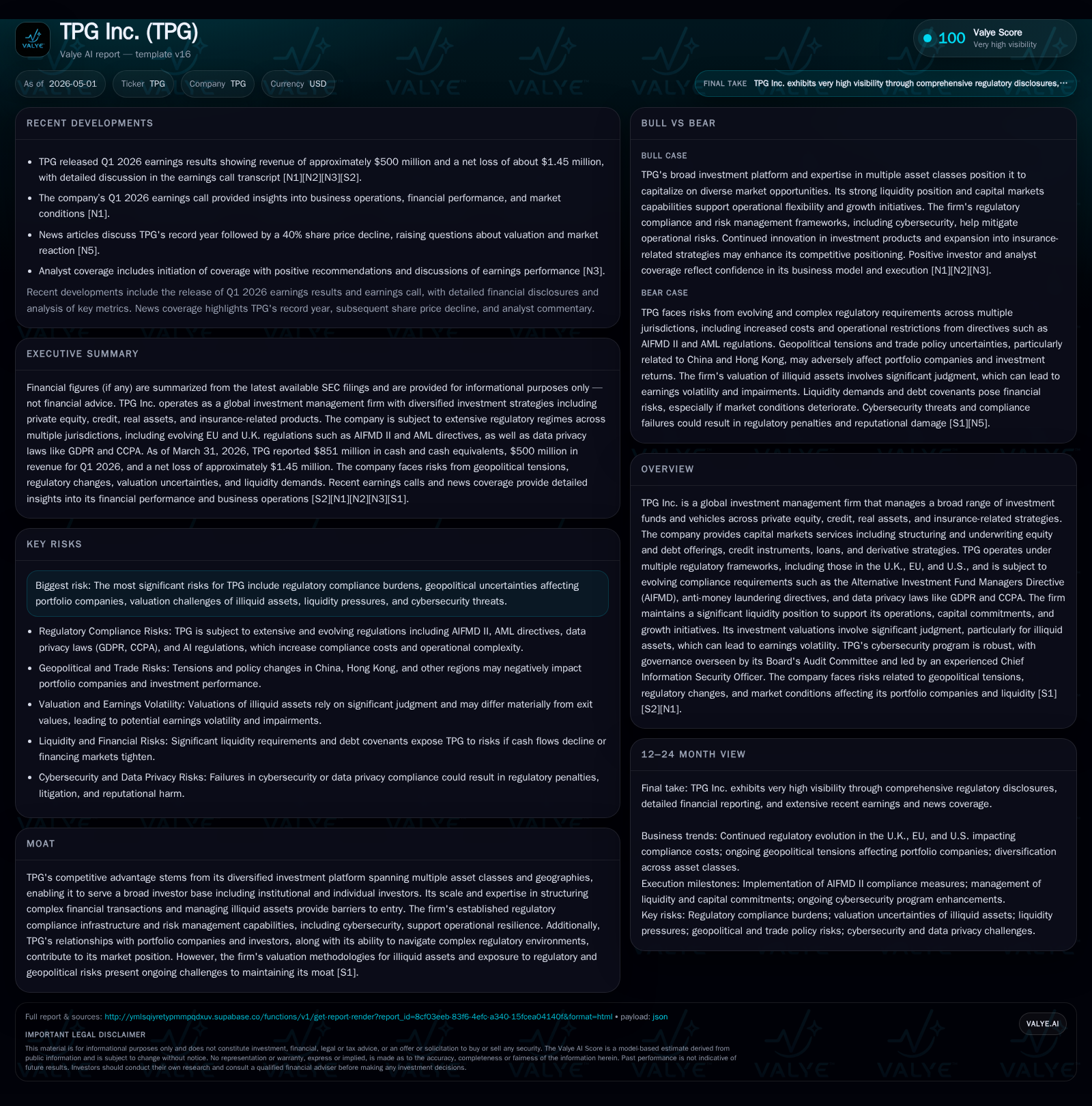
TPG Inc. reported robust Q1 2026 earnings driven by its diversified asset management platform, outperforming market expectations and reinforcing its competitive position. The latest filings highlight stable liquidity, ongoing compliance with evolving regulations including AIFMD II, and strategic fundraises across private equity, credit, and real assets. While valuation of illiquid assets and regulatory burdens remain challenges, TPG’s scale, expertise, and innovation in capital markets services provide durable barriers to entry. Investor focus should track upcoming fund launches, regulatory milestones, and talent retention amid an intensifying competitive landscape.
Q1 2026 Operating Highlights and Key Developments
In its latest quarterly filing dated May 1, 2026 [S2], TPG posted first-quarter results that surpassed market expectations as confirmed by multiple earnings commentaries [N1][N3]. The report showed sustained strength across its diversified investment platforms—private equity, credit solutions, real assets, and insurance-related strategies—that together underpin fee-based revenue stability.
Alongside top-line outperformance, TPG emphasized continued sound liquidity management with cash reserves of approximately $851 million against a total debt burden near $2.34 billion as of quarter-end March 31, 2026 [F1], reflecting a net debt position of about $1.49 billion. This capital structure allows flexibility to support ongoing capital commitments including seeding new strategies and underwriting activities without immediate refinancing pressure.
Operationally, no unexpected credit deterioration or liquidity distress was reported in the quarter despite macroeconomic volatility. However, compliance costs rose due to further regulatory layering associated with the implementation of the Alternative Investment Fund Managers Directive II (AIFMD II) set for April 2026 [S1], which imposes substantive new rules affecting marketing practices and operational authorization across European-managed funds.
Moreover, the company updated recent events via an 8-K filing on the same day confirming no adverse legal or regulatory proceedings currently expected to materially impact near-term results or cash flow stability [S3]. This suggests resilience amid evolving complexity from jurisdictional fragmentation in data privacy laws such as GDPR and U.K. GDPR as well as AML directives.
TPG’s Multi-Asset Investment Management Model and Revenue Drivers
TPG operates a multi-pronged investment management business encompassing private equity buyouts and growth equity funds; credit funds managing leveraged loans and structured credit; real assets including infrastructure and real estate; as well as insurance-related assets catered specifically for insurance companies' risk-based capital needs [S1]. Complementing these is a capital markets division specializing in underwriting equity/debt offerings plus derivative structuring that contributes ancillary transaction fees.
The firm generates revenues primarily from management fees charged on assets under management (AUM), performance fees or carried interest realized on profitable investments upon exit or valuation upticks, plus underwriting income from capital markets transactions. The company’s fee structure benefits from predictable base fee streams while also being sensitive to investment performance variability largely driven by mark-to-market methodologies on illiquid holdings.
Valuation of such illiquid assets remains complex given reliance on significant judgment around fair value estimates which incorporate macroeconomic factors and counterparty assumptions leading to potential earnings volatility quarter-to-quarter [S1]. To moderate this effect, TPG's diversified product mix across multiple asset classes helps smooth revenue recognition relative to firms concentrated solely in private equity or credit.
Co-investment vehicles aligned closely with main funds provide further fee enhancement opportunities while enhancing investor alignment. Importantly, their cross-border presence under U.S., U.K., EU frameworks necessitates layered compliance disciplines increasing operational overhead but also enhancing governance standards viewed favorably by institutional LPs.
Industry Positioning Within the Global Alternative Asset Landscape
Within a highly competitive global alternative investment ecosystem populated by peer firms like KKR, Blackstone and others [N5], TPG differentiates itself through breadth—managing diverse asset classes across numerous geographies—and depth in structuring sophisticated financial products that meet complex client needs spanning institutional pension funds to family offices.
Its established compliance infrastructure encompassing Anti-Money Laundering (AML) regimes (including AMLD5 & AMLD6), GDPR/CCPA data protections, and evolving directive integration like AIFMD II mitigates regulatory risks while creating operational hurdles that deter smaller entrants lacking scale [S1]. This scale barrier extends to IT security protocols essential given prevalent cybersecurity threats flagged repeatedly by regulators worldwide.
Client retention benefits from long-standing relationships cultivated by senior leadership whose expertise drives deal origination quality across sectors. Switching costs are elevated due to high due diligence complexity underlying investor allocations into private funds.
Regulatory regime fragmentation—especially between U.S., EU and U.K.—adds cost but also functional resilience through regional specialization allowing TPG to tailor products compliant with each jurisdiction effectively [S1].
Growth Catalysts: Fundraising Momentum, New Markets, and Product Innovation
TPG's future revenue trajectory hinges significantly on accelerating fundraises across its core verticals backed by demonstrated track records evident from the latest quarterly commentary [N1][N6]. Fresh capital commitments enable seeding newer strategies particularly within insurance asset finance targeting higher risk-adjusted yields compatible with regulatory capital models used by life insurers.
Geographic expansion into Asia-Pacific markets is receiving incremental emphasis leveraging local partnerships while adapting product blends to regional investor appetite dynamics—an approach consistent with industry trends favoring localization balanced with global platform sourcing.
Technological investments underpinning the capital markets division enhance underwriting accuracy and workflow efficiencies potentially expanding fee pool capture even amid tightening spreads. Additionally, innovative co-investment programs align investor interests closer fostering stickiness that aids recurring revenue sustainability.
Margins may improve through economies of scale gained from growing AUM concentrations paired with careful cost discipline offsetting incremental compliance spend driven by AIFMD II provisions post April 2026 rollout.
Key measurable KPIs highlighted include committed capital inflows for newly launched funds currently progressing towards expected closings next quarters as disclosed in filings [S2], alongside portfolio deployment rates signaling demand robustness.
Risk Factors: Regulatory Complexity, Valuation Challenges, and Talent Retention
The alternative investment space remains highly susceptible to escalating regulatory oversight which can increase compliance expenditure significantly while constraining operational flexibility. For TPG this translates into recurrent costs around adapting fund structures to satisfy new AIFMD II constraints limiting open-ended EU fund flexibility or loan origination capabilities plus intensified AML monitoring requirements that could heighten reputational risk if inadequately managed [S1][S6].
Illiquid asset valuations inherently involve subjective inputs making earnings vulnerable to downward revisions especially during market dislocations leading to quarterly volatility impacting performance fee realizations critical for profitability.
Another pressing challenge lies in leadership continuity risks where loss of senior investment professionals who maintain crucial investor relationships or sourcing networks could materially degrade fundraising capability or investment performance potential. Intense competition within buy-side talent pools exacerbates retention difficulty, necessitating aggressive compensation packages which may pressure operating margins adversely over time.
Cybersecurity threats pose both financial risk through potential breaches compromising sensitive data sets alongside reputational damage undermining LP confidence requiring continual investments in robust defense mechanisms calibrated against emerging cyberattacks [S1].
Geopolitical instability affecting portfolio companies introduces another layer of uncertainty affecting underlying asset cash flows thereby influencing fund return profiles especially within credit-sensitive strategies.
Upcoming Milestones and What Investors Should Monitor
Investors should closely monitor progress on several fronts post Q1:
- Successful execution of upcoming fund closings reflecting fundraising momentum critical for fee growth trajectories [S2][N1].
- Implementation outcomes of AIFMD II impacting European operations and fund marketing capabilities plus any new administrative overhead tied to regulatory compliance timelines [S3][S1].
- Updates related to key-person succession plans within senior leadership structural evolution designed to ensure orderly governance transitions reflecting shareholder interests per disclosures in annual filings [S1].
- Pipeline development around new product launches specifically addressing insurance sector demands where regulatory calibration will affect uptake speed—monitoring client feedback loops essential here.
- Market reaction to any further SEC rule proposals or enforcement intensifications around fee disclosure transparency or cybersecurity protocols potentially altering operating cost bases or reputational positioning.
Q1 2026 Financial Snapshot
Latest financial snapshot
| Metric | Value | Period |
|---|---|---|
| Cash & equivalents | $851mm | |
| 2026-03-31 | ||
| Total debt | $2.3bn | |
| 2026-03-31 | ||
| Net debt | $1492mm | |
| 2026-03-31 |
Source: SEC companyfacts cache [F1].
| Metric | Amount (USD) |
|---|---|
| Cash & Equivalents | $851.4 million |
| Total Debt | $2.34 billion |
| Net Debt | $1.49 billion |
This snapshot highlights a balanced liquidity stance conducive to sustaining operating activities including capital commitments required for new fund seeding or portfolio warehousing without immediate refinancing pressures despite broader volatile credit markets noted in the SEC filings [S2][F1].
Disclaimer: This analysis is based exclusively on information publicly disclosed by TPG Inc. through SEC filings and verified news sources as of May 2026. It does not constitute investment advice or recommendations but aims solely at providing a detailed understanding of TPG's business operations and industry positioning.
Disclaimer: This is research-only, informational analysis and not investment advice. It may include AI-generated interpretation and general industry context. Always verify important details using primary sources.

Comments