
Sentage Holdings Faces Intensifying Competition Amid Shrinking Prepaid Payment Market
Sentage’s latest quarterly filing underscores ongoing governance compliance and persistent revenue decline in its core prepaid payment network business amidst a challenging Chinese fintech landscape.
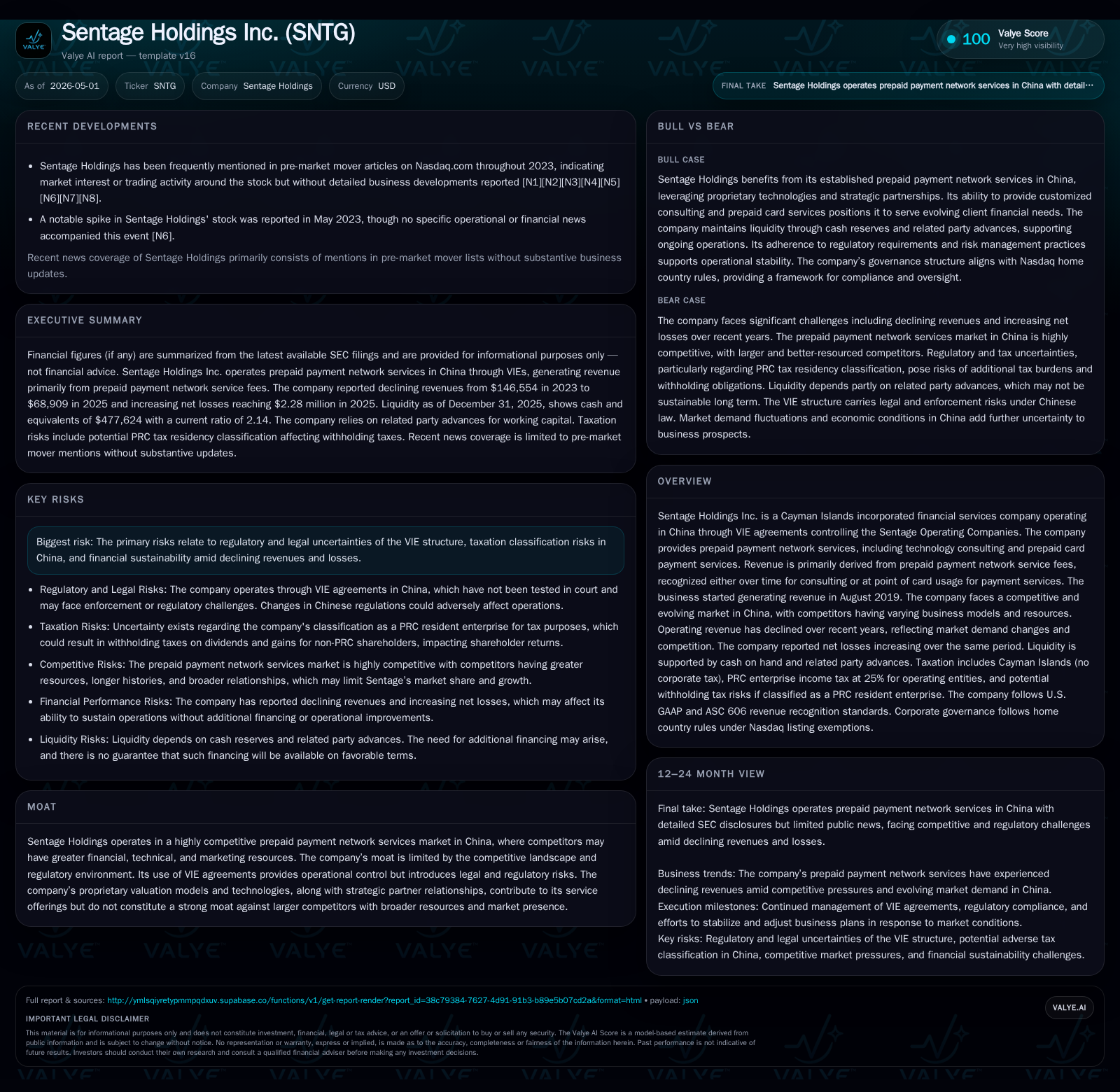
The January 2026 quarterly filing of Sentage Holdings reveals no material operational shifts but confirms the company’s election to follow its Cayman Islands home country governance rules under Nasdaq exemptions. Recent annual filings show a steep revenue decline driven by reduced demand and fierce competition in China’s prepaid payment sector. Sentage’s business model relies on VIE-controlled entities providing prepaid payment network services, but regulatory uncertainties and intense competitive pressures limit growth. The firm’s liquidity remains adequate though losses continue to mount, with related parties providing working capital support. Key risks include China’s regulatory environment, VIE structure legalities, and sustained market fragmentation.
Latest Quarterly Developments and Significance
Sentage Holdings’ most recent filing dated January 9, 2026 ([S2]) centers primarily on corporate governance disclosures rather than material operational updates. The company invoked the home country rule exemption under Nasdaq Listing Rule 5615 to align with Cayman Islands corporate governance requirements instead of holding annual shareholder meetings per Nasdaq Listing Rule 5620(a). This signals management’s preference for governance structures consistent with its Cayman registration while maintaining compliance obligations. No other significant changes in operations or strategic direction were announced alongside this short-form quarterly update.
This modest filing sets a tone of stable yet cautious stewardship during broader market challenges faced by Sentage Holdings.
Business Model and Service Offerings
As detailed extensively in the April 30, 2026 annual report ([S1]), Sentage Holdings operates predominantly through variable interest entity (VIE) agreements controlling several operating companies in Mainland China, collectively referred to as the Sentage Operating Companies. These entities provide prepaid payment network services which constitute the entire revenue stream for Sentage.
The company generates revenue mainly from prepaid payment network service fees charged for two key offerings: technology consulting services related to prepaid cards recognized over time, and transaction-based prepaid card payment services recognized at the point of card usage. The consulting fees reflect contractual advisory engagements supporting clients’ prepaid solutions while payment network fees are volume-driven tied directly to cardholder transaction activity.
Sentage highlights proprietary valuation models and technological platforms that support risk management functions such as anti-money laundering monitoring — integral in a tightly regulated Chinese payments ecosystem. Strategic partner relationships are also crucial for accessing customer bases and executing service contracts.
Notably, Sentage does not hold direct equity interests in its operating subsidiaries but consolidates their financial results owing to effective operational control via the VIE agreements—a structure prevalent among Chinese fintechs restricted from foreign ownership yet fraught with legal ambiguities.
Competitive Positioning in China’s Prepaid Payments Market
Competition within China’s prepaid payment network services is robust and fragmented, characterized by many domestic third-party providers deploying diverse business models. Sentage faces competitors possessing significantly deeper pockets, superior technical expertise, larger marketing budgets, and the flexibility to choose market niches selectively ([S1]).
These larger players exert pricing pressure that undermines Sentage’s ability to sustain margins. The shrinking quantity and scope of consulting services delivered by Sentage underscore both weakening client demand post market saturation phases and difficulty defending wallet share against well-funded rivals.
The lack of protective regulatory or technological moats leaves Sentage vulnerable; its proprietary tech offers differentiation but is insufficient against scale advantages held by major fintech incumbents. Customer retention depends on delivering consistently reliable service experiences — a challenging proposition when facing continuous innovation demands amid constrained investment capacity.
Key Growth Drivers and Innovation Prospects
Sentage’s potential growth avenues hinge on expanding its client network within the prepaid card user base across diverse sectors requiring flexible prepayment solutions. Customer experience improvement through enhanced service delivery reliability and feature innovation represents another lever for growth given the sensitivity of this low-margin financial services niche to service disruptions ([S1]).
Operational efficiencies gained through prudent cost management—reducing staff levels (evident in lower employee compensation expenses for 2025)—and controlling third-party consulting costs could improve profitability if revenues stabilize or expand marginally.
The company recognizes that its influence on overall volumetric growth is limited without access to broader capital or infrastructure to aggressively scale, making incremental gains likely dependent on selective product enhancements aligned with evolving customer expectations rather than large-scale market capture.
Risks and Constraints Including VIE Structure and Regulatory Factors
Sentage confronts profound structural risks stemming from its VIE arrangement which has not been judicially tested within China ([S1]). This legal ambiguity raises questions regarding enforceability that could jeopardize control over critical operating entities.
Furthermore, continued debate over its classification as a PRC resident enterprise for tax purposes presents potential material adverse impacts through increased taxation liabilities including withholding tax on dividends paid to non-resident shareholders ([S1]). Such fiscal uncertainties exacerbate the challenge of sustaining cash flow stability in a business already reeling from declining revenues.
Regulatory scrutiny intensifies across fintech sectors in China targeting compliance with anti-money laundering rules, data security mandates, and capital requirements—all adding compliance costs or constraining operational flexibility. Combined with an intensively competitive marketplace lacking high entry barriers, these factors collectively constrain accelerated growth opportunities.
Liquidity also remains a watchpoint; while positive current ratios indicate coverage of short-term obligations ([F1]), reliance on related party advances exceeding $600K underlines dependence on shareholder support rather than self-sustained operational cash flow ([S4],[S5]).
Upcoming Catalysts and Monitoring Points
Key near-term items to watch include:
- Subsequent quarterly filings detailing whether the election of home country governance rules continues aligning management behavior with shareholder expectations ([S2]).
- Any shifts in Chinese government policy towards VIE structures or fintech regulation that might affect operational control or licensing requirements.
- Indicators signaling stabilization or rebound in prepaid payment volumes such as renewed client agreements or transaction metrics reported by operating companies.
- Announcements regarding enhancements or pivots in product offerings designed to arrest revenue decline or improve competitiveness as noted in annual report plans ([S1]).
- Updates on internal control remediation efforts following management’s disclosure of deficiencies impacting financial reporting accuracy ([S15]).
These developments will help clarify execution risks and growth trajectory amid an evolving regulatory-financial landscape.
Financial Overview: Snapshot of Liquidity, Revenue and Profitability
Latest financial snapshot
| Metric | Value | Period |
|---|---|---|
| Cash & equivalents | $477624 | |
| 2025-12-31 | ||
| Current assets | $638819 | |
| 2025-12-31 | ||
| Current liabilities | $297967 | |
| 2025-12-31 | ||
| Current ratio | 2.14x | |
| 2025-12-31 |
Source: SEC companyfacts cache [F1].
| Metric | Value (USD) | Period Ending |
|---|---|---|
| Revenue | 68,909 | |
| 2025-12-31 | ||
| Operating Income | -2,274,890 | |
| 2025-12-31 | ||
| Net Income | -2,277,606 | |
| 2025-12-31 | ||
| Cash & Equivalents | 477,624 | |
| 2025-12-31 | ||
| Current Ratio | 2.14 | |
| 2025-12-31 |
Despite maintaining a positive current ratio (2.14) supported by roughly $477K in cash equivalents at year-end ([F1]), Sentage's financial position reflects ongoing distress. Operating losses grew worse in 2025 compared to prior years—net income declined further into negative territory at over $2.27 million loss [[F1], [S1]].
Revenues have contracted significantly over consecutive years—from approximately $146K in 2023 down below $70K by end of 2025 ([S1]), tracking shrinking demand for consulting-driven prepaid payment solutions compounded by fierce competitor price erosion. Cost rationalization actions included headcount reductions driving lower employee expenses as part of managing operating expenses tightly ([S24]).
Working capital advances from related parties totaling approximately $622K form an essential lifeline sustaining liquidity needs beyond internal cash generation capacity ([S4], [S5]). The mismatch between cash reserves and burning losses underscores a path dependency on external financing or strategic repositioning for sustainable operations.
This analysis is based exclusively on information available from public filings up to April/January 2026 dated SEC reports without projection or investment advice.
Disclaimer: This is research-only, informational analysis and not investment advice. It may include AI-generated interpretation and general industry context. Always verify important details using primary sources.

Comments