
Kensington Capital Acquisition Corp. VI Advances Toward Business Combination with Strong Trust Position
KCAC.VI maintains robust liquidity and prepares for its initial de-SPAC merger within the mandated timeframe.
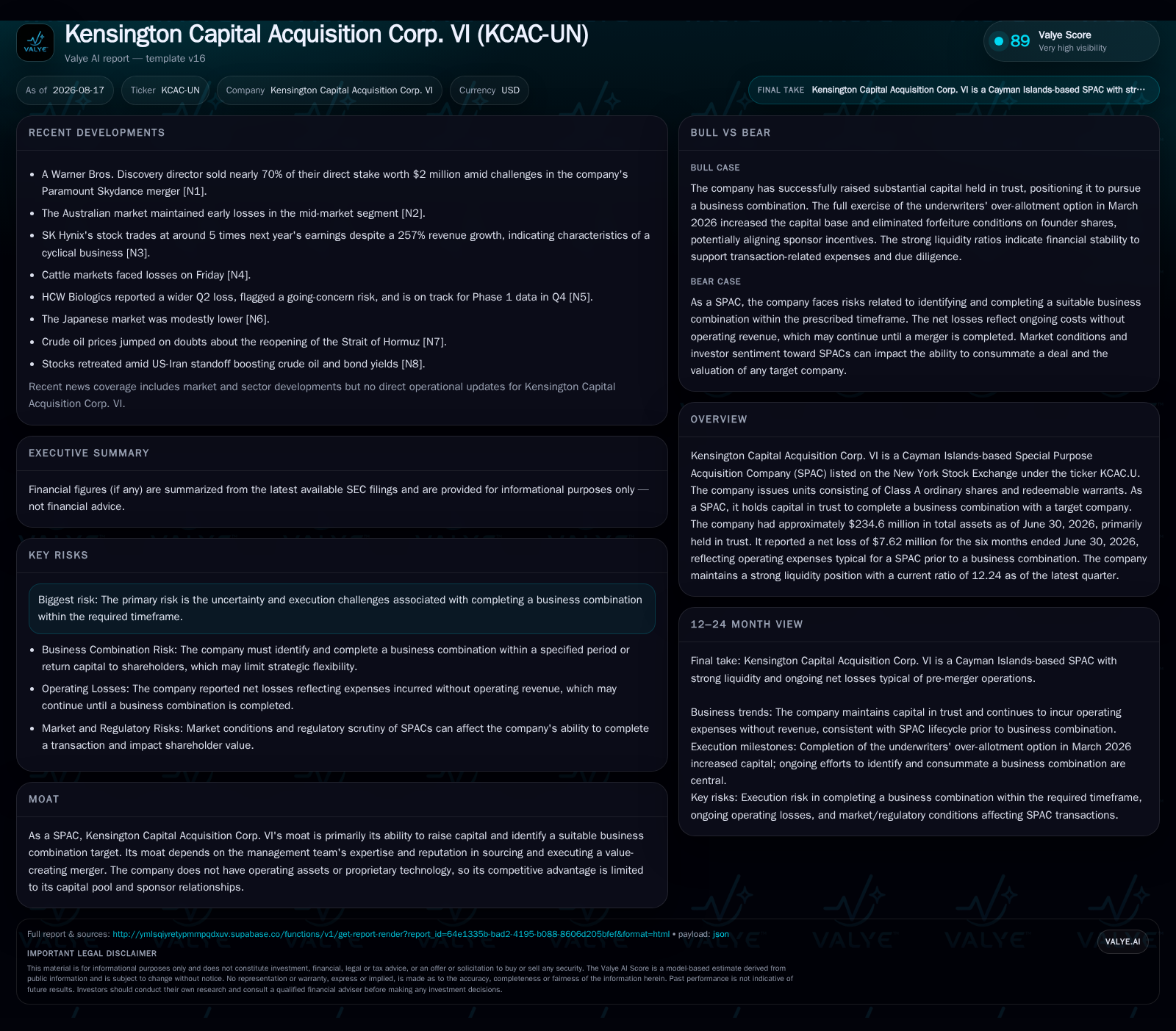
Kensington Capital Acquisition Corp. VI, a Cayman Islands-based SPAC listed on the NYSE as KCAC.U, completed its IPO in March 2026, raising $230 million. As of June 30, 2026, it holds over $232 million primarily in U.S. Treasury securities within its trust account. The company reported a net loss of $7.62 million for the first half of 2026, reflecting typical pre-combination operating expenses. With a current ratio above 12, no debt, and a full over-allotment exercised, KCAC VI is well positioned to complete a business combination within its initial 24-month window. Execution risk and market conditions remain key challenges ahead.
Recent Operating Update: Robust Capital Base Established Post-IPO
Kensington Capital Acquisition Corp. VI (KCAC.VI) successfully completed its initial public offering on March 5, 2026, raising gross proceeds of approximately $230 million inclusive of a fully exercised underwriters' over-allotment option [S2]. Alongside the public offering, the Sponsor purchased private placement warrants totaling $5 million at $0.43 per warrant [S19]. These proceeds were placed into a trust account—invested predominantly in U.S. Treasury securities with maturities under 185 days—to preserve capital until deployment in a business combination [S18]. As of June 30, 2026, cash and marketable securities held in trust amounted to approximately $232.58 million [S18], confirming near-full retention of IPO proceeds.
This trust account constitutes the cornerstone asset backing public shareholders’ liquidation rights should no qualifying acquisition be consummated within the stipulated combination period, currently set at two years from IPO closing [S22]. The SPAC’s management currently has up to March 5, 2028, to identify and complete a merger or acquisition that satisfies minimum valuation requirements typically set at 80% of net trust assets [S22]. If this deadline passes without a deal closure, the trust assets will be returned pro rata to shareholders who did not redeem their shares.
Business Model: Capital Raising Vehicle Without Operating Revenues
As a Special Purpose Acquisition Company (SPAC), Kensington Capital Acquisition Corp. VI operates as a blank-check entity designed solely to provide capital markets access to private companies seeking to become publicly listed without undergoing the traditional initial public offering process. KCAC.VI monetizes investor capital by initially issuing units composed of Class A ordinary shares paired with redeemable warrants [S3]. Though the IPO raised significant funds, revenues will only materialize post-business combination upon transitioning into an operating entity.
The economic logic hinges on identifying promising private targets where incremental value can be realized through access to public markets and capital restructuring. However, until consummation of such a business combination (de-SPAC transaction), Kensington incurs operating losses driven by management fees and administrative costs typical for SPACs maintaining regulatory compliance and transaction readiness [S26]. The net loss was $7.62 million for the six months ending June 30, 2026 [F1], reflecting this non-revenue-generating pre-combination phase.
Crucially, the company maintains substantial liquidity outside the trust to fund operations without drawing upon the trust assets reserved for shareholders’ protection [S10]. The sponsor agreement includes waivers whereby founder shares do not trigger liquidation claims if no business combination occurs; however, public shareholders retain standard redemption rights entitling them to the trust account’s value upon liquidation or failed combinations [S2].
Industry Positioning: Navigating Within a Crowded SPAC Ecosystem
KCAC.VI sits within the increasingly regulated and scrutinized SPAC sector that gained prominence in recent years as an alternative public equity access route compared with traditional IPOs. The company forms part of an extensive peer group including high-profile vehicles like Pershing Square Tontine Holdings and Social Capital Hedosophia but distinguishes itself by focusing specifically on deploying capital sourced via its March 2026 IPO.
While SPACs generally compete by leveraging sponsor reputation and deal sourcing capabilities, KCAC.VI’s competitive moat is limited by its pure financial vehicle status—it has no proprietary technology or operational assets—and depends heavily on management expertise to execute timely mergers creating shareholder value.
The mandatory timeline pressures all SPACs equally; failing to close combinations within two years typically triggers wind-downs disadvantaging investors relative to direct investments in operating companies or traditional IPOs with more predictable timelines. Warrant overhang also introduces dilution pressure post-merger; KCAC.VI issued both Class 1 and Class 2 warrants exercisable at $11.50/share after completion, presenting potential impacts on share count expansion once exercisable [S3], [S19].
Growth Drivers: De-SPAC Completion as Value Catalyst
The primary growth driver for KCAC.VI is successful identification and execution of an attractive business combination target within its timeframe that meets minimum valuation thresholds tied to trust assets [S22]. Successful de-SPAC transactions can unlock value via improved liquidity and capital access for private companies while providing investors entry into potentially high-growth operating platforms.
Additional tailwinds include increasing investor appetite for alternative routes to public markets amid volatile market conditions favoring faster listings than traditional IPO processes enable. Moreover, innovations such as PIPE financing can facilitate deal capital structures enhancing both acquirer flexibility and funding certainty—though KCAC.VI has not disclosed specific PIPE arrangements yet.
Sponsor reputation remains critical; seasoned management teams with established networks often generate more competitive deal flow and execution certainty relative to less experienced peers in the expanding SPAC pool.
Risks and Watchpoints: Execution Uncertainty and Market Sensitivities
The dominant risk for Kensington Capital Acquisition Corp. VI remains failure to consummate a business combination by March 5, 2028, mandating liquidation of trust assets and return of capital net of expenses—a scenario imposing material risk case given SPAC structure limitations. Even with sufficient cash reserves locked in trust ($232m), market dynamics such as unfavorable investor sentiment or target valuation disagreements could derail transaction progress.
Dilution from warrant exercises post-transaction poses shareholder value erosion risks dependent on warrants’ strike prices versus underlying equity valuations following de-SPAC completion [S19]. Additionally, redemption behavior during shareholder votes can reduce available deal proceeds materially if large-scale redemptions occur—threatening deal financing viability absent additional PIPE commitments or sponsor loans.
Regulatory scrutiny remains heightened around SPAC disclosures and accounting treatments; evolving SEC guidance may impose enhanced compliance costs or alter transaction economics unpredictably [S16]. Geopolitical instability noted across global markets could indirectly impact acquisition target valuations or capital market conditions affecting transaction timing
What To Watch Next: De-SPAC Milestones and Market Signals
Investors should monitor announcements regarding any definitive agreements signed with prospective targets alongside detailed disclosures about transaction structure including valuation metrics that align with trust asset minima [S12],. Given KCAC.VI’s recent IPO completion less than six months ago without reported announced targets yet in SEC filings through August 2026, timely disclosure cycles over late 2026 into early 2027 will be crucial execution markers.
Further attention should focus on warrant activity patterns post any business combination approval vote—exercisability timelines coupled with actual exercise volumes inform dilution scale expectations affecting longer-term shareholder returns.
Financial Profile Discussion
As of June 30, 2026, Kensington Capital Acquisition Corp. VI held total current assets approximating $1.96 million outside its trust account against current liabilities around $160 thousand—resulting in a strong current ratio near 12.24 indicative of robust short-term liquidity adequate for covering operating obligations absent reliance on trust resources [F1], [S10].
Notably, total debt stood at zero as the company maintains minimal leverage consistent with typical SPAC balance sheets that prioritize capital preservation prior to de-SPAC completion [F1]. The net loss tallying just over $7.6 million for H1 reflects operating expenditures associated with management overheads rather than revenue operations given pre-combination status [F1], [S26].
Ultimately, KCAC.VI exhibits financial profile characteristics archetypal for emerging growth SPAC entities: substantial cash reserves sheltered in restricted accounts ensuring investor principal protection while facing controlled operational expense burn rates designed to support deal origination functions until merger consummation or requisite wind-down event.
This analysis synthesizes registered filings through August 14, 2026 ([S2],[S3],[F1]) combined with sector context without speculative assumptions regarding target specifics or merits beyond disclosed data points. It does not constitute investment advice but offers an advanced perspective on Kensington Capital Acquisition Corp. VI’s current positioning within the specialized SPAC universe.
Disclaimer: This is research-only, informational analysis and not investment advice. It may include AI-generated interpretation and general industry context. Always verify important details using primary sources.

Comments