
Keurig Dr Pepper’s 2025 Profit Surge Highlights Growth Amid JDE Peet’s Acquisition Risks
Robust operating income growth and brand innovation bolster KDP’s outlook while acquisition integration and supply chain challenges persist.
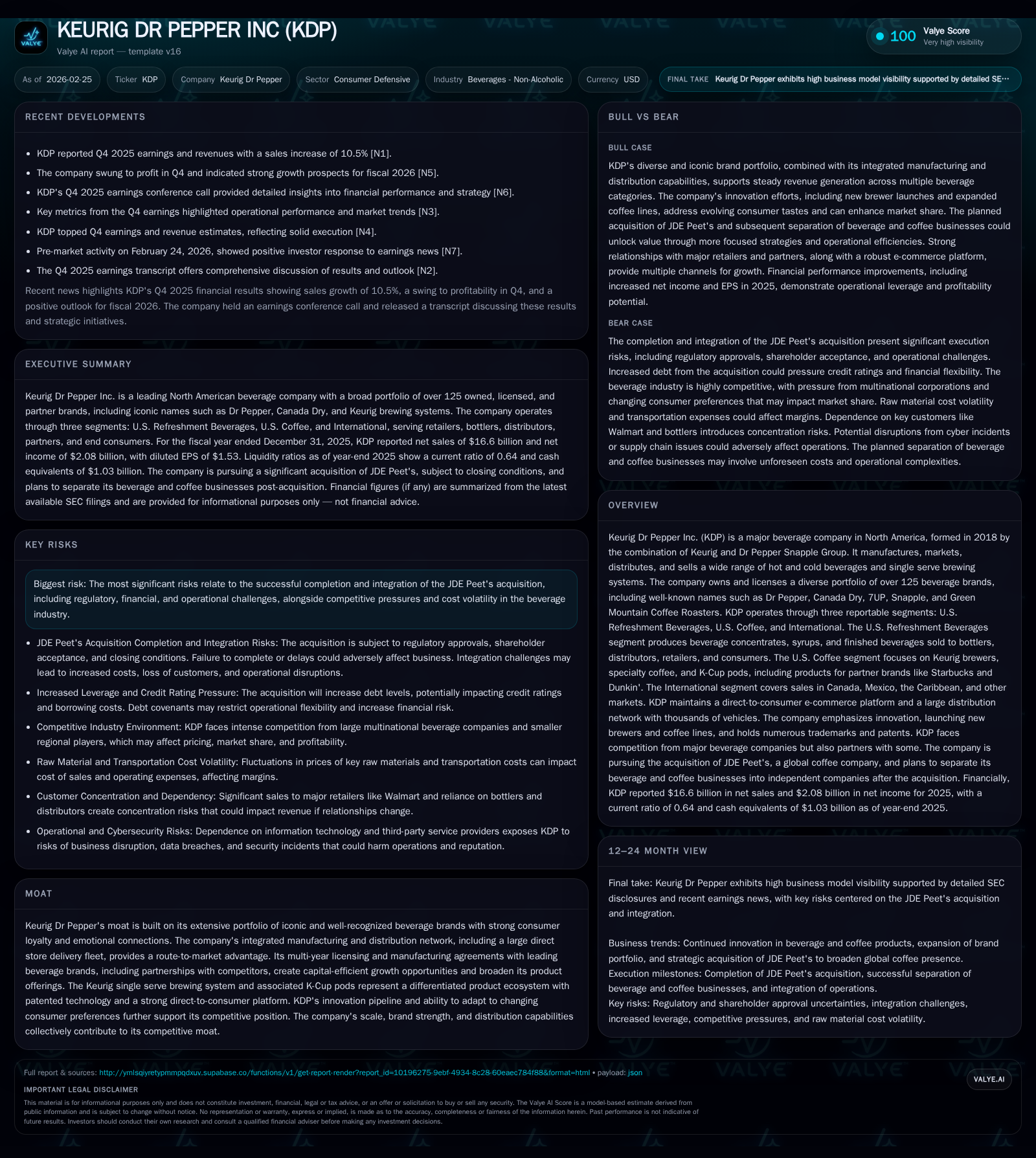
Keurig Dr Pepper Inc. (KDP) delivered a strong 2025 financial performance highlighted by a 38% increase in operating income and a 44% rise in net income, driven by pricing strategies, product innovation, and an expansive beverage portfolio. The company’s multi-pronged segment approach—spanning U.S. Coffee, Refreshment Beverages, and International markets—continues to benefit from deep brand loyalty and a prized route-to-market via its vast direct store delivery fleet. Nonetheless, significant execution and regulatory risks surround the planned JDE Peet's acquisition, which may influence near-term financial and operational outcomes. Capital allocation remains focused on organic growth, infrequent buybacks, and dividend stability amid gearing considerations.
Company Background and Competitive Position
Formed through the merger of Keurig Green Mountain and Dr Pepper Snapple Group (DPS) in 2018, Keurig Dr Pepper Inc. (KDP) operates an extensive portfolio of over 125 beverage brands across North America spanning both hot (coffee/tea) and cold non-alcoholic categories [S1]. Iconic names such as Dr Pepper, Canada Dry, Snapple, Green Mountain Coffee Roasters, and the Keurig single-serve brewer system underpin the company’s robust brand equity that drives consumer loyalty and emotional connections [S1].
KDP’s strategic moat arises from this diversified portfolio combined with its vertically integrated operations including manufacturing, multi-channel distribution (notably a Direct Store Delivery fleet of approximately 8,100 vehicles in the U.S.), patented beverage brewing technology, and long-term licensing agreements with partner beverage brands—even competitors—to expand category reach effectively [S1], [S13].
The company is organized into three reportable segments: U.S. Refreshment Beverages (concentrates, syrups, packaged beverages), U.S. Coffee (Keurig brewers & pods), and International (Canada/Mexico/caribbean markets), each contributing distinct but complementary revenue streams [S1], [S14].
Historical Financial Performance
KDP demonstrated solid top-line momentum in FY2025 with net sales rising to $16.6 billion—an 8.2% improvement over $15.35 billion in FY2024 primarily fueled by volume/mix growth combined with price realization across core beverage categories [S1]. Operating income surged by a robust 38% year-over-year to $3.575 billion from $2.591 billion previously ([F1]). This notable increase reflects operational leverage realized after expense control amidst cost headwinds plus the absence of impairment charges that burdened prior periods ($0 impairment vs nearly $700 million total impairments booked in FY2024) [S1]. Net income followed suit with a strong 44.3% climb to $2.08 billion aided by improved operating profits offsetting modest increases in interest expense [S1].
Operating cash flow declined by approximately 10%, down to roughly $1.99 billion from nearly $2.22 billion the prior year due to working capital swings despite higher net earnings [F1]. Capital expenditures decreased moderately about -13%, falling from $563 million in FY2024 to $486 million invested mainly into upgrading machinery and network optimization initiatives [F1], [S6]. Dividend distributions grew modestly to about $1.25 billion reflecting steady shareholder returns policy alongside constrained buyback activity—a mere $9 million spent compared to over a billion dollars repurchased last year—indicating capital disciplined amid balance sheet management concerns [F1], [S13].
Historical performance (annual)
| FY | Net ($bn) | CFO ($bn) | OpInc ($bn) | Capex ($mm) | Net YoY |
|---|---|---|---|---|---|
| 2025 | 2.1 | 2.0 | 3.6 | 486 | +44.3% |
| 2024 | 1.4 | 2.2 | 2.6 | 563 | -33.9% |
| 2023 | 2.2 | 1.3 | 3.2 | 425 | +51.9% |
| 2022 | 1.4 | 2.8 | 2.6 | 353 |
Note: Omitted columns lack sufficient annual XBRL coverage in the provided tags (need ≥2 annual points): Rev. Source: SEC companyfacts cache [F1].
Capital returns and efficiency (annual)
| FY | Div ($mm) | Buybacks ($mm) | FCF ($bn) |
|---|---|---|---|
| 2025 | 1250 | 9 | 1.5 |
| 2024 | 1194 | 1110 | 1.7 |
| 2023 | 1142 | 706 | 0.9 |
| 2022 | 1080 | 379 | 2.5 |
Source: SEC companyfacts cache [F1].
Note: Revenue figures not directly tagged; missing YoY calculations where data unavailable.
In terms of profitability ratios, using book equity of roughly $25.5 billion at end-2025 yields an approximate Return on Equity near 8%. This moderate ROE aligns with capital intensive beverage production/distribution assets and measured earnings growth accompanied by substantial goodwill/intangible assets totaling approximately $44 billion on the balance sheet—a legacy of acquisitions including DPS merger impacts [F1], [S22], [S25].
Segment Dynamics and Innovation Pipeline
The U.S. Refreshment Beverage segment continues as a backbone contributing significant volume through concentrate case sales distributed primarily via exclusive bottling agreements with major partners including Coca-Cola or PepsiCo-affiliated bottlers across defined territories [S8]. Innovation within this segment includes new flavor introductions like Dr Pepper Blackberry and 7UP Tropical alongside entry into emerging functional drink categories exemplified by Bloom Pop prebiotic CSD launches during 2025 [S14].
The U.S. Coffee division benefits from both hardware innovation—involving recent product launches such as the space-saving Keurig K-Mini Mate brewer—and proprietary advances like the Refined Grind manufacturing technique delivering enhanced coffee density in K-Cup pods under the newly introduced Keurig Coffee Collective brand line [S14]. Sustainability efforts are also evident with anticipated market introduction of plastic- and aluminum-free K-Rounds pods projected for late 2026 beta testing completion phase [S14]. This enhances competitive positioning amid growing environmental scrutiny.
Internationally, growth is driven mainly by concentrate sales volume gains (+2.3%) coupled with modest pod volume increases (+2%) despite slight declines in appliance unit shipments caused perhaps by economic or replacement cycle factors typical for durable goods markets overseas [S18]. Pricing also contributed positively though foreign exchange translation effects weighed somewhat on reported results.
Growth Prospects & Catalysts
Several catalysts exist for KDP’s future expansion: strategic innovation pipeline enhancements continue targeting consumer-driven taste trends encompassing both sugar reduction reformulations as well as functional beverage categories reflecting broader wellness demand shifts; further geographical expansion particularly cross-border leverage of coffee pod ecosystem may unlock incremental revenues; technology platform developments around digital direct-to-consumer channel enhancements powered by keurig.com e-commerce capabilities offer meaningful upside; lastly the pending JDE Peet's acquisition (expected closing H1 2026 pending tender acceptance thresholds and regulatory approval) promises transformative scale particularly within global coffee sectors facilitating broader portfolio diversification beyond North America [N2], [N11], [S13].
Conversely, this acquisition introduces notable integration complexities involving financial resource allocation ($4.5B purchase price plus associated transaction financing), potential regulatory hurdles causing deal execution delays or modifications including antitrust reviews requiring concessions; operational challenges emerging from geographic spread beyond traditional KDP footprint; cultural integration hurdles potentially diluting management focus detracting from core business priorities; along with ongoing macroeconomic headwinds such as inflation pressure on raw materials inputs (sweeteners, packaging plastics), transportation logistics costs inflation impacting DSD economics plus evolving trade-policy uncertainties impacting cross-border supply chains all present headwinds that warrant vigilance throughout FY26 onward [S2], [S4], [S5], [S16].
Capital Allocation & Financial Health
Management maintains disciplined capital deployment balancing reinvestment needs against maintaining liquidity buffers supportive of investment grade credit ratings under Moody’s Baa1 / S&P BBB profiles currently on negative watch reflecting transaction-related leverage risks post-JDE deal announcement [S5], [S6]. The modest decline in share repurchases along with steady dividend growth (total declared dividend per share rising from ~$0.89 to ~$0.92 year-to-year) reflects prioritization of deleveraging capacity preservation ahead of larger inorganic M&A moves while continuing shareholder value transfer through yield consistency [S13].
With cash & equivalents standing at approximately $1 billion end-FY25 versus current liabilities approaching $8.3 billion yielding a current ratio near 0.64 reflective of notably high short-term obligations typical for FMCG enterprises reliant on vendor payables dynamics there's ongoing focus on optimizing working capital efficiency without stifling operational agility amid inventory stocking cycles related to new launches or channel shifts [F1], [S22]. Capex spending has historically remained below depreciation estimates indicating leveraged operational asset base maintenance rather than aggressive expansion capex cycles currently ([F1], analysis).
Risks Overview
Key risks frequently highlighted include disruption vulnerabilities across manufacturing facilities or third-party contract manufacturers mainly concentrated in Asia producing brewers; supply chain interruptions triggered by geopolitical instability or pandemics impacting component availability or logistics networks; intensifying competition pressure particularly in sugary beverages as health consciousness accelerates alternative beverage innovation arms race between behemoth peers like Coca-Cola & PepsiCo plus dynamic challenger segments like energy drinks & RTD coffees; regulatory scrutiny increasing around labeling especially sugar content disclosures/property rights disputes involving intellectual property licensees/partners; labor relations uncertainties affecting unionized plants or distribution centers; reputational damage from allegations tied to product safety/privacy/security breaches in e-commerce transactions or sustainability challenges tied to plastic packaging disposal concerns heightened public policy spotlight[S4], [S12], [S19], [S21].
What To Watch In FY26
Absent explicit formal guidance accompanying recent earnings release given ongoing deals activity is focused closely on:
- Progress updates surrounding JDE Peet's shareholder tender acceptance rates plus regulatory approvals signaling deal consummation timing [N11]
- Integration milestones post-closing covering synergy capture quantification plus cost out initiatives enabling accretion toward long-term profitability goals
- Volume recoveries or expansions within new product launches such as Keurig Alta brewers & biodegradable pods rollout impact on customer engagement metrics/sales trajectory[N2]
- Raw materials cost inflation trajectory versus ability to sustain pricing power without triggering detrimental volume erosion critical for margin preservation seen favorably in Q4 demonstrates foundational pricing resilience
- Working capital cycle changes driving CFO volatility relative to prior years largely affected by inventory period adjustments especially around new SKUs layering vs retail channel inventory demand patterns.
Conclusion
Keurig Dr Pepper’s blend of iconic brands, technological brewing platforms, and extensive distribution infrastructure continues fueling competitive advantage underscored by its robust FY25 financial performance marked by double digit operating income improvement and net profit growth rooted in disciplined pricing actions combined with brand-driven volume resilience[F1],[S14],[N11]. The impending JDE Peet’s acquisition promises transformational scale entry into global coffee markets but equally raises execution risks whose successful management will be critical benchmarks monitored through calendar year milestones[S2],[S5],[N11]. Meanwhile selected capital allocation prudence amidst moderated buybacks complemented by consistent dividends underscores focus on balancing growth investments with financial flexibility required for future expansions.
Disclaimer: This analysis is based solely on publicly available information as of February 25, 2026, including company filings, transcripts, news reports, and standard industry references noted herein without any speculative assumptions beyond provided disclosures or unauthorized projections.
Disclaimer: This is research-only, informational analysis and not investment advice. It may include AI-generated interpretation and general industry context. Always verify important details using primary sources.

Comments